The Network Effect: How We’re Building a Stronger Product Together
Have you ever wondered why some products seem to get better and better the more people use them? Think about Instagram. It's not just the filters and features that make it valuable; it's the fact that all your friends are on it. This powerful dynamic is what we call the network effect, and it’s a concept we want to deeply understand and leverage here at ReceiptRoller.
This post is for all of us. It’s a chance to demystify this powerful idea and get on the same page about how we can build it into the DNA of what we do. Our goal isn't just to add users—it's to make our product more valuable for every single user with each new addition.
What Is the Network Effect?
At its core, the network effect means that a product or service’s value increases for both new and existing users as more people use it. It’s a simple idea with exponential consequences.
A classic example is the telephone. A single telephone is useless. Two telephones allow you to communicate with one person. A network of thousands of telephones creates millions of potential connections, making each phone infinitely more valuable. The value doesn’t just grow—it compounds.
While the goal is to successfully build one, we have to first understand what it is and how it works.
The Two Main Types of Network Effects
Not all network effects are the same. Understanding the two primary types helps us see where opportunities lie for our own product.
1. Direct Network Effects
This is the most straightforward type. The value comes directly from connecting with other users. The more people who join, the more connections you can make. This is the engine behind:
- Social Media Platforms: The value of LinkedIn or Facebook is the direct connection to your professional network and friends.
- Messaging Apps: An app like Slack or WhatsApp becomes essential because everyone you need to talk to is already there.
For us, this could mean that as more teams at a company use our [specific product/feature], it becomes easier for everyone to collaborate, share insights, and get work done. The whole organization becomes more efficient because of the direct connections our product facilitates.
2. Indirect Network Effects
This type is a bit more subtle. The value is created through a two-sided market or ecosystem. One group's participation increases the value for another group.
- Marketplaces: Etsy's value for buyers (one side) increases as more sellers (the other side) join, offering more unique products. More buyers also make the platform more valuable for sellers.
- Operating Systems: As more people use iOS, more developers build apps for it, which in turn attracts even more users.
We see a huge opportunity for an indirect network effect with ReceiptRoller. Imagine our product as a platform: as more merchants join, it creates a larger audience for our end users. This, in turn, incentivizes them to build better integrations or provide better services, ultimately making our platform more valuable for everyone.
The Network Effect as a Growth Flywheel
When a network effect is working, it creates a powerful cycle known as a "flywheel." It’s a self-reinforcing loop that builds momentum over time.
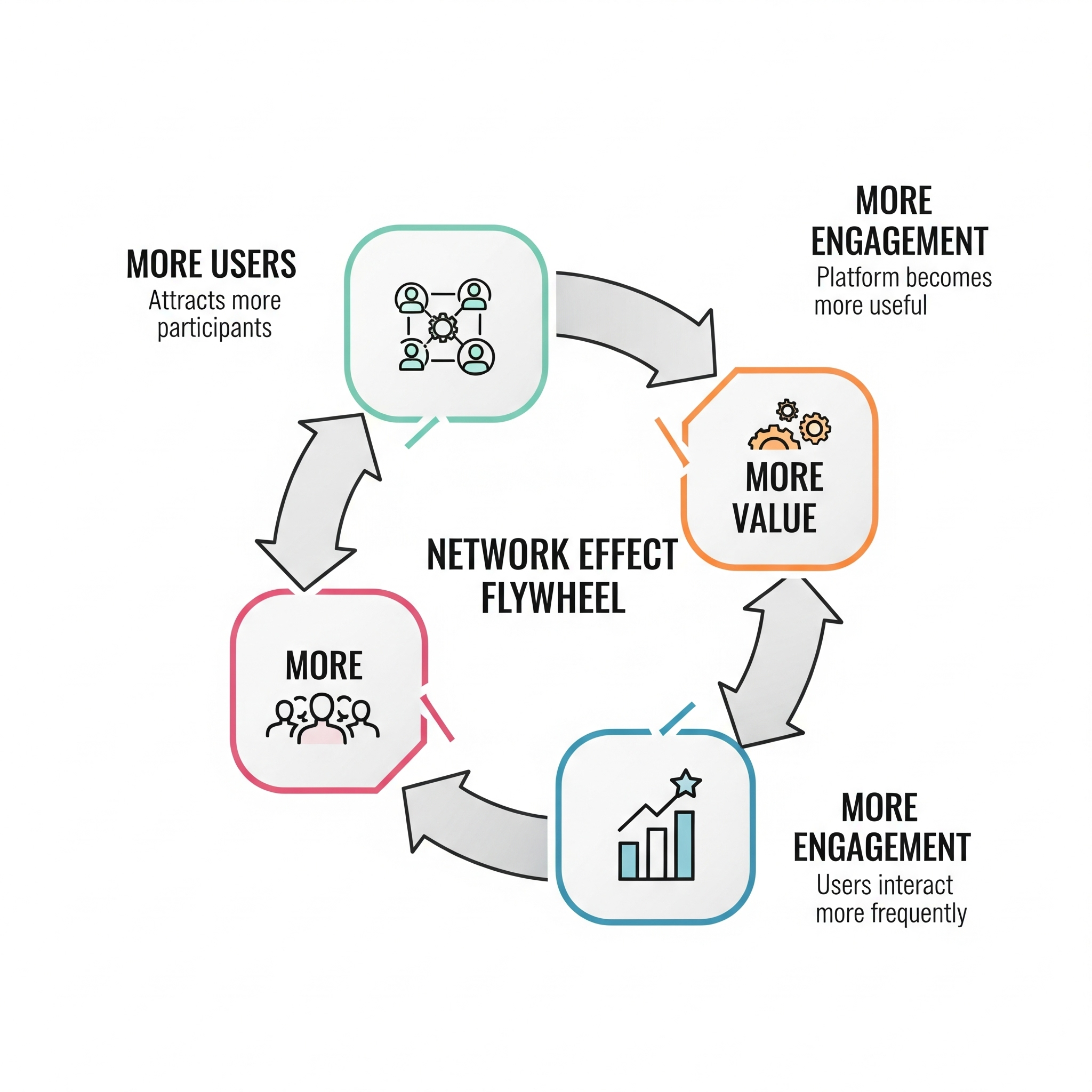
- We deliver a strong initial product that provides value.
- This value attracts a core group of early users.
- The addition of these users makes the product more valuable for everyone else (the network effect kicks in).
- This increased value then attracts even more new users, accelerating growth.
- The loop continues, making our business stronger and more defensible over time.
Our Path Forward: Building a Connected Future
So, where do we go from here? The network effect isn't a silver bullet; it's a consequence of intentional design and a focus on our community. Our challenge is to think critically about how every feature we build and every decision we make contributes to this flywheel.
This means asking ourselves questions like:
- How does this new feature help users connect with each other?
- Does this new product or integration make our platform more valuable for a different type of user?
- What can we do to make it easy and natural for users to invite others to the platform?
By keeping these questions at the forefront of our work, we can transform our product from a useful tool into an indispensable network.
"The single most important thing to focus on is user experience. The network effect is a byproduct of a great user experience." — Reid Hoffman, Co-Founder of LinkedIn
This journey is about more than just numbers. It's about building a connected ecosystem that benefits everyone involved. The more we succeed in making our product valuable to each other, the more successful we will be as a company.