
{R}R Dev Notes
Found total of 49 articles.
Loop Engineering, Chapter 2: The Six Primitives of Loop Engineering
Chapter 2 of the Loop Engineering blog series. If a loop is the engine, the six primitives are the parts. A teaser on automations, worktrees, skills, connectors (MCP), the maker/checker split, and external memory.
2026-06-16
Loop Engineering, Chapter 1: The Anatomy of an Agentic Loop
Chapter 1 of the Loop Engineering blog series. Every agentic system begins with a single loop. A teaser on the ReAct pattern, why a loop beats a fixed prompt chain, the arithmetic of per-step reliability, and the discipline of a verifiable stopping condition.
2026-06-15
The Forward Deployed Engineer, Chapter 19: The Future of Forward Deployment
Chapter 19 of The Forward Deployed Engineer blog series. The final chapter — the automation wave, what the AI FDE cannot do, the rise of FDE-as-a-Service, the talent market evolution, the customer wave, and the function's longer-term maturity. Plus a closing word, and the book.
2026-06-14
The Forward Deployed Engineer, Chapter 18: Hiring and Building the Bench
Chapter 18 of The Forward Deployed Engineer blog series. The FDE function is, in the end, a collection of people. A teaser on the hiring funnel, the four-round interview loop, compensation benchmarks ($170K–$600K+), onboarding, the career ladder, retention, and building a bench.
2026-06-13
The Forward Deployed Engineer, Chapter 13: When FDE Goes Wrong — Failure Modes and Lessons
Chapter 13 of The Forward Deployed Engineer blog series. Six named failure modes that kill FDE functions before they scale. A teaser on the Consulting Trap, the Snowflake-per-Customer trap, the Hero Engineer, the Demo-Debt Spiral, the Sponsor Collapse, and the Burnout Death Spiral.
2026-06-08
The Forward Deployed Engineer, Chapter 12: The New AI Wave — OpenAI, Anthropic, Runway, Greptile
Chapter 12 of The Forward Deployed Engineer blog series. The new wave rebuilds the FDE function for the agentic era. A teaser on how OpenAI, Anthropic, Runway, and Greptile each adapted the Palantir template — what's different, what's the same, and three patterns founders should watch.
2026-06-07
The Forward Deployed Engineer, Chapter 6: The Soft Stack — Diplomacy and Strategy
Chapter 6 of The Forward Deployed Engineer blog series. The "soft stack" is the part of the FDE skillset most often dismissed as soft. A teaser on MECE, the Pyramid Principle, stakeholder mapping, Managing the Skeptic, the Diplomatic Register, and stress inoculation.
2026-06-01
The Engineering of Intent, Chapter 39: Impressionistic Scanning — A Visual Heuristic Guide
Chapter 39 of The Engineering of Intent blog series. Shape matters before content — especially for AI-generated code, where the agent is often blind to global shape. A teaser cheat sheet of six visual code shapes (wide-flat, deep-nesting, high-import-churn, long-thin, jagged, suspicious-uniformity) and what each one means.
2026-05-25
The Engineering of Intent, Chapter 28: The Tips Archive — 100 Notes from Daily Practice
Chapter 28 of The Engineering of Intent blog series. One hundred numbered tips from daily practice, collected over years. A teaser with twelve of the most-quoted — from "if you're repeating it three times, put it in agents.md" through "do not estimate in hours for agent-assisted work; estimate in cycles."
2026-05-14
The Engineering of Intent, Chapter 14: The 30-Day Pilot Framework
Chapter 14 of The Engineering of Intent blog series. Every successful AI-native transformation starts as a thirty-day pilot on a single well-scoped project. A teaser on how to scope the first project, the week-by-week playbook, the five-question graduation rubric, and the three pilots that show what works and what doesn't.
2026-04-30
The Engineering of Intent, Chapter 13: VibeOps and CI/CD Evolution
Chapter 13 of The Engineering of Intent blog series. Static CI/CD was built for human-paced commits. AI-native velocity needs dynamic, context-aware, agent-literate pipelines. A teaser on VibeOps, context preservation across deployments, merge queues at velocity, and the ten-minute pipeline contract.
2026-04-29
The Engineering of Intent, Chapter 7: The GenDD Execution Loop
Chapter 7 of The Engineering of Intent blog series. Generative-Driven Development replaces your ceremony set with a fractal five-step loop: Context, Plan, Confirm, Execute, Validate. A teaser on each step, what goes wrong when it's skipped, and the payments team that cut one-hour cycles down to ten minutes.
2026-04-23
The Engineering of Intent, Chapter 2: Cognitive Load and Material Disengagement
Chapter 2 of The Engineering of Intent blog series. When the agent does most of the typing, the real failure mode is the engineer who has stopped engaging. A teaser on material disengagement, impressionistic scanning, the autocomplete trap, decision fatigue, and the seven habits of engaged engineers.
2026-04-18
The Engineering of Intent, Chapter 1: The Triadic Relationship Model
Chapter 1 of The Engineering of Intent blog series. Software used to be a dyad between engineer and machine. Now a third actor — the AI agent — has joined permanently. A teaser covering the Triadic Relationship Model, the CMDP view of software, and the six failure modes every AI-native team needs to name.
2026-04-17
Frictionless SaaS, Chapter 21: Operations and Scalability Without Friction
Why growing SaaS companies hit a wall that is not a product problem or a sales problem — it is an operations problem. A teaser for Chapter 21 of Frictionless SaaS covering the Event-Driven Operations Architecture and the Scalability Without Headcount Principle.
2026-04-11
Frictionless SaaS Chapter 13: SaaS Metrics, Cohort Analysis, and the North Star
Chapter 13 preview of Frictionless SaaS: the SaaS Metrics Pyramid, Net Revenue Retention, cohort-based optimization, and how to choose a North Star that actually drives retention and revenue.
2026-04-03
Frictionless SaaS Chapter 9: Eliminating Friction and Building Consistency
Chapter 9 preview of Frictionless SaaS: the Friction Audit Matrix, the Consistency Principle, perceived speed, and information ergonomics - the retention levers most teams ignore.
2026-03-30
Chapter 21: Decentralized Identity — DIDs, Verifiable Credentials, and OID4VC
Chapter 21 of the OpenID: Modern Identity series — decentralized identity: DIDs (Decentralized Identifiers) without a central authority, Verifiable Credentials with selective disclosure, and OpenID for Verifiable Credentials (OID4VC) as the bridge from centralized to decentralized identity.
2026-03-27
OpenClaw Engineering, Chapter 10: Multi-Agent Systems
Build teams of specialized agents that work in concert. Learn how to architect planners, coders, critics, and surveyors, coordinate them via channels, and use adversarial collaboration and taste gates for high-quality output.
2026-03-25

Frictionless SaaS, Chapter 3: Signup Design - Stop Interrogating People Before They Can Use Your Product
Chapter 3 of the Frictionless SaaS blog series. Why most SaaS signup forms are conversion killers, what the Minimum Viable Signup really looks like, and how the Progressive Commitment Model lets you collect every piece of information you want - without scaring users off at the door.
2026-03-24

Chapter 18: Claims Design and Privacy — Identity Data Without Overshare
Chapter 18 of the OpenID: Modern Identity series — designing custom claims with namespacing and size discipline, attribute mapping across providers into a single internal schema, and privacy by design through minimization, selective disclosure, pairwise identifiers, and GDPR-ready retention.
2026-03-24
OpenClaw Engineering, Chapter 9: Scheduling and Deterministic Orchestration
Time-based automation for agents: cron jobs for simple periodic tasks and the Lobster workflow engine for complex, deterministic, resumable multi-step pipelines with human approval gates.
2026-03-24
Frictionless SaaS, Chapter 2: The SAFE Journey — A Map of Where Your Users Actually Quit
Chapter 2 of the Frictionless SaaS blog series. The SAFE Journey Framework breaks the user lifecycle into Signup, Activation, Frequency, and Expansion — each with different friction, different metrics, and different fixes. Plus: why Time to Value is the most important retention metric in early-stage SaaS.
2026-03-23
Frictionless SaaS, Chapter 1: Silent Churn — The Users Who Leave Without Complaining
Chapter 1 of the Frictionless SaaS blog series. Silent churn is the most dangerous kind of churn — users who sign up, disappear, and never tell you why. A look at the Silent Churn Pattern and the Activation Gap.
2026-03-22
OpenClaw Engineering, Chapter 6: Extending Capabilities with SKILL.md
The anatomy of SKILL.md files in OpenClaw: how to author reusable, versioned instruction sets with YAML frontmatter, dependencies, and explicit procedural guidance for agents.
2026-03-21
OpenClaw Engineering, Chapter 5: Connecting Multiple Channels
How to connect your OpenClaw agent to multiple messaging platforms (Telegram, WhatsApp, Discord, Slack) and manage multi-channel routing. Setup, configuration quirks, and troubleshooting for each platform.
2026-03-20
Chapter 17 – Guardrails and Governance
Chapter 17 of Master Claude Chat, Cowork and Code moves from understanding risks to implementing controls — permission isolation, tool allow-lists, human-in-the-loop approval workflows, validation hooks, and enterprise-grade audit logging.
2026-03-18
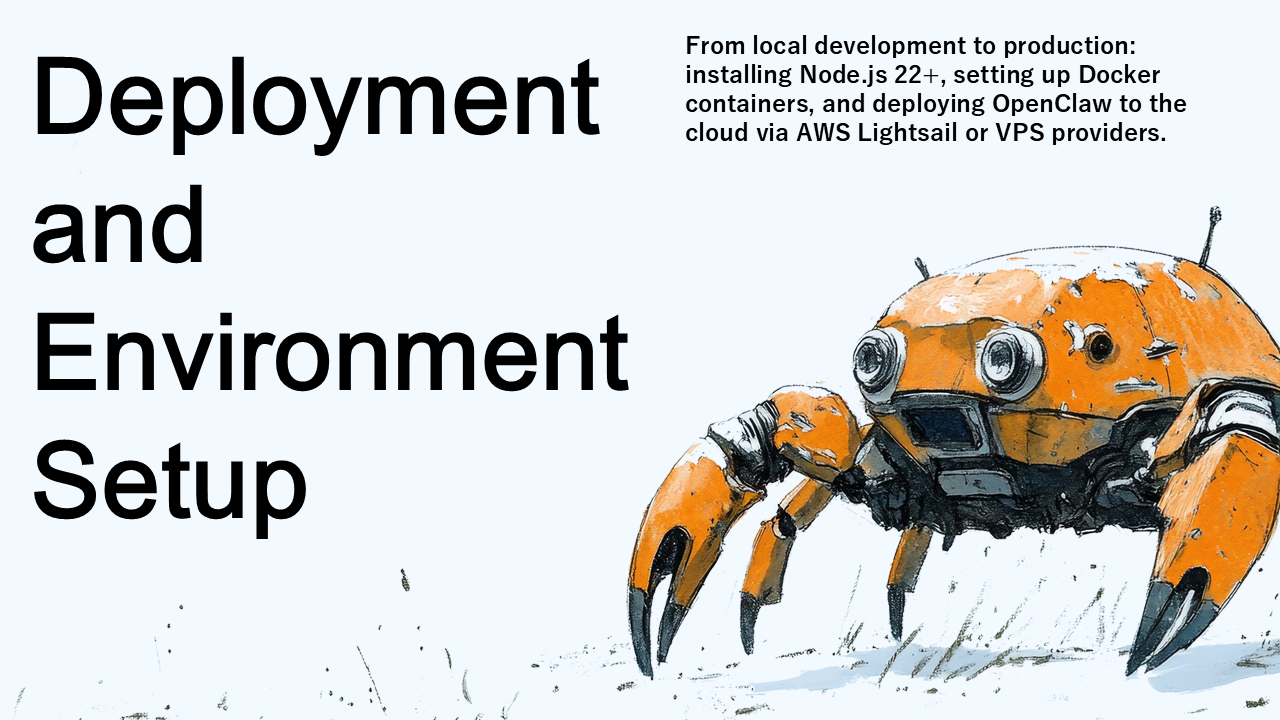
OpenClaw Engineering, Chapter 3: Deployment and Environment Setup
From local development to production: installing Node.js 22+, setting up Docker containers, and deploying OpenClaw to the cloud via AWS Lightsail or VPS providers.
2026-03-18
Chapter 10: Safe Legacy Code Refactoring — Horror Stories and the Discipline That Prevents Them
Chapter 10 of Master Claude Chat, Cowork and Code tackles the hardest problem in AI-assisted development — refactoring legacy code without introducing subtle bugs. Covers characterization tests, incremental verification, PR review, and catching hallucinations.
2026-03-11
Chapter 9: Claude Code Fundamentals — The CLI Agent That Rewrites Your Codebase
Chapter 9 of Master Claude Chat, Cowork and Code introduces Claude Code — a CLI agent that reads, analyzes, and modifies codebases directly from the terminal. Covers architecture, multi-file refactoring, Git worktrees, and permission management.
2026-03-10
7.4 Why QR Is Often Preferred
An in-depth, accessible explanation of why QR decomposition is the preferred method for solving least squares problems and ensuring numerical stability. Covers orthogonality, rank deficiency, Householder reflections, and the broader role of QR in scientific computing, with a smooth transition into eigenvalues and eigenvectors.
2025-10-05
7.3 Least Squares Problems
A clear, intuitive, book-length explanation of least squares problems, including the geometry, normal equations, QR decomposition, and SVD. Learn why least-squares solutions are central to ML and data science, and why QR provides a stable foundation for practical algorithms.
2025-10-04
6.1 SPD Matrices and Why They Matter
A deep, intuitive explanation of symmetric positive definite (SPD) matrices and why they are essential in machine learning, statistics, optimization, and numerical computation. Covers geometry, stability, covariance, kernels, Hessians, and how SPD structure enables efficient Cholesky decomposition.
2025-09-28
5.2 Numerical Pitfalls
A deep, accessible explanation of the numerical pitfalls in LU decomposition. Learn about growth factors, tiny pivots, rounding errors, catastrophic cancellation, ill-conditioning, and why LU may silently produce incorrect results without proper pivoting and numerical care.
2025-09-24
5.1 LU with and without Pivoting
A clear and practical explanation of LU decomposition with and without pivoting. Learn why pivoting is essential, how partial and complete pivoting work, where no-pivot LU fails, and why modern numerical libraries rely on pivoted LU for stability.
2025-09-23
4.4 When Elimination Fails
An in-depth, practical explanation of why Gaussian elimination fails in real numerical systems—covering zero pivots, instability, ill-conditioning, catastrophic cancellation, and singular matrices—and how these failures motivate the move to LU decomposition.
2025-09-21
4.3 Pivoting Strategies
A practical and intuitive guide to pivoting strategies in numerical linear algebra, explaining partial, complete, and scaled pivoting and why pivoting is essential for stable Gaussian elimination and reliable LU decomposition.
2025-09-20
4.1 Gaussian Elimination Revisited
A deep, intuitive exploration of Gaussian elimination as it actually behaves inside floating-point arithmetic. Learn why the textbook algorithm fails in practice, how instability emerges, why pivoting is essential, and how elimination becomes reliable through matrix transformations.
2025-09-18

3.4 Exact Algorithms vs Implemented Algorithms
Learn why textbook algorithms differ from the versions that actually run on computers. This chapter explains rounding, floating-point errors, instability, algorithmic reformulation, and why mathematically equivalent methods behave differently in AI, ML, and scientific computing.
2025-09-16
3.3 Conditioning of Problems vs Stability of Algorithms
Learn the critical difference between problem conditioning and algorithmic stability in numerical computing. Understand why some systems fail even with correct code, and how sensitivity, condition numbers, and numerical stability determine the reliability of AI, ML, and scientific algorithms.
2025-09-15
3.2 Measuring Errors
A clear and intuitive guide to absolute error, relative error, backward error, and how numerical errors propagate in real systems. Essential for understanding stability, trustworthiness, and reliability in scientific computing, AI, and machine learning.
2025-09-14
2.4 Vector and Matrix Storage in Memory
A clear, practical guide to how vectors and matrices are stored in computer memory. Learn row-major vs column-major layout, strides, contiguity, tiling, cache behavior, and why memory layout affects both speed and numerical stability in real systems.
2025-09-11

2.3 Overflow, Underflow, Loss of Significance
A clear and practical guide to overflow, underflow, and loss of significance in floating-point arithmetic. Learn how numerical computations break, why these failures occur, and how they impact AI, optimization, and scientific computing.
2025-09-10

2.2 Machine Epsilon, Rounding, ULPs
A comprehensive, intuitive guide to machine epsilon, rounding behavior, and ULPs in floating-point arithmetic. Learn how precision limits shape numerical accuracy, how rounding errors arise, and why these concepts matter for AI, ML, and scientific computing.
2025-09-09
2.1 Floating-Point Numbers (IEEE 754)
A detailed, intuitive guide to floating-point numbers and the IEEE 754 standard. Learn how computers represent real numbers, why precision is limited, and how rounding, overflow, subnormals, and special values affect numerical algorithms in AI, ML, and scientific computing.
2025-09-08
Chapter 2 — The Computational Model
An introduction to the computational model behind numerical linear algebra. Explains why mathematical algorithms fail inside real computers, how floating-point arithmetic shapes computation, and why understanding precision, rounding, overflow, and memory layout is essential for AI, ML, and scientific computing.
2025-09-07
1.4 A Brief Tour of Real-World Failures
A clear, accessible tour of real-world numerical failures in AI, ML, optimization, and simulation—showing how mathematically correct algorithms break inside real computers, and preparing the reader for Chapter 2 on floating-point reality.
2025-09-06

1.2 Floating-Point Reality vs. Textbook Math
Floating-point numbers don’t behave like real numbers. This article explains how rounding, cancellation, and machine precision break AI systems—and why it matters.
2025-09-04
Numerical Linear Algebra: Understanding Matrices and Vectors Through Computation
Learn how linear algebra actually works inside real computers. A practical guide to LU, QR, SVD, stability, conditioning, and the numerical foundations behind modern AI and machine learning.
2025-09-01
Categories
Tags
Search Logs
Hello World bot 1238
IT assistant bot 1210
Deploy Teams bot to Azure 1207
Microsoft Bot Framework 1105
Teams bot development 1085
Teams production bot 1075
bot for sprint updates 1061
Zendesk Teams integration 1048
Teams app zip 1044
Microsoft Teams Task Modules 1026
Teams chatbot 1024
Bot Framework Adaptive Card 1022
Teams bot tutorial 1013
Bot Framework example 1008
Task Modules 1007
Teams bot packaging 1005
Bot Framework proactive messaging 995
C 993
Graph API token 991
Bot Framework CLI 978
Azure CLI webapp deploy 976
Bot Framework prompts 971
Adaptive Card Action.Submit 965
Azure App Service bot 952
Microsoft Graph 935
Azure Bot Services 933
Adaptive Cards 906
ServiceNow bot 906
Azure bot registration 904
identity in Teams 871
Development & Technical Consulting
Working on a new product or exploring a technical idea? We help teams with system design, architecture reviews, requirements definition, proof-of-concept development, and full implementation. Whether you need a quick technical assessment or end-to-end support, feel free to reach out.
Contact Us