
The Engineering of Intent, Chapter 18: The Prompt Patterns Catalog
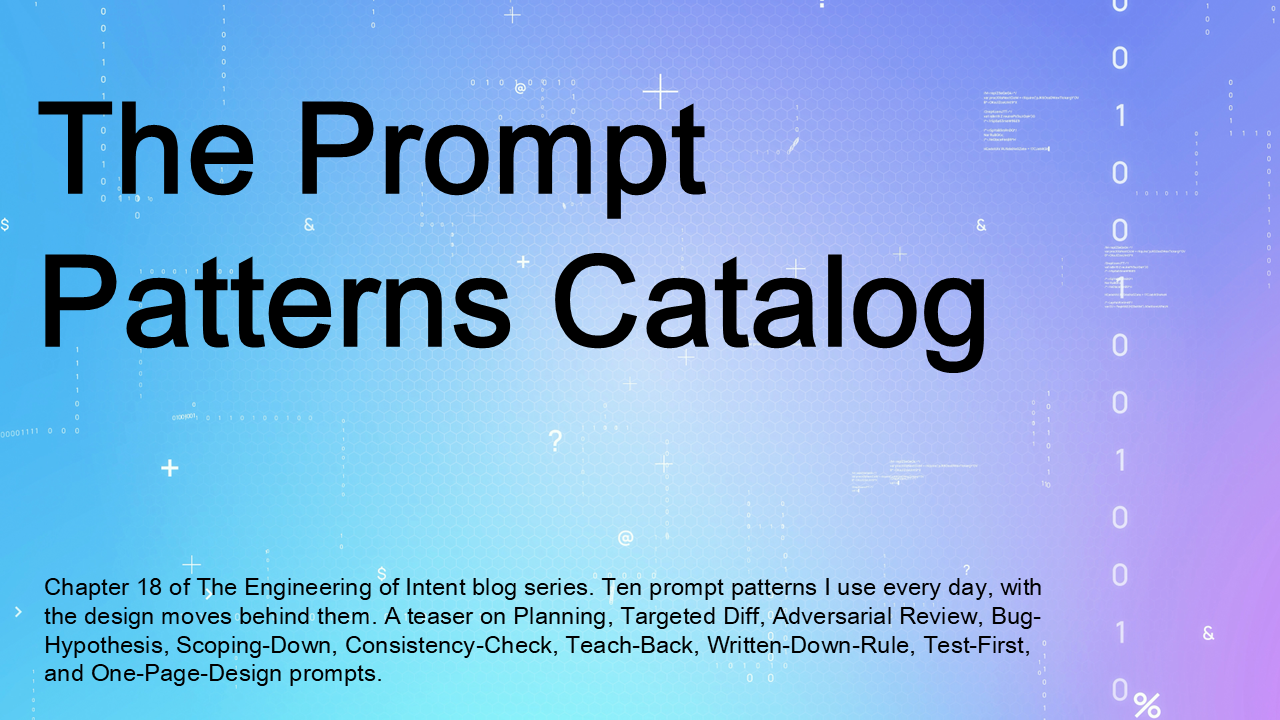
This is Part 18 of a series walking through my book The Engineering of Intent. In the previous chapter, we covered the flow loop. Chapter 18 is the reference catalog behind it — the specific prompt patterns I reach for every day.
Ten Patterns. One Page. Adapt Liberally.
This chapter is a reference catalog of the prompt patterns I use every day. It is not exhaustive — it is the set I actually reach for. Each pattern in the book includes the situation it applies to, the template, a worked example, and the most common failure mode. Here are the ten, compressed.
The Ten
- The Planning Prompt. Force a numbered plan and three self-identified risks before any code is written. Pairs with GenDD’s Confirm step.
- The Targeted Diff Prompt. “Change exactly this. Do NOT modify other files. If any change requires another file, stop and tell me.” The last sentence is the key.
- The Adversarial Review Prompt. “Review this diff as a skeptical senior engineer who has been burned before.” Explicit severity categories prevent the review from collapsing into stylistic nitpicks.
- The Bug-Hypothesis Prompt. Three hypotheses, ranked by likelihood, with diagnostics. Do NOT propose fixes yet.
- The Scoping-Down Prompt. “Cut this into three increments, ordered by value-per-unit-effort. The first must be shippable within one day.”
- The Consistency-Check Prompt. Cross-codebase scan for every instance of a pattern. Use before closing any “consistent change” PR.
- The Teach-Back Prompt. “Summarize, in your own words, the key constraints of this task.” Saves more hours than any other single prompt I use.
- The Written-Down-Rule Prompt. After a lesson, propose an imperative, checkable, one-to-two-sentence rule for
conventions.md. - The Test-First Prompt. Write happy path + two edge cases + one adversarial input. Do NOT write the implementation.
- The One-Page-Design Prompt. Problem, Non-goals, Approach, Alternatives, Risks, Rollout. 400–600 words. Think-document, not announcement.
Patterns That Share a DNA
If you look at all ten, three design moves keep appearing:
- Separate thinking from doing. Plan before execute. Hypothesize before fix. Teach-back before proceed. Test before implement.
- Name the exit conditions. “Stop and tell me.” “Do NOT propose fixes yet.” “Do NOT modify other files.” Agents are happy to wait when you give them a clear “wait” instruction.
- Demand structure in the output. Numbered steps. Severity categories. Ranked hypotheses. Named sections. Structure turns a fluent blob into a reviewable artifact.
“Every prompt you reach for repeatedly should get a name and a template. Without that, you retype a 95% version of it every session and leave 5% of its power on the floor. With that, the pattern becomes part of your vocabulary, and your colleagues can adopt it.”
Next up — Chapter 19: The End-of-Day Routine. If Chapter 16 was about the thirty minutes that set the upper bound on your day, Chapter 19 is about the fifteen minutes that determine whether tomorrow starts hot or cold.
📖 Want the full picture?
The chapter gives each pattern in full: the situation, the complete template, a worked example, and the most common failure mode. Copy, paste, adapt. This is the single most-photocopied chapter in the book, and reader feedback suggests it’s the one people tape to their monitor.

Sho Shimoda
I share and organize what I’ve learned and experienced.Categories
Tags
Search Logs
Development & Technical Consulting
Working on a new product or exploring a technical idea? We help teams with system design, architecture reviews, requirements definition, proof-of-concept development, and full implementation. Whether you need a quick technical assessment or end-to-end support, feel free to reach out.
Contact Us