
OpenClaw Engineering, Chapter 1: The OpenClaw Paradigm
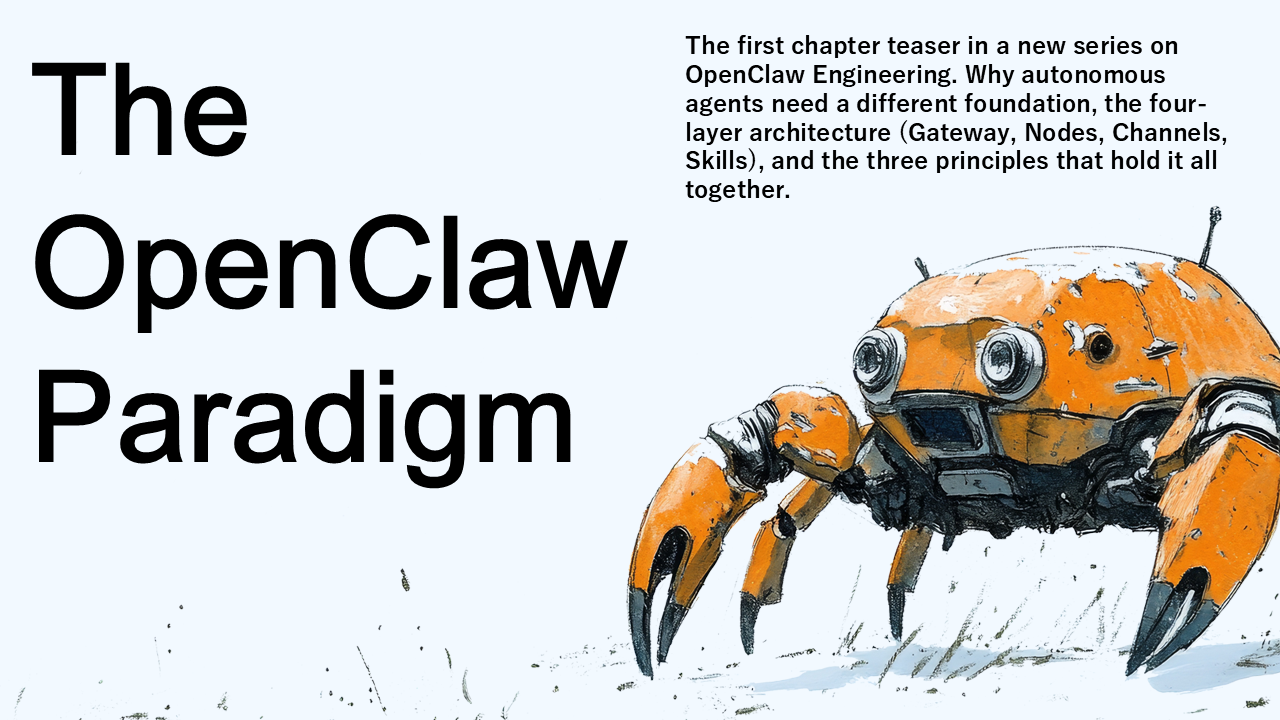
This kicks off a new chapter-by-chapter series on OpenClaw Engineering: Building Autonomous AI Agents in Practice. One post per chapter, in order, until we get to the appendices.
Chapter 1 is called The OpenClaw Paradigm, and honestly, it's the chapter I rewrote the most. The temptation in a book about an agent framework is to open with the architecture diagram and start naming components. I tried that draft. It read like documentation. The problem is that you can't really understand why OpenClaw is built the way it is until you understand the shift it's built for — the shift from chat to autonomy. So that's where the chapter starts, and that's where this post starts too.
From chat, to tool use, to autonomy
The story of AI interfaces is a story of removing limitations, one at a time. In 2022 the dominant interface was conversation. You typed a prompt, you got a response, you closed the tab, the model forgot you existed. Useful as a lookup table. Exhausting as a collaborator.
In 2023, tool use changed the picture. Give the model a function — search the web, run this code, send this email — and it could interleave thought with action. But the loop was still request-driven: a human always had to start the conversation, and the moment the chat window closed, the agent went back to sleep and lost everything it had learned in the session.
Autonomous agents are the next step. An autonomous agent has goals, perceives its environment, decides what to do, and acts — without a human at the wheel. To do that it needs three things most chat systems don't have: persistence (state that survives between interactions), memory (knowledge that accumulates over time), and a runtime that can wake the agent up when there's work to do.
The four-layer architecture
Once you accept that you're building persistent agents and not request-response agents, the architecture starts to design itself. OpenClaw lands on four layers, and the rest of the book leans on this vocabulary heavily, so it's worth getting it into your head early.
- Gateway — the always-on daemon. It runs in the background on your machine or your server, schedules work, routes messages, and persists state. The mental model I use is "postal service": it doesn't read your mail, it doesn't decide what to do with it, but it reliably collects, sorts, and delivers it — 24/7, even when you're asleep.
- Nodes — individual agents. Each Node is a separate AI agent with its own workspace, its own memory, and its own job. One Node handles email, another the calendar, another the codebase. They're long-lived — days, weeks, months — not session-scoped.
- Channels — communication patterns. DM is human-to-agent. Group is agent-to-agent. Integration is agent-to-external-system (Gmail, Calendar, your issue tracker). Broadcast is one-to-many. The Channel type isn't just transport — it's how you express intent.
- Skills — reusable capabilities, written in Python.
send_email,query_db,run_tests. They're versioned independently from agents, so when you fix a bug in one Skill, every agent that uses it gets the fix automatically.
The reason this design holds up is that each layer can be reasoned about on its own. You can think about the Gateway's scheduler without thinking about Skill code. You can write a Skill without thinking about Channel routing. But they compose — a working system is a Gateway managing Nodes, communicating via Channels, using Skills.
The agent loop: receive, route, process, persist
Inside the Gateway, the heart of the system is a four-stage loop:
- Receive — pull new messages from every Channel into a persistent queue.
- Route — figure out which Node should handle each message, applying priorities and rules.
- Process — dispatch each task to a worker, which loads the Node's state, runs the LLM, executes Skills, and observes the results in a synchronous chain of thought.
- Persist — save the updated memory, log the transaction, and record any outputs. The persist step is idempotent, so retries never duplicate actions.
The piece that makes the whole thing feel alive is the heartbeat. Every 30 minutes by default (or hourly with Anthropic's OAuth integration), the Gateway wakes up and asks "does any Node have work?" If yes, it queues a synthetic task message and runs it through the same pipeline as a human DM. Scheduled jobs aren't a separate system bolted on the side — they're just messages.
How OpenClaw compares to other agent frameworks
I get this question a lot, so the chapter spends real time on it. The short version:
- LangChain gave us a flexible toolkit, but persistence, scheduling, and memory were all left as homework. Powerful, but you build a lot of scaffolding yourself.
- AutoGPT was the first framework that made "goal + tools + loop" feel real, but the agents had no real memory between runs and tended to wander.
- CrewAI brought multi-agent collaboration as a first-class concept, but like LangChain, it's more library than runtime. You still wire up persistence and observability yourself.
OpenClaw's bet is different: be an opinionated, full-stack framework. Persistent state, two-layer memory, a built-in scheduler, conventions for agent identity (SOUL.md, AGENTS.md, USER.md), and human-in-the-loop hooks — all in the box, with sensible defaults. None of these ideas are individually novel. The contribution is that they fit together and you don't have to invent the glue.
Three principles: simplicity, transparency, persistence
If you only remember three things from Chapter 1, remember these. They show up again in every chapter that follows, because every other design decision in OpenClaw is downstream of them.
- Simplicity. The four-layer architecture, the four-stage loop, and the Markdown brain are designed so the entire system fits in one developer's head. No magical black boxes, no compiled DSLs, no "you have to learn our internal abstractions" tax.
- Transparency. Logs are human-readable. Memory is plain Markdown. Configuration is YAML and JSON you can edit in any text editor. When an agent misbehaves, you can read what it was thinking — you don't have to guess from neural network weights.
- Persistence. Everything is saved — memory, logs, queues, traces. Agents become truly long-lived. They accumulate context. They build relationships with users. They get smarter over time, not because the model changed but because the agent remembers.
These three are the reason human-in-the-loop autonomy actually works in OpenClaw. You can audit, edit, and steer the agent because the system is built to be inspected — not just executed. Strip any of them out and the framework falls apart.
What's next
Chapter 2 zooms into the agent's brain itself: SOUL.md, AGENTS.md, USER.md, MEMORY.md, and HEARTBEAT.md — the Markdown files that give a Node its identity, knowledge, and proactive behavior. That's where the "Markdown brain" metaphor stops being a marketing line and starts being a concrete file layout you can stand up on your own machine. I'll cover that in the next post.
📖 Get the complete book
All thirteen chapters and four appendices: the full Gateway and PiEmbeddedRunner walk-through, the Markdown brain spec, channel adapters for Telegram / WhatsApp / Discord / Slack, the SKILL.md authoring guide, the Lobster workflow language, multi-agent orchestration patterns, OpenClaw-RL training signals, the agentic zero-trust architecture, and the post-ClawHavoc supply-chain hardening playbook.

Sho Shimoda
I share and organize what I’ve learned and experienced.Categories
Tags
Search Logs
Development & Technical Consulting
Working on a new product or exploring a technical idea? We help teams with system design, architecture reviews, requirements definition, proof-of-concept development, and full implementation. Whether you need a quick technical assessment or end-to-end support, feel free to reach out.
Contact Us