
Physical AI, Chapter 2: A Brief History of Robotic Evolution
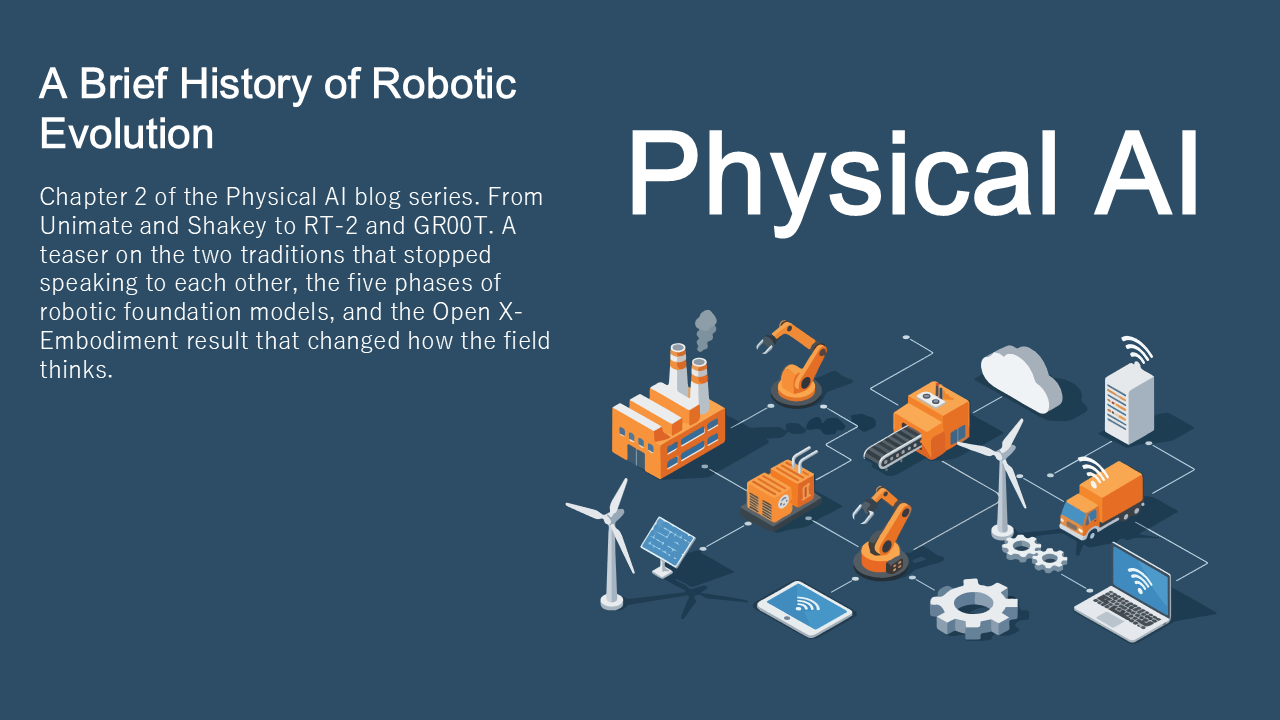
This is Part 2 of a series walking through my book Physical AI: Engineering Embodied Intelligence for the Real World. In the previous chapter, we drew a line around what Physical AI is. This one is about how the field arrived at the design choices it now takes for granted.
The current generation of robotic foundation models did not appear from nowhere. Every architectural choice — fusing vision and language at this layer rather than that one, training on demonstrations rather than in simulation, shipping a 7-billion-parameter policy on edge hardware rather than a 55-billion-parameter cloud model — is a response to a specific limitation of the systems that came before. Chapter 2 walks the path, from Unimate on a General Motors line in 1961 to the humanoid policies of 2026, because the sequence is what makes the present state legible.
Two traditions ran in parallel for fifty years and barely spoke to each other. Industrial robotics took the Unimate lesson — structure the environment so the robot does not have to perceive it — and built ever faster, ever more precise arms for ever more engineered factories. The intelligence in those systems was the factory’s, not the robot’s. Academic robotics took the Shakey lesson and built planners, world models and SLAM for unstructured environments. Shakey, at SRI between 1966 and 1972, could be told to push a box from one room to another and would plan the sequence with STRIPS. It also took minutes per action, and a slight mismatch between its thin world model and reality broke the whole plan. From industry came the engineering discipline: safety analysis, validation against fixtures, the ISO standards. From academia came the conceptual machinery: SLAM, motion planning, manipulation theory. Engineers entering Physical AI from either side tend to arrive with half the inheritance.
Five phases, each one an import
The chapter’s spine is the five phases of robotic foundation models since 2018. Phase 1 bolted existing foundation models onto existing stacks — SayCan using an LLM to decompose “I spilled my drink, can you help?” into skills the robot already had, CLIPort grounding instructions to pixels, Code-as-Policies turning the LLM into a programmer of robotic primitives. It imported high-level reasoning without importing skill learning. Phase 2 scaled behavior cloning: BC-Z across 100 tasks, then Aloha, whose action chunking — predicting a short sequence of future actions rather than one — made contact-rich tasks like threading a zip tie work for the first time. Phase 3 fused the two into the Vision-Language-Action model: RT-1 trained on 130,000 demonstrations over 17 months, then RT-2, which fine-tuned a pre-trained vision-language model and treated robot actions as tokens, so the policy inherited web knowledge it had never seen in a demonstration. Phase 4 pooled data across bodies. Phase 5 — Pi-0, Figure Helix, NVIDIA GR00T, SmolVLA — is about shipping.
What the pattern is, and what it does not predict
Read as a sequence, each phase took a tool that had matured in another field and ported it into robotics: vision-language pretraining, transformer architectures, generative modeling, large-scale dataset curation. Each port produced an immediate jump, then a slower period in which the limits of the imported tool became clear. The useful question for an engineer is which tools have not been ported yet — and the visible gaps are specific: tactile sensing is barely used despite forty years of mature sensors, physics-based priors from classical robotics are largely absent from VLA architectures, long-horizon tasks remain poor, and robustness to a camera that shifted or lighting that changed is fragile in ways deployment engineers know and papers rarely emphasise.
What the history does not tell us is whether the VLA pattern is right for the long run, whether scaling laws hold for robotic policies the way they hold for language, or whether humanoid form factors will prevail. It does tell us one thing reliably: every phase required an order of magnitude more engineering than its headline paper suggests. RT-1 was 17 months of fleet data collection. Open X-Embodiment was a multi-year coordination effort across 22 labs, data-format wrangling and all.
Tomorrow: we stop naming architectures and open one up. Chapter 3 lays out the Physical AI stack layer by layer — sensors, perception, world model, policy, controllers, actuators — with the latency budget that each layer has to live inside.
📖 Get the book
The full history — all five phases with the milestone systems located in each, the crosscutting threads on simulation, evaluation and open source, and an honest account of what the record does not predict — in one place.

Sho Shimoda
I share and organize what I’ve learned and experienced.Categories
Tags
Search Logs
Development & Technical Consulting
Working on a new product or exploring a technical idea? We help teams with system design, architecture reviews, requirements definition, proof-of-concept development, and full implementation. Whether you need a quick technical assessment or end-to-end support, feel free to reach out.
Contact Us