
{R}R Dev Notes
Found total of 70 articles.
Loop Engineering, Chapter 2: The Six Primitives of Loop Engineering
Chapter 2 of the Loop Engineering blog series. If a loop is the engine, the six primitives are the parts. A teaser on automations, worktrees, skills, connectors (MCP), the maker/checker split, and external memory.
2026-06-16
Loop Engineering, Chapter 1: The Anatomy of an Agentic Loop
Chapter 1 of the Loop Engineering blog series. Every agentic system begins with a single loop. A teaser on the ReAct pattern, why a loop beats a fixed prompt chain, the arithmetic of per-step reliability, and the discipline of a verifiable stopping condition.
2026-06-15
The Forward Deployed Engineer, Chapter 18: Hiring and Building the Bench
Chapter 18 of The Forward Deployed Engineer blog series. The FDE function is, in the end, a collection of people. A teaser on the hiring funnel, the four-round interview loop, compensation benchmarks ($170K–$600K+), onboarding, the career ladder, retention, and building a bench.
2026-06-13
The Forward Deployed Engineer, Chapter 10: Governance, Risk, and Safe Deployment
Chapter 10 of The Forward Deployed Engineer blog series. In regulated industries, governance is not a tax — it's a feature. A teaser on the risk taxonomy, audit trails, human-in-the-loop checkpoints, the EU AI Act, sector compliance, and the governance dashboard.
2026-06-05
The Forward Deployed Engineer, Chapter 6: The Soft Stack — Diplomacy and Strategy
Chapter 6 of The Forward Deployed Engineer blog series. The "soft stack" is the part of the FDE skillset most often dismissed as soft. A teaser on MECE, the Pyramid Principle, stakeholder mapping, Managing the Skeptic, the Diplomatic Register, and stress inoculation.
2026-06-01
The Forward Deployed Engineer, Chapter 4: The Technical Bar
Chapter 4 of The Forward Deployed Engineer blog series. The FDE is, first and last, an engineer. A teaser on the four technical primitives, the non-obvious skills, what you don't need to be, and the four-round interview that actually tests for it.
2026-05-30
The Engineering of Intent, Chapter 39: Impressionistic Scanning — A Visual Heuristic Guide
Chapter 39 of The Engineering of Intent blog series. Shape matters before content — especially for AI-generated code, where the agent is often blind to global shape. A teaser cheat sheet of six visual code shapes (wide-flat, deep-nesting, high-import-churn, long-thin, jagged, suspicious-uniformity) and what each one means.
2026-05-25
The Engineering of Intent, Chapter 34: Language-Specific Field Notes
Chapter 34 of The Engineering of Intent blog series. Every programming language produces its own Vibe Coding texture. A teaser with field notes on TypeScript, Python, Go, Rust, Java/Kotlin, Ruby, C#, and Shell — including the cross-language pattern that fixes agent default-to-stale-idiom in any language.
2026-05-20
The Engineering of Intent, Chapter 30: Vibe Coding in the Frontend
Chapter 30 of The Engineering of Intent blog series. Frontend has a different shape — visual, fast-iterating — and specific failure modes around design systems, accessibility, state, and performance. A teaser on the four domains and the dashboard rebuild that shipped in eleven days.
2026-05-16
The Engineering of Intent, Chapter 25: The Debugging Playbook
Chapter 25 of The Engineering of Intent blog series. A flipbook of the ten classes of bug in the AI-native regime, each with investigation pattern and worked example. A teaser on deterministic-but-wrong, intermittent, regression-after-refactor, concurrency, configuration, and the "it cannot happen" bug.
2026-05-11
The Engineering of Intent, Chapter 21: Working With Teammates (Human and Agentic)
Chapter 21 of The Engineering of Intent blog series. Vibe Coding is only solo in the narrowest sense — every piece of code has reviewers and maintainers, some human, some agent. A teaser on the review contract, pair Vibe Coding, handing off to agents without walking off a cliff, and the explicit mentorship that still works in the AI-native era.
2026-05-07
The Engineering of Intent, Chapter 12: The GenDD Pod
Chapter 12 of The Engineering of Intent blog series. Three people, continuous flow, almost no ceremony — the team structure that actually ships AI-native work sustainably. A teaser on the Agentic Product Lead, Engineer, and QA roles, the transition from Agile, and the case study where a SaaS company went from 72 engineers to 24.
2026-04-28
The Engineering of Intent, Chapter 6: Autonomous Orchestration Frameworks
Chapter 6 of The Engineering of Intent blog series. Editors run one agent at a time; orchestration runs many. A teaser on task-specific personalities, memory banks, when to orchestrate (and when not), the 14,000-test case study, and the economics of multi-agent pipelines.
2026-04-22
The Engineering of Intent, Chapter 4: The Model Context Protocol (MCP)
Chapter 4 of The Engineering of Intent blog series. MCP is to agents what HTTP was to the early Web — a common protocol that turns bespoke integrations into reusable infrastructure. A teaser on host/client/server roles, the anatomy of a good tool, the six anti-patterns, and the security pitfalls every team trips over.
2026-04-20
The Engineering of Intent, Chapter 3: Context Momentum and Path Dependence
Chapter 3 of The Engineering of Intent blog series. Agents amplify project momentum — good patterns propagate, bad ones propagate just as fast. A teaser on the First Prompt Trap, context rot, the physics of convention drift, and the ten-thousand-dollar rule for decision rigor.
2026-04-19
Frictionless SaaS, Chapter 24: Anti-Patterns and Failure Modes
The last chapter of Frictionless SaaS is about the mistakes teams keep making, even when they know better. A teaser covering the Anti-Pattern Registry, the Feature Trap, and the additional failure modes that quietly erode good products.
2026-04-14
Frictionless SaaS Chapter 16: The Power of Self-Service
Chapter 16 preview of Frictionless SaaS: the Self-Serve Maturity Model, the Independence Principle, and how self-serve billing and account management turn scalability into a competitive moat.
2026-04-06
OpenClaw Engineering, Chapter 11: Continuous Learning with OpenClaw-RL
How OpenClaw-RL extracts training signals from conversations and uses them to improve agent behavior continuously. From binary feedback to token-level distillation, agents learn from every interaction without retraining the base model.
2026-03-26
OpenClaw Engineering, Chapter 10: Multi-Agent Systems
Build teams of specialized agents that work in concert. Learn how to architect planners, coders, critics, and surveyors, coordinate them via channels, and use adversarial collaboration and taste gates for high-quality output.
2026-03-25
OpenClaw Engineering, Chapter 7: The Skill Ecosystem
Bundled skills vs workspace skills, skill discovery and context, publishing to ClawHub, managing 13,000+ community skills without collision, semantic search, and the meta-skills that let agents improve themselves.
2026-03-22
OpenClaw Engineering, Chapter 6: Extending Capabilities with SKILL.md
The anatomy of SKILL.md files in OpenClaw: how to author reusable, versioned instruction sets with YAML frontmatter, dependencies, and explicit procedural guidance for agents.
2026-03-21
OpenClaw Engineering, Chapter 4: Managing the Gateway and Models
Configuring your running gateway with the onboard wizard, diagnostics, and openclaw.json. How to connect model providers, manage API keys securely, and route different queries to different models.
2026-03-19
Chapter 18 – Sub-Agents and Multi-Agent Collaboration
Chapter 18 of Master Claude Chat, Cowork and Code explores multi-agent architecture — how to decompose complex problems into specialized sub-agents, coordinate parallel execution, and synthesize results into coherent outputs.
2026-03-18
Chapter 15 – Managing Context Rot and Entropy
Chapter 15 of Master Claude Chat, Cowork and Code tackles the silent failure mode of long-running AI sessions — context rot. Learn strategies for context compression, structured state management, and thinking like an operations team to keep Claude sharp over time.
2026-03-16
Chapter 13: Encapsulating Knowledge with Agent Skills — From Conversations to Autonomous Procedures
Chapter 13 of Master Claude Chat, Cowork and Code introduces Skills — reusable, encapsulated procedures that Claude executes autonomously. Covers SKILL.md structure, YAML frontmatter, trigger descriptions, and the Skills Library pattern for team distribution.
2026-03-14
Chapter 6: What Is Claude Cowork? — The Desktop Agent That Touches Your Files
Chapter 6 of Master Claude Chat, Cowork and Code introduces Claude Cowork — a sandboxed desktop agent that automates file management, data extraction, and cross-application workflows on your local machine.
2026-03-07
Master Claude, Chapter 4: Context Persistence with Claude Projects — Solving the AI Amnesia Problem
Chapter 4 of Master Claude Chat, Cowork and Code explains how Claude Projects solve the AI amnesia problem with persistent context — custom instructions, knowledge bases, and shared team workspaces that remember your architecture, conventions, and patterns across every conversation.
2026-03-05
Master Claude, Chapter 3: Understanding Entropy and Prompting Fundamentals — Why Your Prompts Fail and How to Fix Them
Chapter 3 of Master Claude Chat, Cowork and Code explains why some prompts work and others fail — through the lens of entropy and probability. Covers XML-structured prompting, chain-of-thought reasoning, multishot examples, and a standard prompt template you can use immediately.
2026-03-04
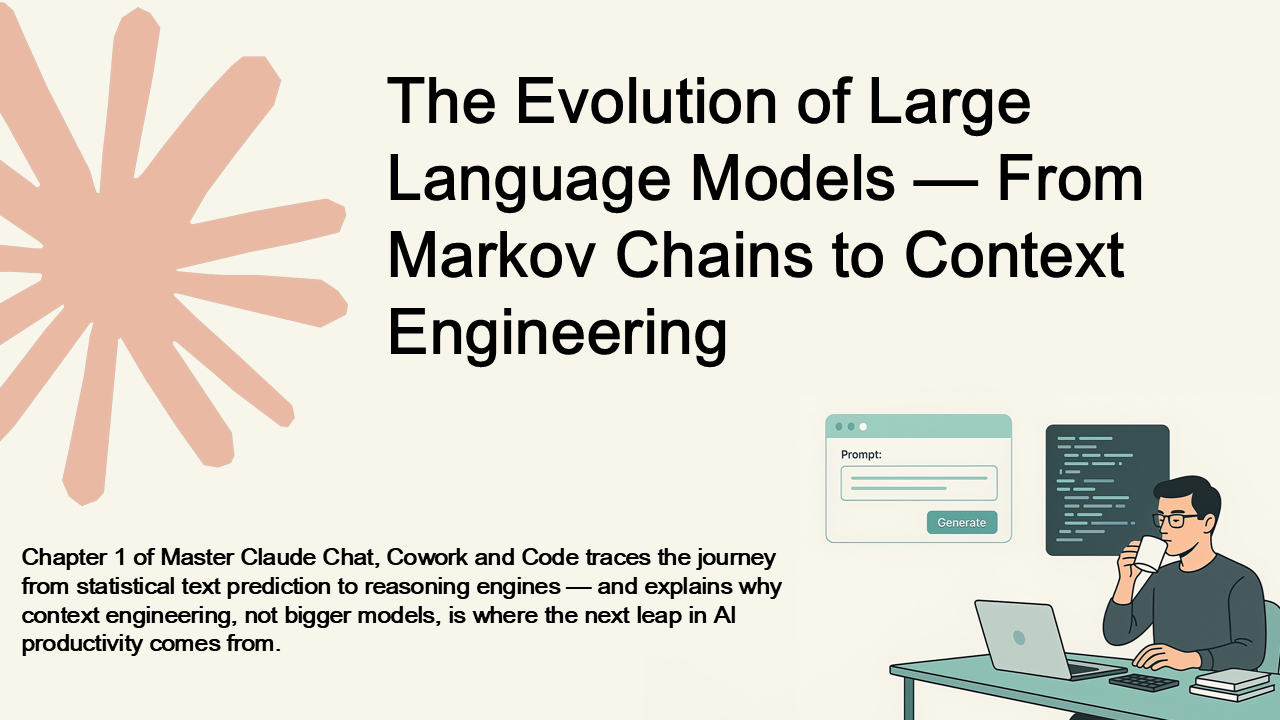
Master Claude, Chapter 1: The Evolution of Large Language Models — From Markov Chains to Context Engineering
Chapter 1 of Master Claude Chat, Cowork and Code traces the journey from statistical text prediction to reasoning engines — and explains why context engineering, not bigger models, is where the next leap in AI productivity comes from.
2026-03-02
Art of Coding, Chapter 7: Error Handling and Resilience
Designing for failure, not avoiding it. How graceful error handling, clear logging, and balanced defense build systems that endure.
2026-01-01
8.4 PCA and Spectral Methods
An intuitive, in-depth explanation of PCA, spectral clustering, and eigenvector-based data analysis. Covers covariance matrices, graph Laplacians, and why eigenvalues reveal hidden structure in data. Concludes Chapter 8 and leads naturally into SVD in Chapter 9.
2025-10-10
8.1 Power Method and Inverse Iteration
A clear, practical, and intuitive explanation of the power method and inverse iteration for computing eigenvalues. Covers dominance, repeated multiplication, shifted inverse iteration, and real applications in ML, PCA, and large-scale systems. Smoothly introduces the Rayleigh quotient.
2025-10-07
Chapter 8 — Eigenvalues and Eigenvectors
A deep, intuitive introduction to eigenvalues and eigenvectors for engineers and practitioners. Explains why spectral methods matter, where they appear in real systems, and how modern numerical algorithms compute eigenvalues efficiently. Leads naturally into the power method and inverse iteration.
2025-10-06
7.4 Why QR Is Often Preferred
An in-depth, accessible explanation of why QR decomposition is the preferred method for solving least squares problems and ensuring numerical stability. Covers orthogonality, rank deficiency, Householder reflections, and the broader role of QR in scientific computing, with a smooth transition into eigenvalues and eigenvectors.
2025-10-05
7.3 Least Squares Problems
A clear, intuitive, book-length explanation of least squares problems, including the geometry, normal equations, QR decomposition, and SVD. Learn why least-squares solutions are central to ML and data science, and why QR provides a stable foundation for practical algorithms.
2025-10-04
7.2 Householder Reflections
A clear, intuitive, book-length explanation of Householder reflections and why they form the foundation of modern QR decomposition. Learn how reflections overcome the numerical instability of Gram–Schmidt and enable stable least-squares solutions across ML, statistics, and scientific computing.
2025-10-03
7.1 Gram–Schmidt and Modified GS
A clear, practical, book-length explanation of Gram–Schmidt and Modified Gram–Schmidt, why classical GS fails in floating-point arithmetic, how MGS improves stability, and why real numerical systems eventually rely on Householder reflections. Ideal for ML engineers, data scientists, and numerical computing practitioners.
2025-10-02
Chapter 7 — QR Decomposition
A deep, intuitive introduction to QR decomposition, explaining why orthogonality and numerical stability make QR essential for least squares, regression, kernel methods, and large-scale computation. Covers Gram–Schmidt, Modified GS, Householder reflections, and why QR is often preferred over LU and normal equations.
2025-10-01
6.3 Applications in ML, Statistics, and Kernel Methods
A deep, intuitive explanation of how Cholesky decomposition powers real machine learning and statistical systems—from Gaussian processes and Bayesian inference to kernel methods, Kalman filters, covariance modeling, and quadratic optimization. Understand why Cholesky is essential for stability, speed, and large-scale computation.
2025-09-30
6.2 Memory Advantages
A detailed, intuitive explanation of why Cholesky decomposition uses half the memory of LU decomposition, how memory locality accelerates computation, and why this efficiency makes Cholesky essential for large-scale machine learning, kernel methods, and statistical modeling.
2025-09-29
6.1 SPD Matrices and Why They Matter
A deep, intuitive explanation of symmetric positive definite (SPD) matrices and why they are essential in machine learning, statistics, optimization, and numerical computation. Covers geometry, stability, covariance, kernels, Hessians, and how SPD structure enables efficient Cholesky decomposition.
2025-09-28
Chapter 6 — Cholesky Decomposition
A deep, narrative-driven introduction to Cholesky decomposition explaining why symmetric positive definite matrices dominate real computation. Covers structure, stability, performance, and the role of Cholesky in ML, statistics, and optimization.
2025-09-27
5.4 Practical Examples
Hands-on LU decomposition examples using NumPy and LAPACK. Learn how pivoting, numerical stability, singular matrices, and performance optimization work in real systems, with clear Python code and practical insights.
2025-09-26
5.3 LU in NumPy and LAPACK
A practical, in-depth guide to how LU decomposition is implemented in NumPy and LAPACK. Learn about partial pivoting, blocked algorithms, BLAS optimization, error handling, and how modern numerical libraries achieve both speed and stability.
2025-09-25
5.2 Numerical Pitfalls
A deep, accessible explanation of the numerical pitfalls in LU decomposition. Learn about growth factors, tiny pivots, rounding errors, catastrophic cancellation, ill-conditioning, and why LU may silently produce incorrect results without proper pivoting and numerical care.
2025-09-24
5.1 LU with and without Pivoting
A clear and practical explanation of LU decomposition with and without pivoting. Learn why pivoting is essential, how partial and complete pivoting work, where no-pivot LU fails, and why modern numerical libraries rely on pivoted LU for stability.
2025-09-23
Chapter 5 — LU Decomposition
An in-depth, accessible introduction to LU decomposition—why it matters, how it improves on Gaussian elimination, where pivoting fits in, and what modern numerical libraries like NumPy and LAPACK do under the hood. Includes a guide to stability, practical applications, and a smooth transition into LU with and without pivoting.
2025-09-22
4.4 When Elimination Fails
An in-depth, practical explanation of why Gaussian elimination fails in real numerical systems—covering zero pivots, instability, ill-conditioning, catastrophic cancellation, and singular matrices—and how these failures motivate the move to LU decomposition.
2025-09-21
4.3 Pivoting Strategies
A practical and intuitive guide to pivoting strategies in numerical linear algebra, explaining partial, complete, and scaled pivoting and why pivoting is essential for stable Gaussian elimination and reliable LU decomposition.
2025-09-20
4.2 Row Operations and Elementary Matrices
A deep but intuitive explanation of row operations and elementary matrices, showing how Gaussian elimination is built from structured matrix transformations and how these transformations form the foundation of LU decomposition and numerical stability.
2025-09-19
Categories
Tags
Search Logs
Hello World bot 1238
IT assistant bot 1210
Deploy Teams bot to Azure 1207
Microsoft Bot Framework 1105
Teams bot development 1085
Teams production bot 1075
bot for sprint updates 1061
Zendesk Teams integration 1048
Teams app zip 1044
Microsoft Teams Task Modules 1026
Teams chatbot 1024
Bot Framework Adaptive Card 1022
Teams bot tutorial 1013
Bot Framework example 1008
Task Modules 1007
Teams bot packaging 1005
Bot Framework proactive messaging 995
C 993
Graph API token 991
Bot Framework CLI 978
Azure CLI webapp deploy 976
Bot Framework prompts 971
Adaptive Card Action.Submit 965
Azure App Service bot 952
Microsoft Graph 935
Azure Bot Services 933
Adaptive Cards 906
ServiceNow bot 906
Azure bot registration 904
identity in Teams 871
Development & Technical Consulting
Working on a new product or exploring a technical idea? We help teams with system design, architecture reviews, requirements definition, proof-of-concept development, and full implementation. Whether you need a quick technical assessment or end-to-end support, feel free to reach out.
Contact Us