
{R}R 開発ノート
合計 12 件の記事が見つかりました。
Frictionless SaaS, Chapter 18: Building Knowledge Into Your Product
The Zero-Support Design Model, Contextual Help Architecture, and four AI Assistant Design Patterns that turn your product into its own best documentation.
2026-04-08
Frictionless SaaS: The Complete Series Index — Your Guide to All 24 Chapters
The complete reader's guide to the Frictionless SaaS blog series. An introduction to the thesis — that in the AI era, features are commoditized and experience is the only lasting competitive advantage — plus direct links to all 25 posts across the 24 chapters of the book.
2026-03-20
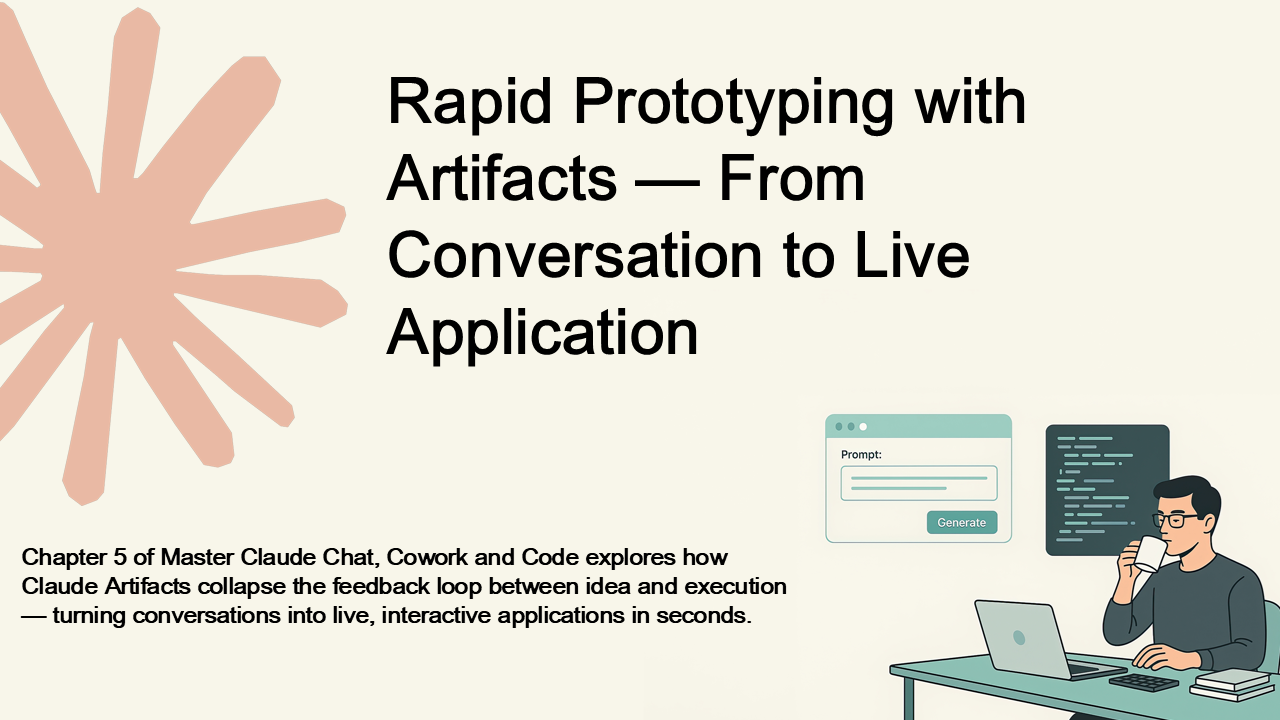
Chapter 5: Rapid Prototyping with Artifacts — From Conversation to Live Application
Chapter 5 of Master Claude Chat, Cowork and Code explores how Claude Artifacts collapse the feedback loop between idea and execution — turning conversations into live, interactive applications in seconds.
2026-03-06
Art of Coding, Chapter 1: Code That Speaks
Chapter 1 of the Art of Coding series. Why beauty in code is not decoration but survival — clarity, empathy, efficiency, and what separates code that works from code that lasts. Plus: what AI-generated code means for craftsmanship.
2025-12-24
8.4 PCA and Spectral Methods
An intuitive, in-depth explanation of PCA, spectral clustering, and eigenvector-based data analysis. Covers covariance matrices, graph Laplacians, and why eigenvalues reveal hidden structure in data. Concludes Chapter 8 and leads naturally into SVD in Chapter 9.
2025-10-10
8.3 The QR Algorithm (High-Level Intuition)
A clear, intuitive, and comprehensive explanation of the QR algorithm—how repeated QR factorizations reveal eigenvalues, why orthogonal transformations provide stability, and how shifts and Hessenberg reductions make the method efficient. Ends with a smooth bridge to PCA and spectral methods.
2025-10-09
8.2 Rayleigh Quotient
An intuitive and comprehensive explanation of the Rayleigh quotient, why it estimates eigenvalues so accurately, how it connects to the power method and inverse iteration, and why it forms the foundation of modern eigenvalue algorithms. Ends with a natural transition to the QR algorithm.
2025-10-08
8.1 Power Method and Inverse Iteration
A clear, practical, and intuitive explanation of the power method and inverse iteration for computing eigenvalues. Covers dominance, repeated multiplication, shifted inverse iteration, and real applications in ML, PCA, and large-scale systems. Smoothly introduces the Rayleigh quotient.
2025-10-07
Chapter 8 — Eigenvalues and Eigenvectors
A deep, intuitive introduction to eigenvalues and eigenvectors for engineers and practitioners. Explains why spectral methods matter, where they appear in real systems, and how modern numerical algorithms compute eigenvalues efficiently. Leads naturally into the power method and inverse iteration.
2025-10-06
7.1 Gram–Schmidt and Modified GS
A clear, practical, book-length explanation of Gram–Schmidt and Modified Gram–Schmidt, why classical GS fails in floating-point arithmetic, how MGS improves stability, and why real numerical systems eventually rely on Householder reflections. Ideal for ML engineers, data scientists, and numerical computing practitioners.
2025-10-02
2.4 Vector and Matrix Storage in Memory
A clear, practical guide to how vectors and matrices are stored in computer memory. Learn row-major vs column-major layout, strides, contiguity, tiling, cache behavior, and why memory layout affects both speed and numerical stability in real systems.
2025-09-11
Numerical Linear Algebra: Understanding Matrices and Vectors Through Computation
Learn how linear algebra actually works inside real computers. A practical guide to LU, QR, SVD, stability, conditioning, and the numerical foundations behind modern AI and machine learning.
2025-09-01
カテゴリー
タグ
検索ログ
Hello World bot 1008
Deploy Teams bot to Azure 948
IT assistant bot 932
Microsoft Bot Framework 910
Azure CLI webapp deploy 862
Teams production bot 826
Teams bot development 825
Adaptive Card Action.Submit 824
Bot Framework Adaptive Card 810
Microsoft Teams Task Modules 810
bot for sprint updates 809
Bot Framework example 807
C 806
Microsoft Graph 805
Teams app zip 804
Graph API token 797
Adaptive Cards 794
Bot Framework proactive messaging 792
Task Modules 792
Zendesk Teams integration 792
Teams chatbot 791
Teams bot packaging 790
Azure Bot Services 786
Teams bot tutorial 785
Azure App Service bot 782
Bot Framework CLI 780
Azure bot registration 772
Bot Framework prompts 769
ServiceNow bot 762
proactive messages 731
Development & Technical Consulting
Working on a new product or exploring a technical idea? We help teams with system design, architecture reviews, requirements definition, proof-of-concept development, and full implementation. Whether you need a quick technical assessment or end-to-end support, feel free to reach out.
Contact Us