
{R}R 開発ノート
合計 78 件の記事が見つかりました。
Chapter 5: Rapid Prototyping with Artifacts — From Conversation to Live Application
Chapter 5 of Master Claude Chat, Cowork and Code explores how Claude Artifacts collapse the feedback loop between idea and execution — turning conversations into live, interactive applications in seconds.
2026-03-06
OpenID: Modern Identity for Developers and Architects — A 22-Part Blog Series
Introduction and index for the 22-part blog series based on OpenID: Modern Identity for Developers and Architects by Sho Shimoda — with links to every chapter from Why Identity Is Hard through Identity in AI Systems.
2026-03-06
Master Claude, Chapter 2: The Three Pillars of Claude — Chat, Cowork, and Code
Claude is not one product — it is three. Chat for reasoning, Cowork for desktop automation, Code for terminal-based development. Chapter 2 of Master Claude Chat, Cowork and Code explains the architecture of each and the decision framework for choosing the right one.
2026-03-03
Master Claude, Chapter 1: The Evolution of Large Language Models — From Markov Chains to Context Engineering
Chapter 1 of Master Claude Chat, Cowork and Code traces the journey from statistical text prediction to reasoning engines — and explains why context engineering, not bigger models, is where the next leap in AI productivity comes from.
2026-03-02
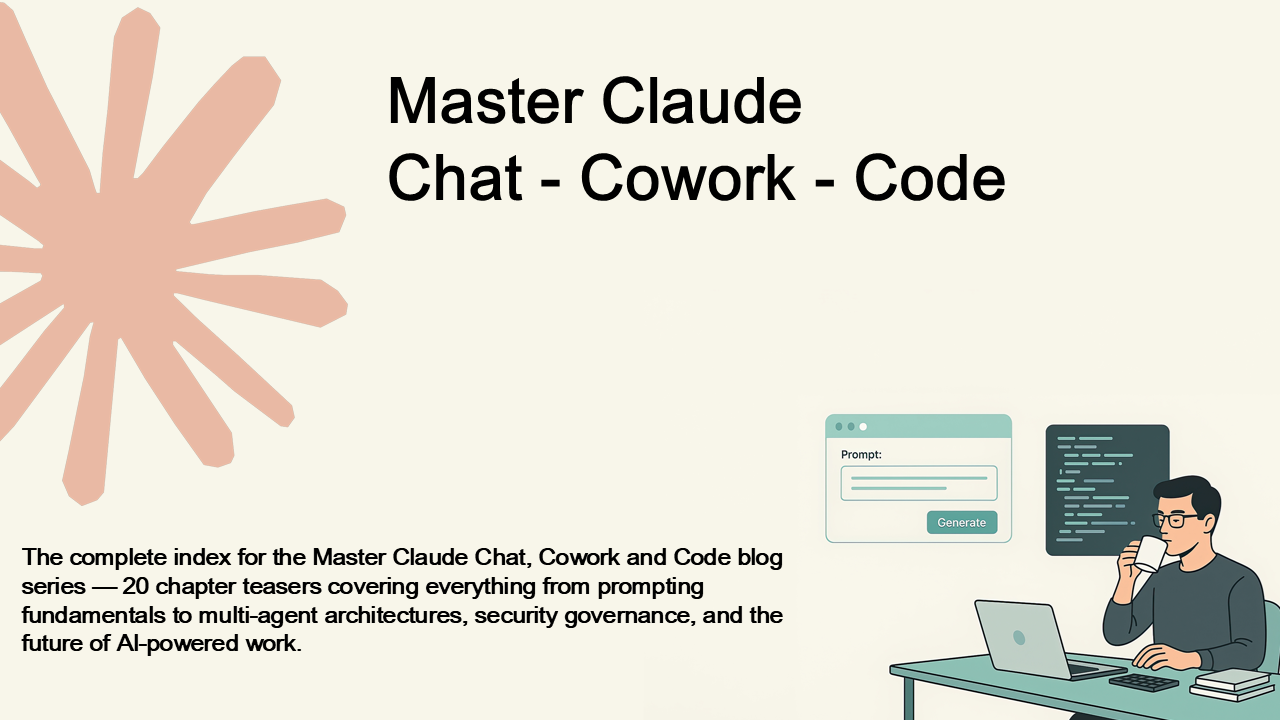
Master Claude Chat, Cowork and Code – The Complete Blog Series
The complete index for the Master Claude Chat, Cowork and Code blog series — 20 chapter teasers covering everything from prompting fundamentals to multi-agent architectures, security governance, and the future of AI-powered work.
2026-03-01
Art of Coding, Chapter 17: AI, Automation, and the Role of the Engineer
How AI changes engineering roles. Why automation removes drudgery but makes human judgment more valuable, and what "curation" means for the future programmer.
2026-01-15
Art of Coding, Part VII: Beyond Today
Introduction to Part VII. As AI writes more code, what becomes the engineer's irreplaceable role? A look at how automation transforms—but doesn't diminish—the craft.
2026-01-14
Art of Coding, Chapter 16: Ethics and Longevity
How ethics and longevity intertwine in code. Why the systems you write today remain your responsibility for years, and how empathy shapes sustainable software.
2026-01-13
Art of Coding, Part IV: Patterns, Anti-Patterns, and Architecture
Part IV explores design patterns as language, anti-patterns as warning signs, and architecture as the invisible skeleton enabling system growth.
2026-01-03
Art of Coding, Chapter 6: Abstraction and Modularity
Drawing boundaries that make systems stronger. How to abstract without over-engineering, and design interfaces that last.
2025-12-31
Art of Coding, Chapter 4: Maintainability and Scalability
How to build code that bends instead of breaks, systems that grow without collapsing, and anticipate change without over-engineering.
2025-12-28
Art of Coding, Chapter 1: Code That Speaks
Chapter 1 of the Art of Coding series. Why beauty in code is not decoration but survival — clarity, empathy, efficiency, and what separates code that works from code that lasts. Plus: what AI-generated code means for craftsmanship.
2025-12-24
8.4 PCA and Spectral Methods
An intuitive, in-depth explanation of PCA, spectral clustering, and eigenvector-based data analysis. Covers covariance matrices, graph Laplacians, and why eigenvalues reveal hidden structure in data. Concludes Chapter 8 and leads naturally into SVD in Chapter 9.
2025-10-10
8.2 Rayleigh Quotient
An intuitive and comprehensive explanation of the Rayleigh quotient, why it estimates eigenvalues so accurately, how it connects to the power method and inverse iteration, and why it forms the foundation of modern eigenvalue algorithms. Ends with a natural transition to the QR algorithm.
2025-10-08
Chapter 8 — Eigenvalues and Eigenvectors
A deep, intuitive introduction to eigenvalues and eigenvectors for engineers and practitioners. Explains why spectral methods matter, where they appear in real systems, and how modern numerical algorithms compute eigenvalues efficiently. Leads naturally into the power method and inverse iteration.
2025-10-06
Chapter 7 — QR Decomposition
A deep, intuitive introduction to QR decomposition, explaining why orthogonality and numerical stability make QR essential for least squares, regression, kernel methods, and large-scale computation. Covers Gram–Schmidt, Modified GS, Householder reflections, and why QR is often preferred over LU and normal equations.
2025-10-01
Chapter 6 — Cholesky Decomposition
A deep, narrative-driven introduction to Cholesky decomposition explaining why symmetric positive definite matrices dominate real computation. Covers structure, stability, performance, and the role of Cholesky in ML, statistics, and optimization.
2025-09-27
5.4 Practical Examples
Hands-on LU decomposition examples using NumPy and LAPACK. Learn how pivoting, numerical stability, singular matrices, and performance optimization work in real systems, with clear Python code and practical insights.
2025-09-26
5.3 LU in NumPy and LAPACK
A practical, in-depth guide to how LU decomposition is implemented in NumPy and LAPACK. Learn about partial pivoting, blocked algorithms, BLAS optimization, error handling, and how modern numerical libraries achieve both speed and stability.
2025-09-25
Chapter 5 — LU Decomposition
An in-depth, accessible introduction to LU decomposition—why it matters, how it improves on Gaussian elimination, where pivoting fits in, and what modern numerical libraries like NumPy and LAPACK do under the hood. Includes a guide to stability, practical applications, and a smooth transition into LU with and without pivoting.
2025-09-22
4.3 Pivoting Strategies
A practical and intuitive guide to pivoting strategies in numerical linear algebra, explaining partial, complete, and scaled pivoting and why pivoting is essential for stable Gaussian elimination and reliable LU decomposition.
2025-09-20
4.0 Solving Ax = b
A deep, accessible introduction to solving linear systems in numerical computing. Learn why Ax = b sits at the center of AI, ML, optimization, and simulation, and explore Gaussian elimination, pivoting, row operations, and failure modes through intuitive explanations.
2025-09-17
3.3 Conditioning of Problems vs Stability of Algorithms
Learn the critical difference between problem conditioning and algorithmic stability in numerical computing. Understand why some systems fail even with correct code, and how sensitivity, condition numbers, and numerical stability determine the reliability of AI, ML, and scientific algorithms.
2025-09-15
2.4 Vector and Matrix Storage in Memory
A clear, practical guide to how vectors and matrices are stored in computer memory. Learn row-major vs column-major layout, strides, contiguity, tiling, cache behavior, and why memory layout affects both speed and numerical stability in real systems.
2025-09-11
2.1 Floating-Point Numbers (IEEE 754)
A detailed, intuitive guide to floating-point numbers and the IEEE 754 standard. Learn how computers represent real numbers, why precision is limited, and how rounding, overflow, subnormals, and special values affect numerical algorithms in AI, ML, and scientific computing.
2025-09-08
Chapter 2 — The Computational Model
An introduction to the computational model behind numerical linear algebra. Explains why mathematical algorithms fail inside real computers, how floating-point arithmetic shapes computation, and why understanding precision, rounding, overflow, and memory layout is essential for AI, ML, and scientific computing.
2025-09-07
Message Handling|Mastering Microsoft Teams Bots 3.1
Learn how to build responsive and intelligent Microsoft Teams bots by handling messages effectively. This section covers activity types, keyword detection, mentions, markdown formatting, conversation context, and tips for scaling from simple replies to powerful, workflow-driven bots.
2025-04-08
Why Build Bots for Microsoft Teams?|Mastering Microsoft Teams Bots 1.1
Discover why Microsoft Teams bots are transforming the workplace. This section explores the real-world impact of building bots in Teams, from automating tasks and integrating external services to enabling context-aware digital assistants. Learn how bots can save time, boost productivity, and bring automation into the flow of daily work.
2025-04-02
カテゴリー
タグ
検索ログ
Hello World bot 956
Deploy Teams bot to Azure 906
IT assistant bot 890
Microsoft Bot Framework 868
Azure CLI webapp deploy 832
Adaptive Card Action.Submit 791
Teams bot development 790
Bot Framework Adaptive Card 782
Teams production bot 775
Bot Framework example 768
Teams app zip 766
Adaptive Cards 764
Microsoft Teams Task Modules 764
Microsoft Graph 763
Graph API token 761
Zendesk Teams integration 758
Teams bot packaging 756
bot for sprint updates 751
C 750
Azure Bot Services 745
Teams bot tutorial 744
Task Modules 741
Azure App Service bot 738
Bot Framework CLI 737
Bot Framework proactive messaging 737
Teams chatbot 737
Azure bot registration 734
ServiceNow bot 728
Bot Framework prompts 722
proactive messages 705
Development & Technical Consulting
Working on a new product or exploring a technical idea? We help teams with system design, architecture reviews, requirements definition, proof-of-concept development, and full implementation. Whether you need a quick technical assessment or end-to-end support, feel free to reach out.
Contact Us