
{R}R Dev Notes
Found total of 17 articles.
Frictionless SaaS Chapter 13: SaaS Metrics, Cohort Analysis, and the North Star
Chapter 13 preview of Frictionless SaaS: the SaaS Metrics Pyramid, Net Revenue Retention, cohort-based optimization, and how to choose a North Star that actually drives retention and revenue.
2026-04-03
Frictionless SaaS Chapter 11: Lifecycle Messaging and Engagement
Chapter 11 preview of Frictionless SaaS: the Lifecycle Messaging Architecture, the Message-Moment Fit Principle, and the Customer Feedback Loop Framework for turning communication into a retention engine.
2026-04-01
OpenClaw Engineering, Chapter 13: Hardening the Ecosystem
The final chapter: ecosystem security, the ClawHavoc incident, defending against malware in dependencies, confirming high-risk operations, and building auditing and disaster recovery systems.
2026-03-28
OpenClaw Engineering, Chapter 10: Multi-Agent Systems
Build teams of specialized agents that work in concert. Learn how to architect planners, coders, critics, and surveyors, coordinate them via channels, and use adversarial collaboration and taste gates for high-quality output.
2026-03-25
Frictionless SaaS, Part 0: How Users Actually Find, Judge, and Try Your Product
Kicking off a blog series based on the book "Frictionless SaaS." This first post introduces Chapters 0.1 through 0.3 — Discovery, the Landing Page, and Freemium & Entry Points — the three friction points every user hits before they ever sign up.
2026-03-21
OpenClaw Engineering, Chapter 6: Extending Capabilities with SKILL.md
The anatomy of SKILL.md files in OpenClaw: how to author reusable, versioned instruction sets with YAML frontmatter, dependencies, and explicit procedural guidance for agents.
2026-03-21
OpenClaw Engineering, Chapter 5: Connecting Multiple Channels
How to connect your OpenClaw agent to multiple messaging platforms (Telegram, WhatsApp, Discord, Slack) and manage multi-channel routing. Setup, configuration quirks, and troubleshooting for each platform.
2026-03-20
OpenClaw Engineering, Chapter 4: Managing the Gateway and Models
Configuring your running gateway with the onboard wizard, diagnostics, and openclaw.json. How to connect model providers, manage API keys securely, and route different queries to different models.
2026-03-19
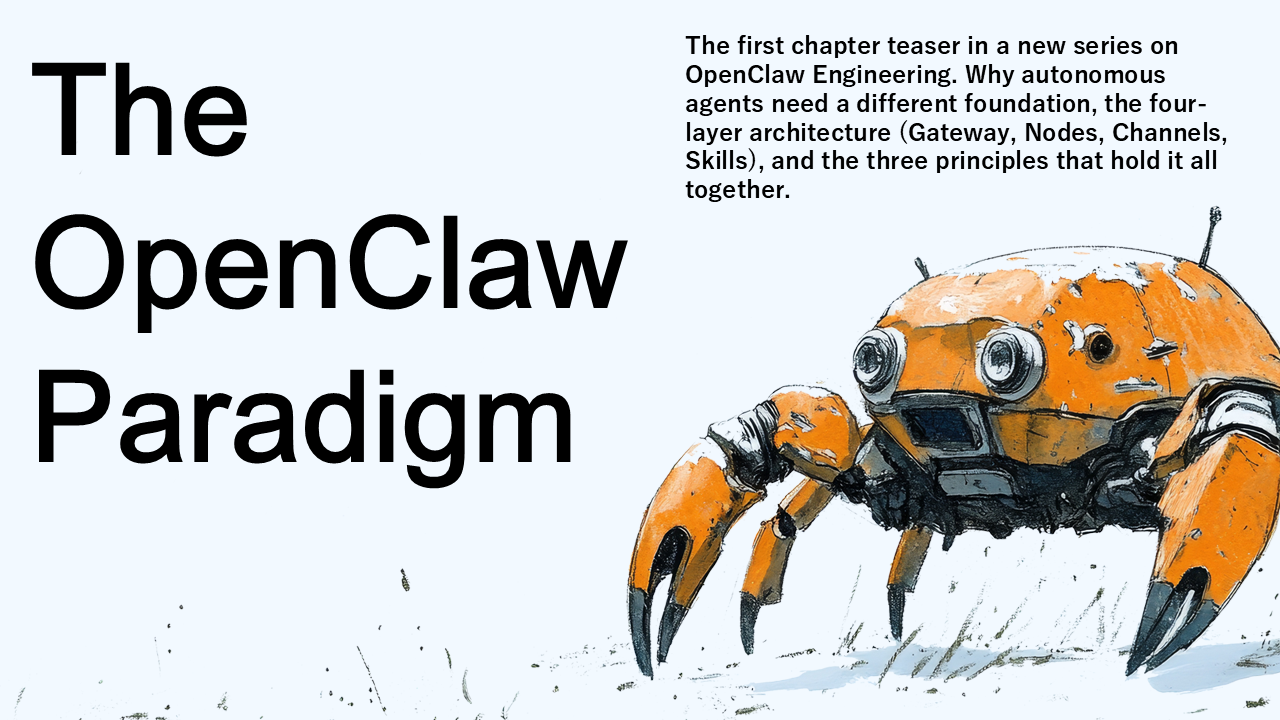
OpenClaw Engineering, Chapter 1: The OpenClaw Paradigm
The first chapter teaser in a new series on OpenClaw Engineering. Why autonomous agents need a different foundation, the four-layer architecture (Gateway, Nodes, Channels, Skills), and the three principles that hold it all together.
2026-03-16
Chapter 14 – Connecting Systems with the Model Context Protocol (MCP)
Chapter 14 of Master Claude Chat, Cowork and Code explores the Model Context Protocol — the universal bridge that lets Claude connect to Slack, GitHub, Jira, Google Drive, and more, turning isolated AI into a deeply integrated workflow partner.
2026-03-15
Chapter 6: What Is Claude Cowork? — The Desktop Agent That Touches Your Files
Chapter 6 of Master Claude Chat, Cowork and Code introduces Claude Cowork — a sandboxed desktop agent that automates file management, data extraction, and cross-application workflows on your local machine.
2026-03-07

Teams App Manifest and Packaging|Mastering Microsoft Teams Bots 5.2
Transform your bot into a full Teams app. This section walks through how to create a Teams app manifest, add branding, define scopes, and package your bot into a distributable .zip file for sideloading, internal use, or submission to the Microsoft App Store.
2025-04-16
Deploying to Azure|Mastering Microsoft Teams Bots 5.1
Learn how to deploy your Microsoft Teams bot to Azure for production use. This section walks through setting up an Azure App Service, configuring environment variables, connecting to Bot Channels Registration, and testing your bot in the cloud.
2025-04-15
Message Handling|Mastering Microsoft Teams Bots 3.1
Learn how to build responsive and intelligent Microsoft Teams bots by handling messages effectively. This section covers activity types, keyword detection, mentions, markdown formatting, conversation context, and tips for scaling from simple replies to powerful, workflow-driven bots.
2025-04-08
Setting Up Your Environment|Mastering Microsoft Teams Bots 2.1
Start your Microsoft Teams bot development journey with a solid foundation. This section walks you through the essential tools—Node.js, .NET SDK, Ngrok, Azure CLI—and explains why setting up your dev environment the right way is critical to building bots successfully.
2025-04-05
Overview of Microsoft Teams Bot Capabilities|Mastering Microsoft Teams Bots 1.3
Explore the full range of capabilities bots can offer in Microsoft Teams. This section breaks down interactive contexts, features like Adaptive Cards, proactive messaging, user authentication, Graph API integration, and what limitations still exist. Get a developer’s guide to what’s possible.
2025-04-04
Overview of Microsoft Teams Architecture|Mastering Microsoft Teams Bots 1.2
Get a developer-friendly introduction to how Microsoft Teams is built. This section explains Teams architecture—channels, tabs, bots, messaging extensions, and Graph API—and shows how each component fits into the broader platform. A must-read before building your first bot.
2025-04-03
Categories
Tags
Search Logs
Hello World bot 1185
IT assistant bot 1140
Deploy Teams bot to Azure 1137
Microsoft Bot Framework 1052
Teams bot development 1025
Teams production bot 1004
bot for sprint updates 994
Microsoft Teams Task Modules 979
Zendesk Teams integration 979
Teams app zip 977
Bot Framework Adaptive Card 973
Bot Framework example 964
Task Modules 961
Teams chatbot 955
Azure CLI webapp deploy 952
C 952
Teams bot packaging 947
Teams bot tutorial 946
Bot Framework proactive messaging 941
Graph API token 937
Bot Framework CLI 932
Adaptive Card Action.Submit 930
Bot Framework prompts 913
Azure App Service bot 908
Microsoft Graph 907
Azure Bot Services 883
Adaptive Cards 881
Azure bot registration 880
ServiceNow bot 866
proactive messages 814
Development & Technical Consulting
Working on a new product or exploring a technical idea? We help teams with system design, architecture reviews, requirements definition, proof-of-concept development, and full implementation. Whether you need a quick technical assessment or end-to-end support, feel free to reach out.
Contact Us