
{R}R 開発ノート
合計 40 件の記事が見つかりました。
The Engineering of Intent, Chapter 6: Autonomous Orchestration Frameworks
Chapter 6 of The Engineering of Intent blog series. Editors run one agent at a time; orchestration runs many. A teaser on task-specific personalities, memory banks, when to orchestrate (and when not), the 14,000-test case study, and the economics of multi-agent pipelines.
2026-04-22
Frictionless SaaS, Chapter 24: Anti-Patterns and Failure Modes
The last chapter of Frictionless SaaS is about the mistakes teams keep making, even when they know better. A teaser covering the Anti-Pattern Registry, the Feature Trap, and the additional failure modes that quietly erode good products.
2026-04-14
Frictionless SaaS, Chapter 21: Operations and Scalability Without Friction
Why growing SaaS companies hit a wall that is not a product problem or a sales problem — it is an operations problem. A teaser for Chapter 21 of Frictionless SaaS covering the Event-Driven Operations Architecture and the Scalability Without Headcount Principle.
2026-04-11
Frictionless SaaS, Chapter 20: Organizational Design for Frictionless Delivery
The Experience Ownership Model and the Behavior Design Canvas — two reorganizations that stop user experience from falling through the cracks between departments.
2026-04-10
Frictionless SaaS, Chapter 18: Building Knowledge Into Your Product
The Zero-Support Design Model, Contextual Help Architecture, and four AI Assistant Design Patterns that turn your product into its own best documentation.
2026-04-08
Frictionless SaaS, Chapter 17: Self-Serve Onboarding and Setup
Why self-serve setup converts 2-3x better than assisted onboarding, and the Progressive Setup Pattern and Smart Defaults Strategy that make complex products feel simple.
2026-04-07
Frictionless SaaS Chapter 16: The Power of Self-Service
Chapter 16 preview of Frictionless SaaS: the Self-Serve Maturity Model, the Independence Principle, and how self-serve billing and account management turn scalability into a competitive moat.
2026-04-06
Frictionless SaaS Chapter 15: Continuous Optimization and the Data-Intuition Balance
Chapter 15 preview of Frictionless SaaS: the Experiment-Learn-Ship cycle, the Data-Intuition Balance, staged rollouts, and the retention operating model that turns improvement into a flywheel.
2026-04-05
Frictionless SaaS Chapter 10: Data Lock-In and Network Lock-In
Chapter 10 preview of Frictionless SaaS: the Data Gravity Effect, the Network Lock-In Model, and how to build structural moats that make churn expensive without being manipulative.
2026-03-31
Frictionless SaaS Chapter 9: Eliminating Friction and Building Consistency
Chapter 9 preview of Frictionless SaaS: the Friction Audit Matrix, the Consistency Principle, perceived speed, and information ergonomics - the retention levers most teams ignore.
2026-03-30

Frictionless SaaS, Chapter 8: Designing for Habit - Why Retention Is Your Real Growth Engine
Chapter 8 of the Frictionless SaaS blog series. Retention is the multiplier on every dollar of acquisition you'll ever spend. The Habit Loop Engine, the Return Reason Architecture, and the DAU/WAU signals that tell you whether you're building a habit or a one-night stand.
2026-03-29
OpenClaw Engineering, Chapter 12: The Agentic Zero-Trust Architecture
Zero-trust security for autonomous agents: managing blast radius, implementing three-tier defense (pre-action, in-action, post-action), container isolation, and defending against indirect prompt injection attacks.
2026-03-27
Chapter 19: Observability and Operations — Identity You Can Actually Run
Chapter 19 of the OpenID: Modern Identity series — observability and operations for identity systems: structured authentication logging with correlation IDs, distributed tracing of login flows, and immutable audit trails aligned to regulatory requirements.
2026-03-25
OpenClaw Engineering, Chapter 10: Multi-Agent Systems
Build teams of specialized agents that work in concert. Learn how to architect planners, coders, critics, and surveyors, coordinate them via channels, and use adversarial collaboration and taste gates for high-quality output.
2026-03-25
OpenClaw Engineering, Chapter 9: Scheduling and Deterministic Orchestration
Time-based automation for agents: cron jobs for simple periodic tasks and the Lobster workflow engine for complex, deterministic, resumable multi-step pipelines with human approval gates.
2026-03-24
Chapter 18: Claims Design and Privacy — Identity Data Without Overshare
Chapter 18 of the OpenID: Modern Identity series — designing custom claims with namespacing and size discipline, attribute mapping across providers into a single internal schema, and privacy by design through minimization, selective disclosure, pairwise identifiers, and GDPR-ready retention.
2026-03-24
OpenClaw Engineering, Chapter 8: Event-Driven Workflows
How OpenClaw agents spring into action automatically via hooks, webhooks, and TypeScript handlers—without waiting for human invocation. From internal events to CI/CD pipelines.
2026-03-23
Frictionless SaaS, Chapter 1: Silent Churn — The Users Who Leave Without Complaining
Chapter 1 of the Frictionless SaaS blog series. Silent churn is the most dangerous kind of churn — users who sign up, disappear, and never tell you why. A look at the Silent Churn Pattern and the Activation Gap.
2026-03-22
OpenClaw Engineering, Chapter 7: The Skill Ecosystem
Bundled skills vs workspace skills, skill discovery and context, publishing to ClawHub, managing 13,000+ community skills without collision, semantic search, and the meta-skills that let agents improve themselves.
2026-03-22
Frictionless SaaS: The Complete Series Index — Your Guide to All 24 Chapters
The complete reader's guide to the Frictionless SaaS blog series. An introduction to the thesis — that in the AI era, features are commoditized and experience is the only lasting competitive advantage — plus direct links to all 25 posts across the 24 chapters of the book.
2026-03-20
OpenClaw Engineering, Chapter 4: Managing the Gateway and Models
Configuring your running gateway with the onboard wizard, diagnostics, and openclaw.json. How to connect model providers, manage API keys securely, and route different queries to different models.
2026-03-19
OpenClaw Engineering, Chapter 3: Deployment and Environment Setup
From local development to production: installing Node.js 22+, setting up Docker containers, and deploying OpenClaw to the cloud via AWS Lightsail or VPS providers.
2026-03-18
Chapter 12: User Lifecycle Management — Provisioning, SCIM, and the De-Provisioning Problem
Chapter 12 of the OpenID: Modern Identity series — user lifecycle management: JIT and bulk provisioning, SCIM for cross-system sync, de-provisioning done right, role mapping from IdP claims, and identity architecture for multi-tenant SaaS.
2026-03-18
Chapter 10: Single Sign-On at Scale — Identity as Infrastructure
Chapter 10 of the OpenID: Modern Identity series — running identity at organizational scale: corporate IdPs (AD, Entra ID), the CIAM vendor ecosystem (Okta, Auth0, Entra ID), multi-tenant isolation, account linking, and external user access.
2026-03-16
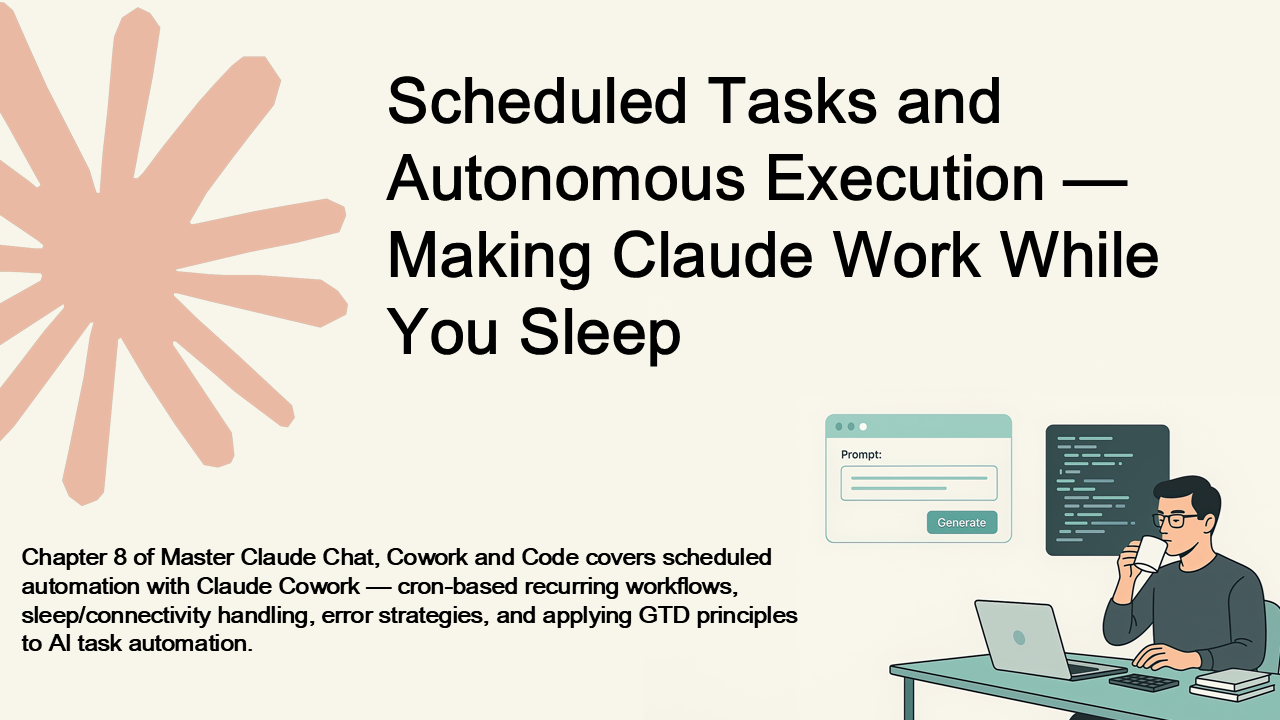
Chapter 8: Scheduled Tasks and Autonomous Execution — Making Claude Work While You Sleep
Chapter 8 of Master Claude Chat, Cowork and Code covers scheduled automation with Claude Cowork — cron-based recurring workflows, sleep/connectivity handling, error strategies, and applying GTD principles to AI task automation.
2026-03-09
Chapter 2: From OpenID to OpenID Connect — How the Industry Got This One Right
Chapter 2 of the OpenID: Modern Identity series — tracing how the industry moved from the original OpenID and SAML through OAuth 2.0 to OpenID Connect, and when to reach for each standard.
2026-03-08
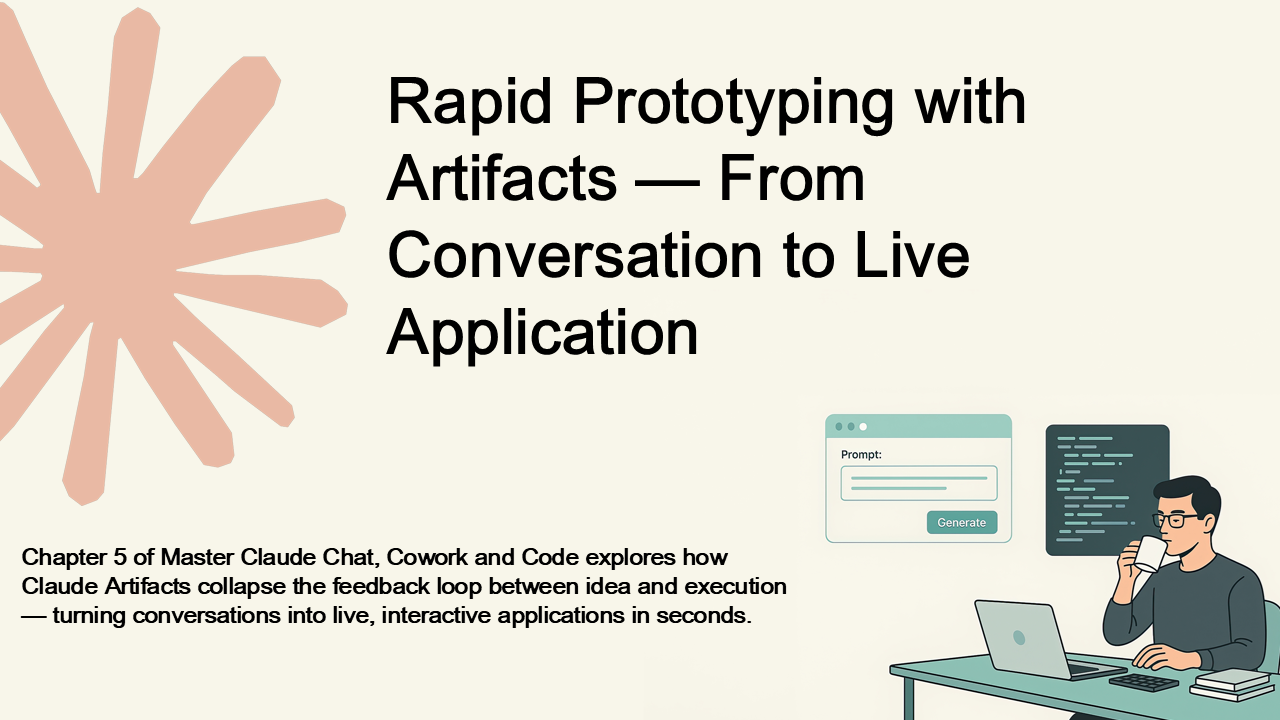
Chapter 5: Rapid Prototyping with Artifacts — From Conversation to Live Application
Chapter 5 of Master Claude Chat, Cowork and Code explores how Claude Artifacts collapse the feedback loop between idea and execution — turning conversations into live, interactive applications in seconds.
2026-03-06
Art of Coding, Chapter 7: Error Handling and Resilience
Designing for failure, not avoiding it. How graceful error handling, clear logging, and balanced defense build systems that endure.
2026-01-01
6.3 Applications in ML, Statistics, and Kernel Methods
A deep, intuitive explanation of how Cholesky decomposition powers real machine learning and statistical systems—from Gaussian processes and Bayesian inference to kernel methods, Kalman filters, covariance modeling, and quadratic optimization. Understand why Cholesky is essential for stability, speed, and large-scale computation.
2025-09-30

1.0 Why Numerical Linear Algebra Matters
A deep, practical introduction to why numerical linear algebra matters in real AI, ML, and optimization systems. Learn how stability, conditioning, and floating-point behavior impact models.
2025-09-02
Numerical Linear Algebra: Understanding Matrices and Vectors Through Computation
Learn how linear algebra actually works inside real computers. A practical guide to LU, QR, SVD, stability, conditioning, and the numerical foundations behind modern AI and machine learning.
2025-09-01
Use Case: Project Management Assistant Bot|Mastering Microsoft Teams Bots 6.2
Explore how to build a Project Management Assistant Bot for Microsoft Teams that delivers task summaries, reminders, and updates directly in the chat. Learn how this bot improves team productivity by integrating with tools like Jira or Trello and surfacing key information within the Teams workflow.
2025-04-19
Use Case: Helpdesk Assistant Bot|Mastering Microsoft Teams Bots 6.1
Explore how to build a Helpdesk Assistant Bot in Microsoft Teams. Learn how bots can reduce IT load by handling FAQs, logging support tickets, and notifying users — all within Teams. This section explains features, user experience, and implementation strategies.
2025-04-18
Monitoring, Logging, and Telemetry|Mastering Microsoft Teams Bots 5.3
Learn how to monitor and support your Microsoft Teams bot in production using logging, Azure Application Insights, and alerts. This section shows how to track user events, diagnose failures, and create telemetry that makes your bot reliable and supportable.
2025-04-17

Teams App Manifest and Packaging|Mastering Microsoft Teams Bots 5.2
Transform your bot into a full Teams app. This section walks through how to create a Teams app manifest, add branding, define scopes, and package your bot into a distributable .zip file for sideloading, internal use, or submission to the Microsoft App Store.
2025-04-16

Localization and Multi-Tenant Support|Mastering Microsoft Teams Bots 4.4
Prepare your Microsoft Teams bot for real-world deployment. This section covers how to support multiple languages using localization, and how to safely handle multiple organizations with multi-tenant support — including tenant isolation, data security, and consent flows.
2025-04-14

Message Extensions|Mastering Microsoft Teams Bots 4.3
Learn how to build search- and action-based Message Extensions in Microsoft Teams. This section shows how to let users interact with your bot directly from the message composer — to search records, fill forms, or insert rich cards — all without leaving the chat.
2025-04-13
Rich Responses with Adaptive Cards|Mastering Microsoft Teams Bots 3.2
Learn how to create rich, interactive messages in Microsoft Teams using Adaptive Cards. This section explains how to design, send, and handle cards in your bot — making your bot feel less like a chat and more like a true app experience inside Teams.
2025-04-09
Setting Up Your Environment|Mastering Microsoft Teams Bots 2.1
Start your Microsoft Teams bot development journey with a solid foundation. This section walks you through the essential tools—Node.js, .NET SDK, Ngrok, Azure CLI—and explains why setting up your dev environment the right way is critical to building bots successfully.
2025-04-05
Mastering Microsoft Teams Bots: A Complete Developer’s Guide
The definitive guide to building bots for Microsoft Teams—from fundamentals to deployment. Learn how to build intelligent and interactive bots using the Microsoft Bot Framework, integrate Adaptive Cards and Task Modules, send proactive messages, authenticate users with Teams SSO, and deploy securely on Azure. Packed with practical examples and real-world use cases, this book will help you automate workflows, enhance collaboration, and deliver smart experiences inside Teams.
2025-04-01
カテゴリー
タグ
検索ログ
Hello World bot 938
IT assistant bot 876
Deploy Teams bot to Azure 874
Microsoft Bot Framework 848
Azure CLI webapp deploy 818
Adaptive Card Action.Submit 781
Teams bot development 775
Bot Framework example 751
Microsoft Graph 749
Adaptive Cards 748
Bot Framework Adaptive Card 747
Graph API token 742
Microsoft Teams Task Modules 740
Teams app zip 737
Teams bot packaging 737
Teams bot tutorial 731
Teams production bot 731
C 730
Task Modules 729
bot for sprint updates 727
Zendesk Teams integration 725
Azure Bot Services 724
Azure App Service bot 722
Teams chatbot 721
Bot Framework CLI 717
ServiceNow bot 715
Bot Framework proactive messaging 710
Bot Framework prompts 708
Azure bot registration 707
proactive messages 694
Development & Technical Consulting
Working on a new product or exploring a technical idea? We help teams with system design, architecture reviews, requirements definition, proof-of-concept development, and full implementation. Whether you need a quick technical assessment or end-to-end support, feel free to reach out.
Contact Us