
{R}R Dev Notes
Found total of 18 articles.
Loop Engineering, Chapter 1: The Anatomy of an Agentic Loop
Chapter 1 of the Loop Engineering blog series. Every agentic system begins with a single loop. A teaser on the ReAct pattern, why a loop beats a fixed prompt chain, the arithmetic of per-step reliability, and the discipline of a verifiable stopping condition.
2026-06-15
The Forward Deployed Engineer, Chapter 17: Measuring Success with Outcome-Level Agreements
Chapter 17 of The Forward Deployed Engineer blog series. Standard SaaS metrics fail for the FDE function. A teaser on Outcome-Level Agreements (OLAs), the engagement dashboard, function-level metrics, building the dashboard, and the OLA as a strategic tool with customers.
2026-06-12
The Forward Deployed Engineer, Chapter 16: When Not to Build an FDE Function
Chapter 16 of The Forward Deployed Engineer blog series. The inverse case — when an FDE function is the wrong answer. A teaser on the five disqualifying conditions, the alternative models, the hybrid patterns, the premature-optimization trap, and what to build instead.
2026-06-11
The Forward Deployed Engineer, Chapter 13: When FDE Goes Wrong — Failure Modes and Lessons
Chapter 13 of The Forward Deployed Engineer blog series. Six named failure modes that kill FDE functions before they scale. A teaser on the Consulting Trap, the Snowflake-per-Customer trap, the Hero Engineer, the Demo-Debt Spiral, the Sponsor Collapse, and the Burnout Death Spiral.
2026-06-08
The Engineering of Intent, Chapter 35: A Short Bestiary of Vibe Coders
Chapter 35 of The Engineering of Intent blog series. A light-hearted bestiary of the eight Vibe Coder archetypes — the Sprinter, the Architect, the Skeptic, the Believer, the Pedagog, the Tool-Smith, the Commentator, and the Steady. With growth paths for each.
2026-05-21
The Engineering of Intent, Chapter 30: Vibe Coding in the Frontend
Chapter 30 of The Engineering of Intent blog series. Frontend has a different shape — visual, fast-iterating — and specific failure modes around design systems, accessibility, state, and performance. A teaser on the four domains and the dashboard rebuild that shipped in eleven days.
2026-05-16
The Engineering of Intent, Chapter 29: Vibe Coding in the Backend
Chapter 29 of The Engineering of Intent blog series. Backends are unusually well suited to agentic development — but each subdomain has characteristic failure modes. A teaser on API design, migrations, job idempotency, caching, auth, and the billing-service rewrite that shipped in four months via extraction rather than vibes.
2026-05-15
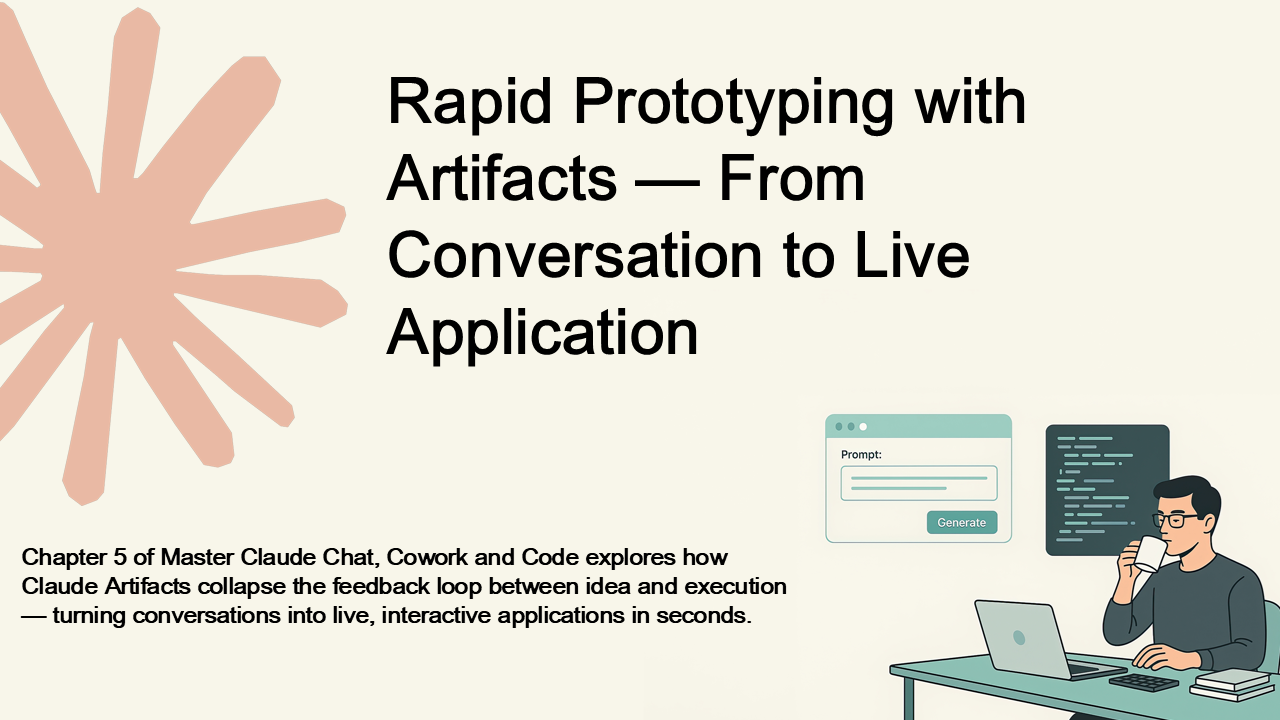
Chapter 5: Rapid Prototyping with Artifacts — From Conversation to Live Application
Chapter 5 of Master Claude Chat, Cowork and Code explores how Claude Artifacts collapse the feedback loop between idea and execution — turning conversations into live, interactive applications in seconds.
2026-03-06
8.4 PCA and Spectral Methods
An intuitive, in-depth explanation of PCA, spectral clustering, and eigenvector-based data analysis. Covers covariance matrices, graph Laplacians, and why eigenvalues reveal hidden structure in data. Concludes Chapter 8 and leads naturally into SVD in Chapter 9.
2025-10-10
8.3 The QR Algorithm (High-Level Intuition)
A clear, intuitive, and comprehensive explanation of the QR algorithm—how repeated QR factorizations reveal eigenvalues, why orthogonal transformations provide stability, and how shifts and Hessenberg reductions make the method efficient. Ends with a smooth bridge to PCA and spectral methods.
2025-10-09
8.2 Rayleigh Quotient
An intuitive and comprehensive explanation of the Rayleigh quotient, why it estimates eigenvalues so accurately, how it connects to the power method and inverse iteration, and why it forms the foundation of modern eigenvalue algorithms. Ends with a natural transition to the QR algorithm.
2025-10-08
8.1 Power Method and Inverse Iteration
A clear, practical, and intuitive explanation of the power method and inverse iteration for computing eigenvalues. Covers dominance, repeated multiplication, shifted inverse iteration, and real applications in ML, PCA, and large-scale systems. Smoothly introduces the Rayleigh quotient.
2025-10-07
Chapter 8 — Eigenvalues and Eigenvectors
A deep, intuitive introduction to eigenvalues and eigenvectors for engineers and practitioners. Explains why spectral methods matter, where they appear in real systems, and how modern numerical algorithms compute eigenvalues efficiently. Leads naturally into the power method and inverse iteration.
2025-10-06
7.1 Gram–Schmidt and Modified GS
A clear, practical, book-length explanation of Gram–Schmidt and Modified Gram–Schmidt, why classical GS fails in floating-point arithmetic, how MGS improves stability, and why real numerical systems eventually rely on Householder reflections. Ideal for ML engineers, data scientists, and numerical computing practitioners.
2025-10-02
Chapter 7 — QR Decomposition
A deep, intuitive introduction to QR decomposition, explaining why orthogonality and numerical stability make QR essential for least squares, regression, kernel methods, and large-scale computation. Covers Gram–Schmidt, Modified GS, Householder reflections, and why QR is often preferred over LU and normal equations.
2025-10-01
5.4 Practical Examples
Hands-on LU decomposition examples using NumPy and LAPACK. Learn how pivoting, numerical stability, singular matrices, and performance optimization work in real systems, with clear Python code and practical insights.
2025-09-26
2.4 Vector and Matrix Storage in Memory
A clear, practical guide to how vectors and matrices are stored in computer memory. Learn row-major vs column-major layout, strides, contiguity, tiling, cache behavior, and why memory layout affects both speed and numerical stability in real systems.
2025-09-11
Numerical Linear Algebra: Understanding Matrices and Vectors Through Computation
Learn how linear algebra actually works inside real computers. A practical guide to LU, QR, SVD, stability, conditioning, and the numerical foundations behind modern AI and machine learning.
2025-09-01
Categories
Tags
Search Logs
Hello World bot 1238
IT assistant bot 1210
Deploy Teams bot to Azure 1207
Microsoft Bot Framework 1105
Teams bot development 1085
Teams production bot 1075
bot for sprint updates 1061
Zendesk Teams integration 1048
Teams app zip 1044
Microsoft Teams Task Modules 1026
Teams chatbot 1024
Bot Framework Adaptive Card 1020
Teams bot tutorial 1013
Bot Framework example 1008
Task Modules 1007
Teams bot packaging 1005
Bot Framework proactive messaging 995
C 993
Graph API token 991
Bot Framework CLI 978
Azure CLI webapp deploy 976
Bot Framework prompts 971
Adaptive Card Action.Submit 965
Azure App Service bot 952
Microsoft Graph 935
Azure Bot Services 933
Adaptive Cards 906
ServiceNow bot 906
Azure bot registration 904
identity in Teams 871
Development & Technical Consulting
Working on a new product or exploring a technical idea? We help teams with system design, architecture reviews, requirements definition, proof-of-concept development, and full implementation. Whether you need a quick technical assessment or end-to-end support, feel free to reach out.
Contact Us