
{R}R Dev Notes
Found total of 49 articles.
The Forward Deployed Engineer, Chapter 7: Customer Discovery and the Messy Reality
Chapter 7 of The Forward Deployed Engineer blog series. The most important fourteen days of any engagement are the first fourteen. A teaser on the three outputs of discovery, the async interview, the Weird Tuesday problem, the workflow inventory, and the Eval-Customer Split.
2026-06-02
The Forward Deployed Engineer, Chapter 5: The AI and Agentic Frontier
Chapter 5 of The Forward Deployed Engineer blog series. The technical bar that the FDE shares with platform engineers — plus the AI-specific skills that separate the role in 2026. A teaser on agents beyond chatbots, RAG, multi-agent orchestration, evals as a discipline, and model-agnostic deployment.
2026-05-31
The Forward Deployed Engineer, Chapter 4: The Technical Bar
Chapter 4 of The Forward Deployed Engineer blog series. The FDE is, first and last, an engineer. A teaser on the four technical primitives, the non-obvious skills, what you don't need to be, and the four-round interview that actually tests for it.
2026-05-30
The Forward Deployed Engineer, Chapter 3: Where the FDE Sits in the Org
Chapter 3 of The Forward Deployed Engineer blog series. The first organizational decision is also the most consequential — and the most often wrong. A teaser on the classification mistake, the pod structure, the seniority distribution, and the career-path problem that quietly kills FDE functions.
2026-05-29
The Forward Deployed Engineer, Chapter 2: The Last-Mile Problem in Enterprise AI
Chapter 2 of The Forward Deployed Engineer blog series. Where SaaS stopped at the enterprise threshold, AI has to walk the last mile. A teaser on the four frictions at the last mile, the integration tax no demo shows, and why workflow redesign — not the model — is the product.
2026-05-28
The Forward Deployed Engineer, Chapter 1: What Is a Forward Deployed Engineer?
Chapter 1 of The Forward Deployed Engineer blog series. The opening chapter of a new book — the operator's contradiction, the Palantir origin, the anatomy of the role, why the AI moment needs it now, and how the FDE differs from every sister role it gets confused with.
2026-05-27
The Engineering of Intent, Chapter 40: The De-Vibing Protocol — Stabilization Sprints for Production
Chapter 40 of The Engineering of Intent blog series. The final chapter and the remedy for the autocomplete trap — a two-week, agent-heavy stabilization sprint that moves a fast vibes-only build from 90/10 to 50/50 without halting feature development. A teaser on recognizing when you need it, the four tracks, and the three post-sprint disciplines.
2026-05-26
The Engineering of Intent, Chapter 27: Anti-Patterns — What Not to Do
Chapter 27 of The Engineering of Intent blog series. Twenty-five named anti-patterns — the tempting shortcuts that look like speed and cost you the quarter. A teaser on ten of the worst, including Let-the-Agent-Decide, Rewrite-From-Scratch, Forever Pilot, and the Plan-Free Zone that pairs with One-Prompt-Solves-Everything to wreck AI-native rollouts.
2026-05-13
The Engineering of Intent, Chapter 19: The End-of-Day Routine
Chapter 19 of The Engineering of Intent blog series. The last twenty minutes of your workday set up tomorrow. A teaser on the five-step end-of-day routine — handoff note, convention update, lesson capture, open-loop closure, and tomorrow's first task — plus the "one more thing" anti-pattern that undoes all of it.
2026-05-05
The Engineering of Intent, Chapter 18: The Prompt Patterns Catalog
Chapter 18 of The Engineering of Intent blog series. Ten prompt patterns I use every day, with the design moves behind them. A teaser on Planning, Targeted Diff, Adversarial Review, Bug-Hypothesis, Scoping-Down, Consistency-Check, Teach-Back, Written-Down-Rule, Test-First, and One-Page-Design prompts.
2026-05-04
The Engineering of Intent, Chapter 17: The Flow Loop
Chapter 17 of The Engineering of Intent blog series. Flow with an agent in the loop is different from classical flow, but just as performance-defining. A teaser on the two-minute rule, the three-strike rule, the flow killers, and the checkout refactor that shipped in one afternoon instead of two days.
2026-05-03
The Engineering of Intent, Chapter 16: The Morning Routine
Chapter 16 of The Engineering of Intent blog series. The first thirty minutes of your workday set the upper bound on how much you will accomplish. A teaser on the five-step morning routine — reload, sync Specs, review memory bank, warm up, launch — and the anti-routine that destroys more productive days than any other pattern.
2026-05-02
The Engineering of Intent, Chapter 12: The GenDD Pod
Chapter 12 of The Engineering of Intent blog series. Three people, continuous flow, almost no ceremony — the team structure that actually ships AI-native work sustainably. A teaser on the Agentic Product Lead, Engineer, and QA roles, the transition from Agile, and the case study where a SaaS company went from 72 engineers to 24.
2026-04-28
The Engineering of Intent, Chapter 11: The Art of Agentic Debugging
Chapter 11 of The Engineering of Intent blog series. Debugging in the AI-native regime is archaeology — the code may have been written by an agent you supervised loosely. A teaser on the self-correction loop, control-flow visualization, bisection under velocity, and the caching heisenbug that took hours manually but fifteen minutes with the agent.
2026-04-27
The Engineering of Intent, Chapter 7: The GenDD Execution Loop
Chapter 7 of The Engineering of Intent blog series. Generative-Driven Development replaces your ceremony set with a fractal five-step loop: Context, Plan, Confirm, Execute, Validate. A teaser on each step, what goes wrong when it's skipped, and the payments team that cut one-hour cycles down to ten minutes.
2026-04-23
The Engineering of Intent, Chapter 6: Autonomous Orchestration Frameworks
Chapter 6 of The Engineering of Intent blog series. Editors run one agent at a time; orchestration runs many. A teaser on task-specific personalities, memory banks, when to orchestrate (and when not), the 14,000-test case study, and the economics of multi-agent pipelines.
2026-04-22
The Engineering of Intent, Chapter 4: The Model Context Protocol (MCP)
Chapter 4 of The Engineering of Intent blog series. MCP is to agents what HTTP was to the early Web — a common protocol that turns bespoke integrations into reusable infrastructure. A teaser on host/client/server roles, the anatomy of a good tool, the six anti-patterns, and the security pitfalls every team trips over.
2026-04-20
The Engineering of Intent, Chapter 2: Cognitive Load and Material Disengagement
Chapter 2 of The Engineering of Intent blog series. When the agent does most of the typing, the real failure mode is the engineer who has stopped engaging. A teaser on material disengagement, impressionistic scanning, the autocomplete trap, decision fatigue, and the seven habits of engaged engineers.
2026-04-18
The Engineering of Intent, Chapter 1: The Triadic Relationship Model
Chapter 1 of The Engineering of Intent blog series. Software used to be a dyad between engineer and machine. Now a third actor — the AI agent — has joined permanently. A teaser covering the Triadic Relationship Model, the CMDP view of software, and the six failure modes every AI-native team needs to name.
2026-04-17
Frictionless SaaS, Chapter 24: Anti-Patterns and Failure Modes
The last chapter of Frictionless SaaS is about the mistakes teams keep making, even when they know better. A teaser covering the Anti-Pattern Registry, the Feature Trap, and the additional failure modes that quietly erode good products.
2026-04-14

Frictionless SaaS, Chapter 23: Pattern Libraries and Proven Approaches
Frameworks are nice. Patterns are what you actually ship. A teaser for Chapter 23 of Frictionless SaaS, introducing the Fast Activation Pattern Library, the Frictionless Onboarding Catalog, and a set of high-performing product patterns borrowed from the SaaS companies that get activation right.
2026-04-13
Frictionless SaaS, Chapter 22: AI, Automation, and the Future of Frictionless Design
In the AI era, features are commoditized overnight. So what actually becomes defensible? A teaser for Chapter 22 of Frictionless SaaS, covering the AI-Era SaaS Framework and the Experience Moat — the only lasting competitive advantage left.
2026-04-12
Frictionless SaaS, Chapter 21: Operations and Scalability Without Friction
Why growing SaaS companies hit a wall that is not a product problem or a sales problem — it is an operations problem. A teaser for Chapter 21 of Frictionless SaaS covering the Event-Driven Operations Architecture and the Scalability Without Headcount Principle.
2026-04-11
Frictionless SaaS Chapter 14: Experience Observability and Friction Detection
Chapter 14 preview of Frictionless SaaS: experience observability, synthetic and real-user monitoring, and the friction detection engine that surfaces retention issues before they become churn.
2026-04-04
Frictionless SaaS Chapter 11: Lifecycle Messaging and Engagement
Chapter 11 preview of Frictionless SaaS: the Lifecycle Messaging Architecture, the Message-Moment Fit Principle, and the Customer Feedback Loop Framework for turning communication into a retention engine.
2026-04-01
Frictionless SaaS Chapter 9: Eliminating Friction and Building Consistency
Chapter 9 preview of Frictionless SaaS: the Friction Audit Matrix, the Consistency Principle, perceived speed, and information ergonomics - the retention levers most teams ignore.
2026-03-30

Frictionless SaaS, Chapter 8: Designing for Habit - Why Retention Is Your Real Growth Engine
Chapter 8 of the Frictionless SaaS blog series. Retention is the multiplier on every dollar of acquisition you'll ever spend. The Habit Loop Engine, the Return Reason Architecture, and the DAU/WAU signals that tell you whether you're building a habit or a one-night stand.
2026-03-29
Frictionless SaaS, Chapter 7: Behavioral Nudges - Guiding Users Without Nagging Them
Chapter 7 of the Frictionless SaaS blog series. How to build a behavioral nudge system that feels like a helpful friend instead of an annoying pop-up, and how the Re-engagement Cascade catches users before they fully churn - without spamming them.
2026-03-28
Chapter 22: Identity in AI Systems — When the "User" Is an Agent
Chapter 22 of the OpenID: Modern Identity series — identity for AI systems: LLM authentication, the Model Context Protocol (MCP), Dynamic Client Registration for ephemeral agents, and the emerging patterns for trusting autonomous non-human actors.
2026-03-28

Frictionless SaaS, Chapter 6: The Activation Event - The One Metric That Predicts Everything Else
Chapter 6 of the Frictionless SaaS blog series. Activation isn't a moment - it's a specific, measurable event. How to define it, why precision matters, and how the Micro-Success Ladder turns a single activation action into a path most users will actually walk.
2026-03-27
Chapter 19: Observability and Operations — Identity You Can Actually Run
Chapter 19 of the OpenID: Modern Identity series — observability and operations for identity systems: structured authentication logging with correlation IDs, distributed tracing of login flows, and immutable audit trails aligned to regulatory requirements.
2026-03-25
Frictionless SaaS, Chapter 1: Silent Churn — The Users Who Leave Without Complaining
Chapter 1 of the Frictionless SaaS blog series. Silent churn is the most dangerous kind of churn — users who sign up, disappear, and never tell you why. A look at the Silent Churn Pattern and the Activation Gap.
2026-03-22
OpenClaw Engineering, Chapter 6: Extending Capabilities with SKILL.md
The anatomy of SKILL.md files in OpenClaw: how to author reusable, versioned instruction sets with YAML frontmatter, dependencies, and explicit procedural guidance for agents.
2026-03-21
Frictionless SaaS: The Complete Series Index — Your Guide to All 24 Chapters
The complete reader's guide to the Frictionless SaaS blog series. An introduction to the thesis — that in the AI era, features are commoditized and experience is the only lasting competitive advantage — plus direct links to all 25 posts across the 24 chapters of the book.
2026-03-20
OpenClaw Engineering, Chapter 5: Connecting Multiple Channels
How to connect your OpenClaw agent to multiple messaging platforms (Telegram, WhatsApp, Discord, Slack) and manage multi-channel routing. Setup, configuration quirks, and troubleshooting for each platform.
2026-03-20
Chapter 17 – Guardrails and Governance
Chapter 17 of Master Claude Chat, Cowork and Code moves from understanding risks to implementing controls — permission isolation, tool allow-lists, human-in-the-loop approval workflows, validation hooks, and enterprise-grade audit logging.
2026-03-18
Chapter 1: Why Identity Is Hard — The Trust Problem Behind Every Login
Chapter 1 of the OpenID: Modern Identity book series — why identity is a trust problem first and a technology problem second, and why authentication and authorization must never be conflated.
2026-03-07
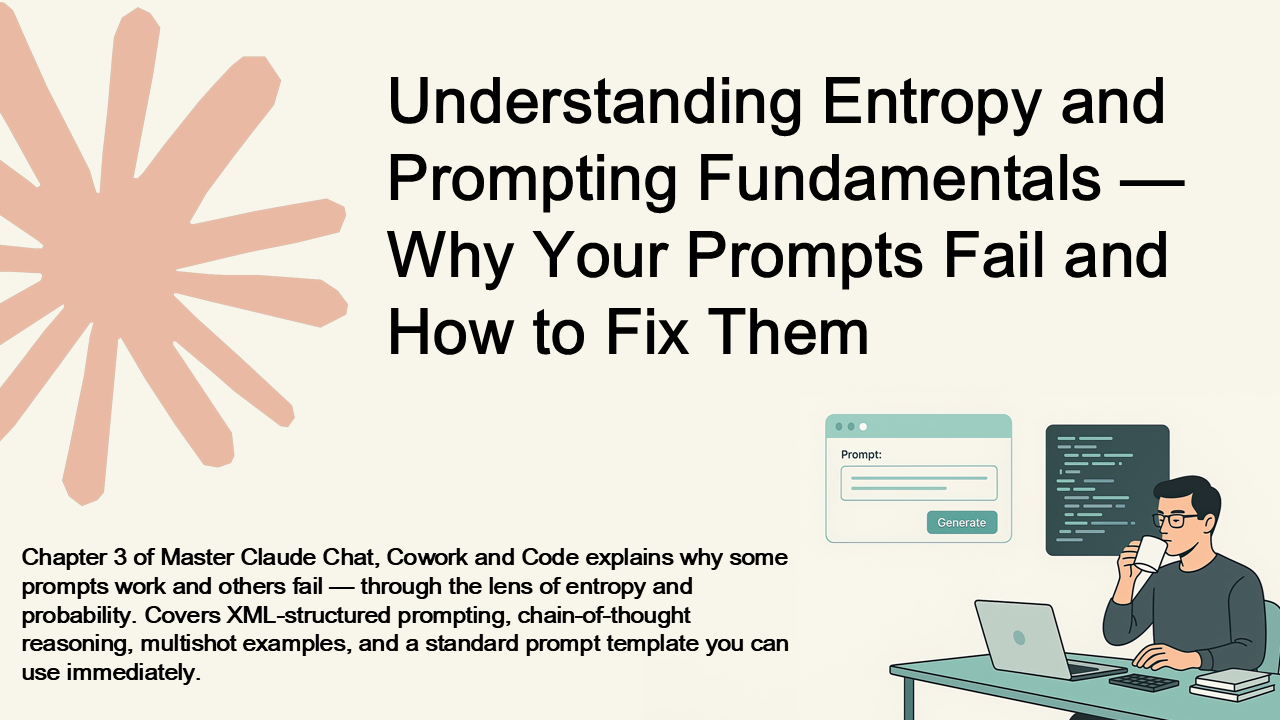
Master Claude, Chapter 3: Understanding Entropy and Prompting Fundamentals — Why Your Prompts Fail and How to Fix Them
Chapter 3 of Master Claude Chat, Cowork and Code explains why some prompts work and others fail — through the lens of entropy and probability. Covers XML-structured prompting, chain-of-thought reasoning, multishot examples, and a standard prompt template you can use immediately.
2026-03-04
Art of Coding, Part VI: The Human Side of Code
The human side of code: collaboration, culture, and the practices that make software sustainable. How teams thrive when they value people as much as process.
2026-01-11
Art of Coding, Part IV: Patterns, Anti-Patterns, and Architecture
Part IV explores design patterns as language, anti-patterns as warning signs, and architecture as the invisible skeleton enabling system growth.
2026-01-03

Art of Coding, Chapter 6: Abstraction and Modularity
Drawing boundaries that make systems stronger. How to abstract without over-engineering, and design interfaces that last.
2025-12-31
Art of Coding, Chapter 4: Maintainability and Scalability
How to build code that bends instead of breaks, systems that grow without collapsing, and anticipate change without over-engineering.
2025-12-28
Art of Coding, Chapter 3: Readability First
Readability first: how naming, structure, and visual rhythm make code habitable for teams and time.
2025-12-27
Art of Coding, Part II: Principles of Clarity
Part II introduces clarity as the compass of software: readability, maintainability, and the consistency that makes teams move faster.
2025-12-26
Art of Coding, Chapter 1: Code That Speaks
Chapter 1 of the Art of Coding series. Why beauty in code is not decoration but survival — clarity, empathy, efficiency, and what separates code that works from code that lasts. Plus: what AI-generated code means for craftsmanship.
2025-12-24

2.2 Machine Epsilon, Rounding, ULPs
A comprehensive, intuitive guide to machine epsilon, rounding behavior, and ULPs in floating-point arithmetic. Learn how precision limits shape numerical accuracy, how rounding errors arise, and why these concepts matter for AI, ML, and scientific computing.
2025-09-09
1.4 A Brief Tour of Real-World Failures
A clear, accessible tour of real-world numerical failures in AI, ML, optimization, and simulation—showing how mathematically correct algorithms break inside real computers, and preparing the reader for Chapter 2 on floating-point reality.
2025-09-06
Use Case: Project Management Assistant Bot|Mastering Microsoft Teams Bots 6.2
Explore how to build a Project Management Assistant Bot for Microsoft Teams that delivers task summaries, reminders, and updates directly in the chat. Learn how this bot improves team productivity by integrating with tools like Jira or Trello and surfacing key information within the Teams workflow.
2025-04-19
Monitoring, Logging, and Telemetry|Mastering Microsoft Teams Bots 5.3
Learn how to monitor and support your Microsoft Teams bot in production using logging, Azure Application Insights, and alerts. This section shows how to track user events, diagnose failures, and create telemetry that makes your bot reliable and supportable.
2025-04-17
Categories
Tags
Search Logs
Hello World bot 1182
IT assistant bot 1137
Deploy Teams bot to Azure 1132
Microsoft Bot Framework 1050
Teams bot development 1019
Teams production bot 1003
bot for sprint updates 988
Microsoft Teams Task Modules 975
Teams app zip 975
Zendesk Teams integration 974
Bot Framework Adaptive Card 968
Bot Framework example 959
Task Modules 954
Teams chatbot 953
Azure CLI webapp deploy 951
C 948
Teams bot tutorial 945
Teams bot packaging 943
Bot Framework proactive messaging 938
Graph API token 933
Bot Framework CLI 931
Adaptive Card Action.Submit 926
Bot Framework prompts 910
Microsoft Graph 905
Azure App Service bot 904
Azure Bot Services 882
Adaptive Cards 879
Azure bot registration 876
ServiceNow bot 865
proactive messages 813
Development & Technical Consulting
Working on a new product or exploring a technical idea? We help teams with system design, architecture reviews, requirements definition, proof-of-concept development, and full implementation. Whether you need a quick technical assessment or end-to-end support, feel free to reach out.
Contact Us