
{R}R Dev Notes
Found total of 66 articles.
The Forward Deployed Engineer, Chapter 19: The Future of Forward Deployment
Chapter 19 of The Forward Deployed Engineer blog series. The final chapter — the automation wave, what the AI FDE cannot do, the rise of FDE-as-a-Service, the talent market evolution, the customer wave, and the function's longer-term maturity. Plus a closing word, and the book.
2026-06-14
The Forward Deployed Engineer, Chapter 18: Hiring and Building the Bench
Chapter 18 of The Forward Deployed Engineer blog series. The FDE function is, in the end, a collection of people. A teaser on the hiring funnel, the four-round interview loop, compensation benchmarks ($170K–$600K+), onboarding, the career ladder, retention, and building a bench.
2026-06-13
The Forward Deployed Engineer, Chapter 17: Measuring Success with Outcome-Level Agreements
Chapter 17 of The Forward Deployed Engineer blog series. Standard SaaS metrics fail for the FDE function. A teaser on Outcome-Level Agreements (OLAs), the engagement dashboard, function-level metrics, building the dashboard, and the OLA as a strategic tool with customers.
2026-06-12
The Forward Deployed Engineer, Chapter 15: The Economics of Forward Deployment
Chapter 15 of The Forward Deployed Engineer blog series. The economic case for the FDE function — and the traps inside it. A teaser on the three pricing models, the impact on gross margin, the services-company trap, multi-year contracts, and what the math implies for founders.
2026-06-10
The Forward Deployed Engineer, Chapter 11: Palantir — The Original Playbook
Chapter 11 of The Forward Deployed Engineer blog series. The Palantir teardown — founding conditions, the Delta and Echo split, the long years of operational refinement, the AIP pivot, the AI FDE, and the three lessons for founders.
2026-06-06
The Forward Deployed Engineer, Chapter 10: Governance, Risk, and Safe Deployment
Chapter 10 of The Forward Deployed Engineer blog series. In regulated industries, governance is not a tax — it's a feature. A teaser on the risk taxonomy, audit trails, human-in-the-loop checkpoints, the EU AI Act, sector compliance, and the governance dashboard.
2026-06-05
The Forward Deployed Engineer, Chapter 3: Where the FDE Sits in the Org
Chapter 3 of The Forward Deployed Engineer blog series. The first organizational decision is also the most consequential — and the most often wrong. A teaser on the classification mistake, the pod structure, the seniority distribution, and the career-path problem that quietly kills FDE functions.
2026-05-29
The Forward Deployed Engineer, Chapter 2: The Last-Mile Problem in Enterprise AI
Chapter 2 of The Forward Deployed Engineer blog series. Where SaaS stopped at the enterprise threshold, AI has to walk the last mile. A teaser on the four frictions at the last mile, the integration tax no demo shows, and why workflow redesign — not the model — is the product.
2026-05-28
The Forward Deployed Engineer, Chapter 1: What Is a Forward Deployed Engineer?
Chapter 1 of The Forward Deployed Engineer blog series. The opening chapter of a new book — the operator's contradiction, the Palantir origin, the anatomy of the role, why the AI moment needs it now, and how the FDE differs from every sister role it gets confused with.
2026-05-27
The Engineering of Intent, Chapter 39: Impressionistic Scanning — A Visual Heuristic Guide
Chapter 39 of The Engineering of Intent blog series. Shape matters before content — especially for AI-generated code, where the agent is often blind to global shape. A teaser cheat sheet of six visual code shapes (wide-flat, deep-nesting, high-import-churn, long-thin, jagged, suspicious-uniformity) and what each one means.
2026-05-25
The Engineering of Intent, Chapter 37: Context Scaling — Just-In-Time Retrieval for Million-Line Codebases
Chapter 37 of The Engineering of Intent blog series. Hand-authored Context Packs don't scale past a million lines. A teaser on Just-In-Time Context, retrieval via MCP, the three governors that prevent runaway retrieval, and a concrete pipeline from a 3.8M-line codebase.
2026-05-23
The Engineering of Intent, Chapter 29: Vibe Coding in the Backend
Chapter 29 of The Engineering of Intent blog series. Backends are unusually well suited to agentic development — but each subdomain has characteristic failure modes. A teaser on API design, migrations, job idempotency, caching, auth, and the billing-service rewrite that shipped in four months via extraction rather than vibes.
2026-05-15
The Engineering of Intent, Chapter 21: Working With Teammates (Human and Agentic)
Chapter 21 of The Engineering of Intent blog series. Vibe Coding is only solo in the narrowest sense — every piece of code has reviewers and maintainers, some human, some agent. A teaser on the review contract, pair Vibe Coding, handing off to agents without walking off a cliff, and the explicit mentorship that still works in the AI-native era.
2026-05-07
The Engineering of Intent, Chapter 20: The Weekly Cadence
Chapter 20 of The Engineering of Intent blog series. Daily habits compound; weekly rituals keep the compounding honest. A teaser on the four weekly practices — the Friday Review, the Context Pack Audit, the Skill Refresh, and the Reading Hour — that separate sharp Vibe Coders from those who drift.
2026-05-06
The Engineering of Intent, Chapter 12: The GenDD Pod
Chapter 12 of The Engineering of Intent blog series. Three people, continuous flow, almost no ceremony — the team structure that actually ships AI-native work sustainably. A teaser on the Agentic Product Lead, Engineer, and QA roles, the transition from Agile, and the case study where a SaaS company went from 72 engineers to 24.
2026-04-28
The Engineering of Intent, Chapter 7: The GenDD Execution Loop
Chapter 7 of The Engineering of Intent blog series. Generative-Driven Development replaces your ceremony set with a fractal five-step loop: Context, Plan, Confirm, Execute, Validate. A teaser on each step, what goes wrong when it's skipped, and the payments team that cut one-hour cycles down to ten minutes.
2026-04-23
The Engineering of Intent, Chapter 6: Autonomous Orchestration Frameworks
Chapter 6 of The Engineering of Intent blog series. Editors run one agent at a time; orchestration runs many. A teaser on task-specific personalities, memory banks, when to orchestrate (and when not), the 14,000-test case study, and the economics of multi-agent pipelines.
2026-04-22
The Engineering of Intent, Chapter 5: Agentic Editors and Flow States
Chapter 5 of The Engineering of Intent blog series. The editor is where the wiring meets your hands. A teaser on the three generations of editor, how semantic search amplifies your codebase's virtues and vices, the flow killers that destroy productivity, and the shortcut rebind that doubled a team lead's output.
2026-04-21
The Engineering of Intent, Chapter 1: The Triadic Relationship Model
Chapter 1 of The Engineering of Intent blog series. Software used to be a dyad between engineer and machine. Now a third actor — the AI agent — has joined permanently. A teaser covering the Triadic Relationship Model, the CMDP view of software, and the six failure modes every AI-native team needs to name.
2026-04-17
Frictionless SaaS, Chapter 20: Organizational Design for Frictionless Delivery
The Experience Ownership Model and the Behavior Design Canvas — two reorganizations that stop user experience from falling through the cracks between departments.
2026-04-10
Frictionless SaaS, Chapter 19: Self-Serve Monetization and Growth
The Self-Serve Growth Engine, the Expansion Revenue Framework, and the Seamless Handoff Principle — how to turn upgrades into a natural moment instead of a sales call.
2026-04-09
Frictionless SaaS, Chapter 18: Building Knowledge Into Your Product
The Zero-Support Design Model, Contextual Help Architecture, and four AI Assistant Design Patterns that turn your product into its own best documentation.
2026-04-08
Frictionless SaaS, Chapter 17: Self-Serve Onboarding and Setup
Why self-serve setup converts 2-3x better than assisted onboarding, and the Progressive Setup Pattern and Smart Defaults Strategy that make complex products feel simple.
2026-04-07
Frictionless SaaS Chapter 16: The Power of Self-Service
Chapter 16 preview of Frictionless SaaS: the Self-Serve Maturity Model, the Independence Principle, and how self-serve billing and account management turn scalability into a competitive moat.
2026-04-06
Frictionless SaaS Chapter 14: Experience Observability and Friction Detection
Chapter 14 preview of Frictionless SaaS: experience observability, synthetic and real-user monitoring, and the friction detection engine that surfaces retention issues before they become churn.
2026-04-04
Frictionless SaaS Chapter 13: SaaS Metrics, Cohort Analysis, and the North Star
Chapter 13 preview of Frictionless SaaS: the SaaS Metrics Pyramid, Net Revenue Retention, cohort-based optimization, and how to choose a North Star that actually drives retention and revenue.
2026-04-03
Frictionless SaaS Chapter 9: Eliminating Friction and Building Consistency
Chapter 9 preview of Frictionless SaaS: the Friction Audit Matrix, the Consistency Principle, perceived speed, and information ergonomics - the retention levers most teams ignore.
2026-03-30

Frictionless SaaS, Chapter 8: Designing for Habit - Why Retention Is Your Real Growth Engine
Chapter 8 of the Frictionless SaaS blog series. Retention is the multiplier on every dollar of acquisition you'll ever spend. The Habit Loop Engine, the Return Reason Architecture, and the DAU/WAU signals that tell you whether you're building a habit or a one-night stand.
2026-03-29
Frictionless SaaS, Chapter 7: Behavioral Nudges - Guiding Users Without Nagging Them
Chapter 7 of the Frictionless SaaS blog series. How to build a behavioral nudge system that feels like a helpful friend instead of an annoying pop-up, and how the Re-engagement Cascade catches users before they fully churn - without spamming them.
2026-03-28
OpenClaw Engineering, Chapter 13: Hardening the Ecosystem
The final chapter: ecosystem security, the ClawHavoc incident, defending against malware in dependencies, confirming high-risk operations, and building auditing and disaster recovery systems.
2026-03-28
OpenClaw Engineering, Chapter 12: The Agentic Zero-Trust Architecture
Zero-trust security for autonomous agents: managing blast radius, implementing three-tier defense (pre-action, in-action, post-action), container isolation, and defending against indirect prompt injection attacks.
2026-03-27
OpenClaw Engineering, Chapter 11: Continuous Learning with OpenClaw-RL
How OpenClaw-RL extracts training signals from conversations and uses them to improve agent behavior continuously. From binary feedback to token-level distillation, agents learn from every interaction without retraining the base model.
2026-03-26
Chapter 19: Observability and Operations — Identity You Can Actually Run
Chapter 19 of the OpenID: Modern Identity series — observability and operations for identity systems: structured authentication logging with correlation IDs, distributed tracing of login flows, and immutable audit trails aligned to regulatory requirements.
2026-03-25
Chapter 17: Federation Between Organizations — Identity Across Corporate Boundaries
Chapter 17 of the OpenID: Modern Identity series — federation between organizations: B2B identity, partner federation with metadata exchange and claim mapping, and the trust chains that emerge when federation goes multi-hop.
2026-03-23
Chapter 20 – The Next Decade of AI Coworkers
Chapter 20 of Master Claude Chat, Cowork and Code looks ahead — from conversational AI to embedded infrastructure, from chat interfaces to computer use, and the trust and responsibility questions that will define how AI reshapes work over the next decade.
2026-03-20
Chapter 18 – Sub-Agents and Multi-Agent Collaboration
Chapter 18 of Master Claude Chat, Cowork and Code explores multi-agent architecture — how to decompose complex problems into specialized sub-agents, coordinate parallel execution, and synthesize results into coherent outputs.
2026-03-18
Chapter 17 – Guardrails and Governance
Chapter 17 of Master Claude Chat, Cowork and Code moves from understanding risks to implementing controls — permission isolation, tool allow-lists, human-in-the-loop approval workflows, validation hooks, and enterprise-grade audit logging.
2026-03-18
Chapter 16 – Execution Risks and Isolation
Chapter 16 of Master Claude Chat, Cowork and Code confronts the real security risks of AI systems that execute commands and manipulate files — from command injection to data exposure — and explains the isolation models that keep things safe.
2026-03-17
Chapter 11: MFA and Conditional Access — Dispersing Authentication Risk
Chapter 11 of the OpenID: Modern Identity series — MFA fundamentals across the three factor categories, risk-based adaptive authentication, and step-up authentication using the OIDC acr and amr claims to match assurance to operation sensitivity.
2026-03-17
Chapter 15 – Managing Context Rot and Entropy
Chapter 15 of Master Claude Chat, Cowork and Code tackles the silent failure mode of long-running AI sessions — context rot. Learn strategies for context compression, structured state management, and thinking like an operations team to keep Claude sharp over time.
2026-03-16
Chapter 10: Single Sign-On at Scale — Identity as Infrastructure
Chapter 10 of the OpenID: Modern Identity series — running identity at organizational scale: corporate IdPs (AD, Entra ID), the CIAM vendor ecosystem (Okta, Auth0, Entra ID), multi-tenant isolation, account linking, and external user access.
2026-03-16
Chapter 13: Encapsulating Knowledge with Agent Skills — From Conversations to Autonomous Procedures
Chapter 13 of Master Claude Chat, Cowork and Code introduces Skills — reusable, encapsulated procedures that Claude executes autonomously. Covers SKILL.md structure, YAML frontmatter, trigger descriptions, and the Skills Library pattern for team distribution.
2026-03-14
Chapter 7: Your First OpenID Application — The Handshake, End to End
Chapter 7 of the OpenID: Modern Identity series — building a real OIDC login end to end: the minimal flow, state and nonce, strict redirect URI matching, sessions from tokens, and the three flavors of logout.
2026-03-13
Chapter 8: Scheduled Tasks and Autonomous Execution — Making Claude Work While You Sleep
Chapter 8 of Master Claude Chat, Cowork and Code covers scheduled automation with Claude Cowork — cron-based recurring workflows, sleep/connectivity handling, error strategies, and applying GTD principles to AI task automation.
2026-03-09
Chapter 7: Plugins and Domain Specialization — Turning Claude Into Your Organization's Expert
Chapter 7 of Master Claude Chat, Cowork and Code explores how plugins transform Claude from a generalist into a domain expert — with pre-built plugins for Sales, Finance, Marketing, and Legal, slash commands, and organization-managed customization.
2026-03-08
OpenID: Modern Identity for Developers and Architects — A 22-Part Blog Series
Introduction and index for the 22-part blog series based on OpenID: Modern Identity for Developers and Architects by Sho Shimoda — with links to every chapter from Why Identity Is Hard through Identity in AI Systems.
2026-03-06
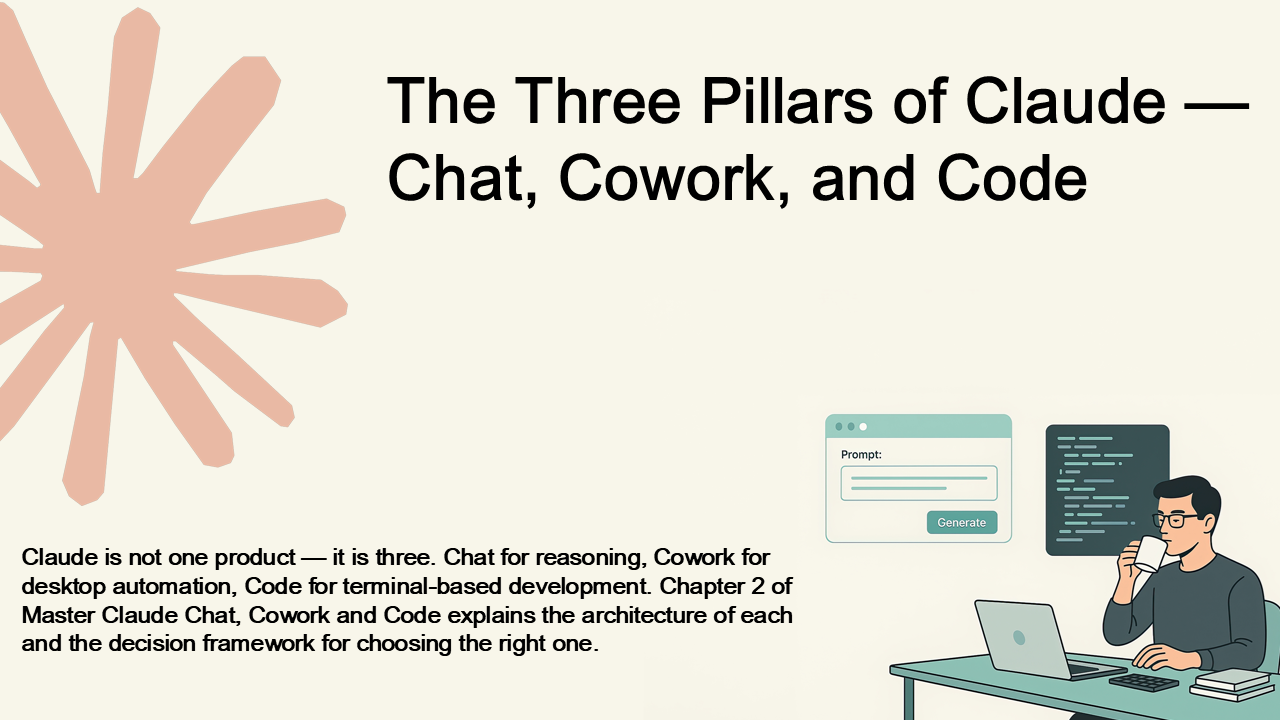
Master Claude, Chapter 2: The Three Pillars of Claude — Chat, Cowork, and Code
Claude is not one product — it is three. Chat for reasoning, Cowork for desktop automation, Code for terminal-based development. Chapter 2 of Master Claude Chat, Cowork and Code explains the architecture of each and the decision framework for choosing the right one.
2026-03-03
Art of Coding, Chapter 17: AI, Automation, and the Role of the Engineer
How AI changes engineering roles. Why automation removes drudgery but makes human judgment more valuable, and what "curation" means for the future programmer.
2026-01-15
Art of Coding, Chapter 7: Error Handling and Resilience
Designing for failure, not avoiding it. How graceful error handling, clear logging, and balanced defense build systems that endure.
2026-01-01

Art of Coding, Chapter 6: Abstraction and Modularity
Drawing boundaries that make systems stronger. How to abstract without over-engineering, and design interfaces that last.
2025-12-31
Categories
Tags
Search Logs
Hello World bot 1227
IT assistant bot 1201
Deploy Teams bot to Azure 1199
Microsoft Bot Framework 1098
Teams bot development 1079
Teams production bot 1070
bot for sprint updates 1053
Zendesk Teams integration 1040
Teams app zip 1037
Microsoft Teams Task Modules 1021
Teams chatbot 1015
Bot Framework Adaptive Card 1011
Teams bot tutorial 1002
Bot Framework example 1000
Task Modules 999
Teams bot packaging 993
Bot Framework proactive messaging 989
C 988
Graph API token 982
Azure CLI webapp deploy 975
Bot Framework CLI 969
Bot Framework prompts 960
Adaptive Card Action.Submit 957
Azure App Service bot 948
Microsoft Graph 930
Azure Bot Services 925
Adaptive Cards 902
Azure bot registration 898
ServiceNow bot 897
identity in Teams 864
Development & Technical Consulting
Working on a new product or exploring a technical idea? We help teams with system design, architecture reviews, requirements definition, proof-of-concept development, and full implementation. Whether you need a quick technical assessment or end-to-end support, feel free to reach out.
Contact Us