
{R}R 開発ノート
合計 61 件の記事が見つかりました。
The Engineering of Intent, Chapter 4: The Model Context Protocol (MCP)
Chapter 4 of The Engineering of Intent blog series. MCP is to agents what HTTP was to the early Web — a common protocol that turns bespoke integrations into reusable infrastructure. A teaser on host/client/server roles, the anatomy of a good tool, the six anti-patterns, and the security pitfalls every team trips over.
2026-04-20
The Engineering of Intent, Chapter 3: Context Momentum and Path Dependence
Chapter 3 of The Engineering of Intent blog series. Agents amplify project momentum — good patterns propagate, bad ones propagate just as fast. A teaser on the First Prompt Trap, context rot, the physics of convention drift, and the ten-thousand-dollar rule for decision rigor.
2026-04-19
Frictionless SaaS, Chapter 24: Anti-Patterns and Failure Modes
The last chapter of Frictionless SaaS is about the mistakes teams keep making, even when they know better. A teaser covering the Anti-Pattern Registry, the Feature Trap, and the additional failure modes that quietly erode good products.
2026-04-14
Frictionless SaaS, Chapter 22: AI, Automation, and the Future of Frictionless Design
In the AI era, features are commoditized overnight. So what actually becomes defensible? A teaser for Chapter 22 of Frictionless SaaS, covering the AI-Era SaaS Framework and the Experience Moat — the only lasting competitive advantage left.
2026-04-12
Frictionless SaaS, Chapter 20: Organizational Design for Frictionless Delivery
The Experience Ownership Model and the Behavior Design Canvas — two reorganizations that stop user experience from falling through the cracks between departments.
2026-04-10
Frictionless SaaS Chapter 16: The Power of Self-Service
Chapter 16 preview of Frictionless SaaS: the Self-Serve Maturity Model, the Independence Principle, and how self-serve billing and account management turn scalability into a competitive moat.
2026-04-06
Frictionless SaaS Chapter 14: Experience Observability and Friction Detection
Chapter 14 preview of Frictionless SaaS: experience observability, synthetic and real-user monitoring, and the friction detection engine that surfaces retention issues before they become churn.
2026-04-04
Frictionless SaaS Chapter 9: Eliminating Friction and Building Consistency
Chapter 9 preview of Frictionless SaaS: the Friction Audit Matrix, the Consistency Principle, perceived speed, and information ergonomics - the retention levers most teams ignore.
2026-03-30
OpenClaw Engineering, Chapter 11: Continuous Learning with OpenClaw-RL
How OpenClaw-RL extracts training signals from conversations and uses them to improve agent behavior continuously. From binary feedback to token-level distillation, agents learn from every interaction without retraining the base model.
2026-03-26
OpenClaw Engineering, Chapter 9: Scheduling and Deterministic Orchestration
Time-based automation for agents: cron jobs for simple periodic tasks and the Lobster workflow engine for complex, deterministic, resumable multi-step pipelines with human approval gates.
2026-03-24
OpenClaw Engineering, Chapter 8: Event-Driven Workflows
How OpenClaw agents spring into action automatically via hooks, webhooks, and TypeScript handlers—without waiting for human invocation. From internal events to CI/CD pipelines.
2026-03-23
OpenClaw Engineering, Chapter 6: Extending Capabilities with SKILL.md
The anatomy of SKILL.md files in OpenClaw: how to author reusable, versioned instruction sets with YAML frontmatter, dependencies, and explicit procedural guidance for agents.
2026-03-21
OpenClaw Engineering, Chapter 5: Connecting Multiple Channels
How to connect your OpenClaw agent to multiple messaging platforms (Telegram, WhatsApp, Discord, Slack) and manage multi-channel routing. Setup, configuration quirks, and troubleshooting for each platform.
2026-03-20
Chapter 19 – Measuring AI Effectiveness
Chapter 19 of Master Claude Chat, Cowork and Code tackles the question every team eventually asks: is our AI actually working? Learn to build metrics frameworks, structured evaluations, and workflow acceleration measurements that prove (or disprove) AI's value.
2026-03-19
OpenClaw Engineering, Chapter 4: Managing the Gateway and Models
Configuring your running gateway with the onboard wizard, diagnostics, and openclaw.json. How to connect model providers, manage API keys securely, and route different queries to different models.
2026-03-19
Chapter 13: Threat Modeling OpenID Systems — Thinking Like the Adversary
Chapter 13 of the OpenID: Modern Identity series — threat modeling for OIDC systems: token theft vectors and defenses, replay attacks and nonce validation, CSRF and state parameter mismanagement, redirect abuse and mix-up attacks.
2026-03-19
Chapter 18 – Sub-Agents and Multi-Agent Collaboration
Chapter 18 of Master Claude Chat, Cowork and Code explores multi-agent architecture — how to decompose complex problems into specialized sub-agents, coordinate parallel execution, and synthesize results into coherent outputs.
2026-03-18
Chapter 15 – Managing Context Rot and Entropy
Chapter 15 of Master Claude Chat, Cowork and Code tackles the silent failure mode of long-running AI sessions — context rot. Learn strategies for context compression, structured state management, and thinking like an operations team to keep Claude sharp over time.
2026-03-16
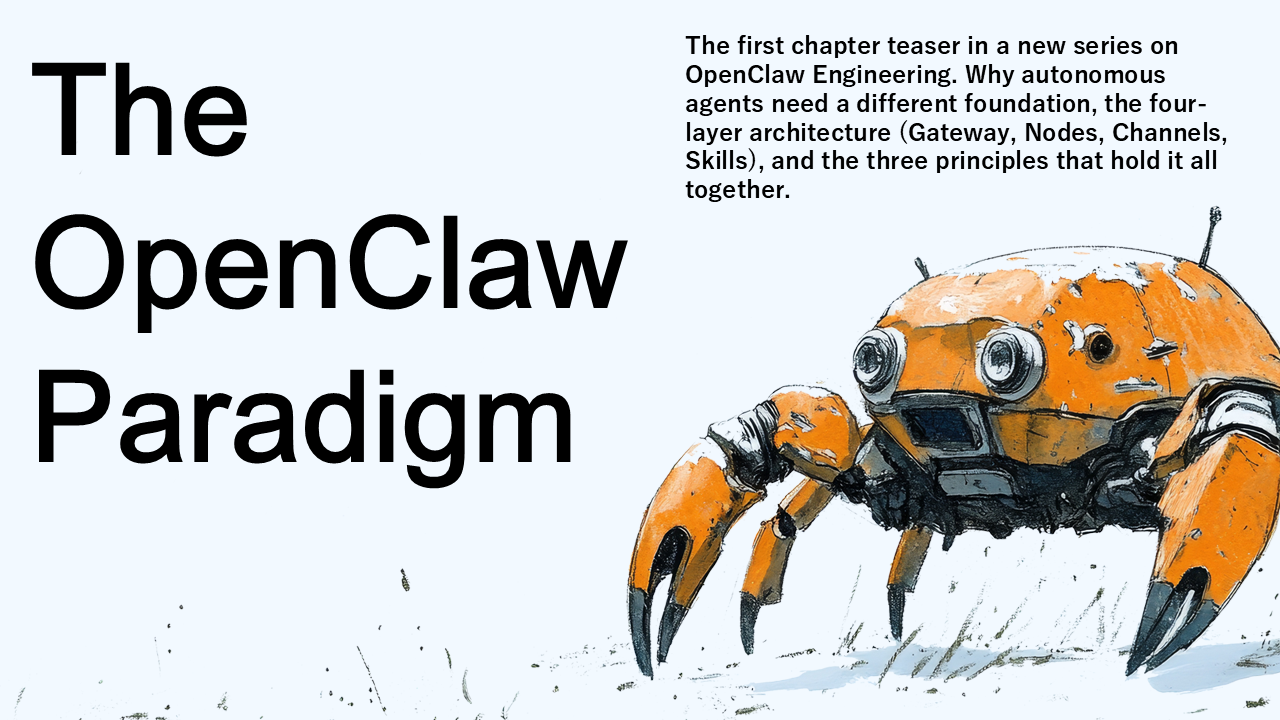
OpenClaw Engineering, Chapter 1: The OpenClaw Paradigm
The first chapter teaser in a new series on OpenClaw Engineering. Why autonomous agents need a different foundation, the four-layer architecture (Gateway, Nodes, Channels, Skills), and the three principles that hold it all together.
2026-03-16
Chapter 13: Encapsulating Knowledge with Agent Skills — From Conversations to Autonomous Procedures
Chapter 13 of Master Claude Chat, Cowork and Code introduces Skills — reusable, encapsulated procedures that Claude executes autonomously. Covers SKILL.md structure, YAML frontmatter, trigger descriptions, and the Skills Library pattern for team distribution.
2026-03-14
Chapter 12: CLAUDE.md — Designing Guardrails That Shape How Claude Thinks
Chapter 12 of Master Claude Chat, Cowork and Code explores CLAUDE.md as a living constitution for AI behavior — positive constraints over prohibitions, complete financial and startup examples, instruction decay, hierarchical files, and anti-patterns to avoid.
2026-03-13
Chapter 11: CI/CD Integration and Automation — Claude Code in Your Pipeline
Chapter 11 of Master Claude Chat, Cowork and Code shows how to deploy Claude Code into CI/CD pipelines — GitHub Actions, GitLab CI, automated PR reviews, security audits, documentation sync, cost management, and production safety patterns.
2026-03-12
Chapter 10: Safe Legacy Code Refactoring — Horror Stories and the Discipline That Prevents Them
Chapter 10 of Master Claude Chat, Cowork and Code tackles the hardest problem in AI-assisted development — refactoring legacy code without introducing subtle bugs. Covers characterization tests, incremental verification, PR review, and catching hallucinations.
2026-03-11
Chapter 9: Claude Code Fundamentals — The CLI Agent That Rewrites Your Codebase
Chapter 9 of Master Claude Chat, Cowork and Code introduces Claude Code — a CLI agent that reads, analyzes, and modifies codebases directly from the terminal. Covers architecture, multi-file refactoring, Git worktrees, and permission management.
2026-03-10
Chapter 8: Scheduled Tasks and Autonomous Execution — Making Claude Work While You Sleep
Chapter 8 of Master Claude Chat, Cowork and Code covers scheduled automation with Claude Cowork — cron-based recurring workflows, sleep/connectivity handling, error strategies, and applying GTD principles to AI task automation.
2026-03-09
Master Claude, Chapter 4: Context Persistence with Claude Projects — Solving the AI Amnesia Problem
Chapter 4 of Master Claude Chat, Cowork and Code explains how Claude Projects solve the AI amnesia problem with persistent context — custom instructions, knowledge bases, and shared team workspaces that remember your architecture, conventions, and patterns across every conversation.
2026-03-05
Master Claude, Chapter 2: The Three Pillars of Claude — Chat, Cowork, and Code
Claude is not one product — it is three. Chat for reasoning, Cowork for desktop automation, Code for terminal-based development. Chapter 2 of Master Claude Chat, Cowork and Code explains the architecture of each and the decision framework for choosing the right one.
2026-03-03
Master Claude, Chapter 1: The Evolution of Large Language Models — From Markov Chains to Context Engineering
Chapter 1 of Master Claude Chat, Cowork and Code traces the journey from statistical text prediction to reasoning engines — and explains why context engineering, not bigger models, is where the next leap in AI productivity comes from.
2026-03-02
Art of Coding, Chapter 19: Why I Still Code
The final chapter. A personal reflection on why the act of writing code remains meaningful—and why craftsmanship endures even as everything else changes.
2026-01-17
Art of Coding, Chapter 16: Ethics and Longevity
How ethics and longevity intertwine in code. Why the systems you write today remain your responsibility for years, and how empathy shapes sustainable software.
2026-01-13
Art of Coding, Chapter 12: Version Control as a Storytelling Tool
Git is not just a backup system—it's a narrative tool. How clean commits and thoughtful branching strategies turn version control into a form of storytelling.
2026-01-08
Art of Coding, Chapter 8: Performance without Sacrificing Clarity
Chasing speed too early blinds you to real bottlenecks. Clarity first, measurement second, optimization third—that's the order.
2026-01-02
Art of Coding, Chapter 7: Error Handling and Resilience
Designing for failure, not avoiding it. How graceful error handling, clear logging, and balanced defense build systems that endure.
2026-01-01
Art of Coding, Chapter 6: Abstraction and Modularity
Drawing boundaries that make systems stronger. How to abstract without over-engineering, and design interfaces that last.
2025-12-31
Art of Coding, Part III: Practices That Shape Good Code
From principles to practice. How daily habits, small decisions, and repeated choices shape code that actually endures.
2025-12-30
8.3 The QR Algorithm (High-Level Intuition)
A clear, intuitive, and comprehensive explanation of the QR algorithm—how repeated QR factorizations reveal eigenvalues, why orthogonal transformations provide stability, and how shifts and Hessenberg reductions make the method efficient. Ends with a smooth bridge to PCA and spectral methods.
2025-10-09
7.4 Why QR Is Often Preferred
An in-depth, accessible explanation of why QR decomposition is the preferred method for solving least squares problems and ensuring numerical stability. Covers orthogonality, rank deficiency, Householder reflections, and the broader role of QR in scientific computing, with a smooth transition into eigenvalues and eigenvectors.
2025-10-05
7.2 Householder Reflections
A clear, intuitive, book-length explanation of Householder reflections and why they form the foundation of modern QR decomposition. Learn how reflections overcome the numerical instability of Gram–Schmidt and enable stable least-squares solutions across ML, statistics, and scientific computing.
2025-10-03
7.1 Gram–Schmidt and Modified GS
A clear, practical, book-length explanation of Gram–Schmidt and Modified Gram–Schmidt, why classical GS fails in floating-point arithmetic, how MGS improves stability, and why real numerical systems eventually rely on Householder reflections. Ideal for ML engineers, data scientists, and numerical computing practitioners.
2025-10-02
Chapter 7 — QR Decomposition
A deep, intuitive introduction to QR decomposition, explaining why orthogonality and numerical stability make QR essential for least squares, regression, kernel methods, and large-scale computation. Covers Gram–Schmidt, Modified GS, Householder reflections, and why QR is often preferred over LU and normal equations.
2025-10-01
5.3 LU in NumPy and LAPACK
A practical, in-depth guide to how LU decomposition is implemented in NumPy and LAPACK. Learn about partial pivoting, blocked algorithms, BLAS optimization, error handling, and how modern numerical libraries achieve both speed and stability.
2025-09-25
5.2 Numerical Pitfalls
A deep, accessible explanation of the numerical pitfalls in LU decomposition. Learn about growth factors, tiny pivots, rounding errors, catastrophic cancellation, ill-conditioning, and why LU may silently produce incorrect results without proper pivoting and numerical care.
2025-09-24
5.1 LU with and without Pivoting
A clear and practical explanation of LU decomposition with and without pivoting. Learn why pivoting is essential, how partial and complete pivoting work, where no-pivot LU fails, and why modern numerical libraries rely on pivoted LU for stability.
2025-09-23
Chapter 5 — LU Decomposition
An in-depth, accessible introduction to LU decomposition—why it matters, how it improves on Gaussian elimination, where pivoting fits in, and what modern numerical libraries like NumPy and LAPACK do under the hood. Includes a guide to stability, practical applications, and a smooth transition into LU with and without pivoting.
2025-09-22
4.4 When Elimination Fails
An in-depth, practical explanation of why Gaussian elimination fails in real numerical systems—covering zero pivots, instability, ill-conditioning, catastrophic cancellation, and singular matrices—and how these failures motivate the move to LU decomposition.
2025-09-21
4.3 Pivoting Strategies
A practical and intuitive guide to pivoting strategies in numerical linear algebra, explaining partial, complete, and scaled pivoting and why pivoting is essential for stable Gaussian elimination and reliable LU decomposition.
2025-09-20
4.1 Gaussian Elimination Revisited
A deep, intuitive exploration of Gaussian elimination as it actually behaves inside floating-point arithmetic. Learn why the textbook algorithm fails in practice, how instability emerges, why pivoting is essential, and how elimination becomes reliable through matrix transformations.
2025-09-18
4.0 Solving Ax = b
A deep, accessible introduction to solving linear systems in numerical computing. Learn why Ax = b sits at the center of AI, ML, optimization, and simulation, and explore Gaussian elimination, pivoting, row operations, and failure modes through intuitive explanations.
2025-09-17

3.4 Exact Algorithms vs Implemented Algorithms
Learn why textbook algorithms differ from the versions that actually run on computers. This chapter explains rounding, floating-point errors, instability, algorithmic reformulation, and why mathematically equivalent methods behave differently in AI, ML, and scientific computing.
2025-09-16
3.3 Conditioning of Problems vs Stability of Algorithms
Learn the critical difference between problem conditioning and algorithmic stability in numerical computing. Understand why some systems fail even with correct code, and how sensitivity, condition numbers, and numerical stability determine the reliability of AI, ML, and scientific algorithms.
2025-09-15
カテゴリー
タグ
検索ログ
Hello World bot 1021
Deploy Teams bot to Azure 964
IT assistant bot 948
Microsoft Bot Framework 925
Azure CLI webapp deploy 873
Teams bot development 842
Teams production bot 840
Adaptive Card Action.Submit 836
bot for sprint updates 824
Bot Framework Adaptive Card 823
Microsoft Teams Task Modules 821
Bot Framework example 818
C 817
Microsoft Graph 817
Teams app zip 816
Teams chatbot 808
Zendesk Teams integration 808
Graph API token 806
Task Modules 804
Bot Framework proactive messaging 803
Adaptive Cards 802
Teams bot packaging 800
Teams bot tutorial 797
Azure Bot Services 794
Bot Framework CLI 791
Azure App Service bot 790
Bot Framework prompts 781
Azure bot registration 780
ServiceNow bot 771
proactive messages 741
Development & Technical Consulting
Working on a new product or exploring a technical idea? We help teams with system design, architecture reviews, requirements definition, proof-of-concept development, and full implementation. Whether you need a quick technical assessment or end-to-end support, feel free to reach out.
Contact Us