
{R}R Dev Notes
Found total of 80 articles.
The Engineering of Intent, Chapter 38: Multi-Agent Conflict Resolution — Protocols for Agentic Tie-Breaking
Chapter 38 of The Engineering of Intent blog series. When multiple specialized agents block the same PR with incompatible demands, the answer is a protocol for Agentic Tie-Breaking. A teaser on triaging stacked concerns vs. real conflicts, three resolution protocols, Architect Agent design, and the four governance failure modes.
2026-05-24
The Engineering of Intent, Chapter 31: Vibe Coding in Data and ML
Chapter 31 of The Engineering of Intent blog series. Data and ML work is where AI-native velocity meets statistical thinking and slow feedback loops. A teaser on ETL graduated rollout, feature-leakage guards, model evaluation boundaries, and the churn-pipeline case study that split build-time (8 days) from validation-time (weeks).
2026-05-17
The Engineering of Intent, Chapter 26: Checklists for the Working Engineer
Chapter 26 of The Engineering of Intent blog series. Six one-page checklists I reach for mid-task — new feature, PR, deploy, post-incident, Context Pack health, and interview. A teaser on why checklists are most valuable when you're most confident you don't need them.
2026-05-12
Azure Front Door: a practical introduction
What Azure Front Door is, who it's for, what it costs, how it compares to Cloudflare and CloudFront, and a walkthrough of the settings that matter when putting it in front of an Azure App Service.
2026-05-11
The Engineering of Intent, Chapter 19: The End-of-Day Routine
Chapter 19 of The Engineering of Intent blog series. The last twenty minutes of your workday set up tomorrow. A teaser on the five-step end-of-day routine — handoff note, convention update, lesson capture, open-loop closure, and tomorrow's first task — plus the "one more thing" anti-pattern that undoes all of it.
2026-05-05
The Engineering of Intent, Chapter 8: The Four Pillars of AI Architecture
Chapter 8 of The Engineering of Intent blog series. Every durable AI-native project has the same four pillars — Vibes, Specs, Skills, and Agents — and most teams over-invest in one and neglect the rest. A teaser on the pillars, the healthy cycle, and the rebalancing that cut a company's regression rate by 80%.
2026-04-24
The Engineering of Intent, Chapter 7: The GenDD Execution Loop
Chapter 7 of The Engineering of Intent blog series. Generative-Driven Development replaces your ceremony set with a fractal five-step loop: Context, Plan, Confirm, Execute, Validate. A teaser on each step, what goes wrong when it's skipped, and the payments team that cut one-hour cycles down to ten minutes.
2026-04-23
The Engineering of Intent, Chapter 3: Context Momentum and Path Dependence
Chapter 3 of The Engineering of Intent blog series. Agents amplify project momentum — good patterns propagate, bad ones propagate just as fast. A teaser on the First Prompt Trap, context rot, the physics of convention drift, and the ten-thousand-dollar rule for decision rigor.
2026-04-19
Frictionless SaaS, Chapter 22: AI, Automation, and the Future of Frictionless Design
In the AI era, features are commoditized overnight. So what actually becomes defensible? A teaser for Chapter 22 of Frictionless SaaS, covering the AI-Era SaaS Framework and the Experience Moat — the only lasting competitive advantage left.
2026-04-12
Frictionless SaaS, Chapter 18: Building Knowledge Into Your Product
The Zero-Support Design Model, Contextual Help Architecture, and four AI Assistant Design Patterns that turn your product into its own best documentation.
2026-04-08
Frictionless SaaS, Chapter 17: Self-Serve Onboarding and Setup
Why self-serve setup converts 2-3x better than assisted onboarding, and the Progressive Setup Pattern and Smart Defaults Strategy that make complex products feel simple.
2026-04-07
Frictionless SaaS Chapter 15: Continuous Optimization and the Data-Intuition Balance
Chapter 15 preview of Frictionless SaaS: the Experiment-Learn-Ship cycle, the Data-Intuition Balance, staged rollouts, and the retention operating model that turns improvement into a flywheel.
2026-04-05
Frictionless SaaS Chapter 12: Detecting Disengagement and Structured Win-Back
Chapter 12 preview of Frictionless SaaS: the Disengagement Detection System, the four-touch Win-Back Sequence, and why value rediscovery beats discount offers every time.
2026-04-02
Frictionless SaaS Chapter 11: Lifecycle Messaging and Engagement
Chapter 11 preview of Frictionless SaaS: the Lifecycle Messaging Architecture, the Message-Moment Fit Principle, and the Customer Feedback Loop Framework for turning communication into a retention engine.
2026-04-01
Frictionless SaaS Chapter 9: Eliminating Friction and Building Consistency
Chapter 9 preview of Frictionless SaaS: the Friction Audit Matrix, the Consistency Principle, perceived speed, and information ergonomics - the retention levers most teams ignore.
2026-03-30

Frictionless SaaS, Chapter 8: Designing for Habit - Why Retention Is Your Real Growth Engine
Chapter 8 of the Frictionless SaaS blog series. Retention is the multiplier on every dollar of acquisition you'll ever spend. The Habit Loop Engine, the Return Reason Architecture, and the DAU/WAU signals that tell you whether you're building a habit or a one-night stand.
2026-03-29
Chapter 17: Federation Between Organizations — Identity Across Corporate Boundaries
Chapter 17 of the OpenID: Modern Identity series — federation between organizations: B2B identity, partner federation with metadata exchange and claim mapping, and the trust chains that emerge when federation goes multi-hop.
2026-03-23
Frictionless SaaS, Chapter 1: Silent Churn — The Users Who Leave Without Complaining
Chapter 1 of the Frictionless SaaS blog series. Silent churn is the most dangerous kind of churn — users who sign up, disappear, and never tell you why. A look at the Silent Churn Pattern and the Activation Gap.
2026-03-22
OpenClaw Engineering, Chapter 7: The Skill Ecosystem
Bundled skills vs workspace skills, skill discovery and context, publishing to ClawHub, managing 13,000+ community skills without collision, semantic search, and the meta-skills that let agents improve themselves.
2026-03-22
OpenClaw Engineering, Chapter 6: Extending Capabilities with SKILL.md
The anatomy of SKILL.md files in OpenClaw: how to author reusable, versioned instruction sets with YAML frontmatter, dependencies, and explicit procedural guidance for agents.
2026-03-21
Frictionless SaaS, Part 0: How Users Actually Find, Judge, and Try Your Product
Kicking off a blog series based on the book "Frictionless SaaS." This first post introduces Chapters 0.1 through 0.3 — Discovery, the Landing Page, and Freemium & Entry Points — the three friction points every user hits before they ever sign up.
2026-03-21
Chapter 14: Hardening Your Identity Stack — Setting the Defaults That Keep You Safe
Chapter 14 of the OpenID: Modern Identity series — hardening defaults that neutralize common attacks: strict redirect URI matching, audience validation to solve the confused deputy problem, token lifetime tuning, and refresh token binding, rotation, and revocation.
2026-03-20
OpenClaw Engineering, Chapter 5: Connecting Multiple Channels
How to connect your OpenClaw agent to multiple messaging platforms (Telegram, WhatsApp, Discord, Slack) and manage multi-channel routing. Setup, configuration quirks, and troubleshooting for each platform.
2026-03-20
Chapter 12: User Lifecycle Management — Provisioning, SCIM, and the De-Provisioning Problem
Chapter 12 of the OpenID: Modern Identity series — user lifecycle management: JIT and bulk provisioning, SCIM for cross-system sync, de-provisioning done right, role mapping from IdP claims, and identity architecture for multi-tenant SaaS.
2026-03-18
Chapter 11: MFA and Conditional Access — Dispersing Authentication Risk
Chapter 11 of the OpenID: Modern Identity series — MFA fundamentals across the three factor categories, risk-based adaptive authentication, and step-up authentication using the OIDC acr and amr claims to match assurance to operation sensitivity.
2026-03-17
Chapter 10: Single Sign-On at Scale — Identity as Infrastructure
Chapter 10 of the OpenID: Modern Identity series — running identity at organizational scale: corporate IdPs (AD, Entra ID), the CIAM vendor ecosystem (Okta, Auth0, Entra ID), multi-tenant isolation, account linking, and external user access.
2026-03-16
Chapter 8: Securing Backend APIs — Bearer Tokens, Scopes, and Service-to-Service
Chapter 8 of the OpenID: Modern Identity series — securing backend APIs with bearer tokens, scope design for least privilege, token introspection versus local JWT validation, and the three mechanisms for service-to-service authentication.
2026-03-14
Chapter 6: Discovery and Metadata — How Clients and Providers Find Each Other
Chapter 6 of the OpenID: Modern Identity series — how OIDC discovery, .well-known/openid-configuration, JWKS, and Dynamic Client Registration allow clients and providers to find each other without hand-crafted configuration.
2026-03-12
Chapter 5: Tokens in Depth — What's Actually in That JWT
Chapter 5 of the OpenID: Modern Identity series — what's really inside an ID Token, Access Token, and Refresh Token, how JWTs are structured, how to validate signatures correctly, and how DPoP and mTLS bind tokens to their legitimate holders.
2026-03-11
Chapter 3: Core Concepts — The Vocabulary of OpenID Connect
Chapter 3 of the OpenID: Modern Identity series — the IdP/RP/user triangle, claims and JWTs, the three OIDC token types, consent and scopes, sessions vs tokens, and the boundary between authentication and authorization.
2026-03-09
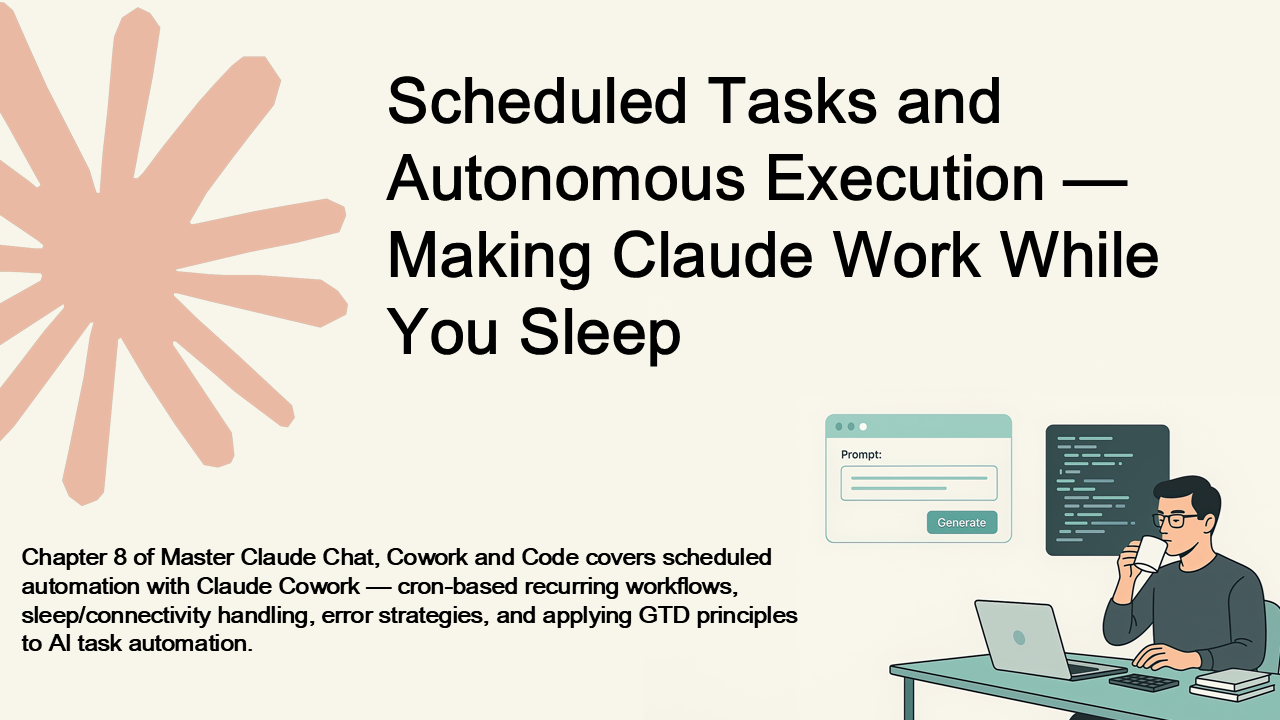
Chapter 8: Scheduled Tasks and Autonomous Execution — Making Claude Work While You Sleep
Chapter 8 of Master Claude Chat, Cowork and Code covers scheduled automation with Claude Cowork — cron-based recurring workflows, sleep/connectivity handling, error strategies, and applying GTD principles to AI task automation.
2026-03-09
Chapter 2: From OpenID to OpenID Connect — How the Industry Got This One Right
Chapter 2 of the OpenID: Modern Identity series — tracing how the industry moved from the original OpenID and SAML through OAuth 2.0 to OpenID Connect, and when to reach for each standard.
2026-03-08
Chapter 1: Why Identity Is Hard — The Trust Problem Behind Every Login
Chapter 1 of the OpenID: Modern Identity book series — why identity is a trust problem first and a technology problem second, and why authentication and authorization must never be conflated.
2026-03-07
OpenID: Modern Identity for Developers and Architects — A 22-Part Blog Series
Introduction and index for the 22-part blog series based on OpenID: Modern Identity for Developers and Architects by Sho Shimoda — with links to every chapter from Why Identity Is Hard through Identity in AI Systems.
2026-03-06
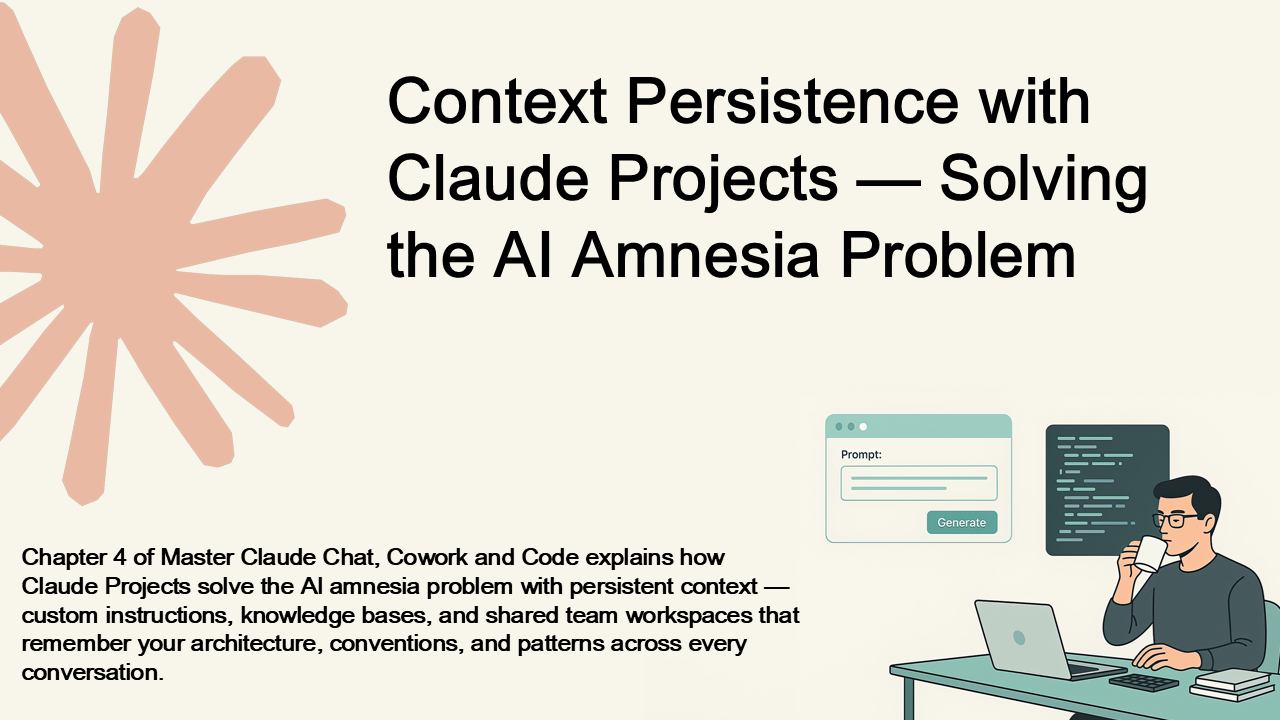
Master Claude, Chapter 4: Context Persistence with Claude Projects — Solving the AI Amnesia Problem
Chapter 4 of Master Claude Chat, Cowork and Code explains how Claude Projects solve the AI amnesia problem with persistent context — custom instructions, knowledge bases, and shared team workspaces that remember your architecture, conventions, and patterns across every conversation.
2026-03-05
Art of Coding, Chapter 8: Performance without Sacrificing Clarity
Chasing speed too early blinds you to real bottlenecks. Clarity first, measurement second, optimization third—that's the order.
2026-01-02
Art of Coding, Chapter 7: Error Handling and Resilience
Designing for failure, not avoiding it. How graceful error handling, clear logging, and balanced defense build systems that endure.
2026-01-01

Art of Coding, Chapter 6: Abstraction and Modularity
Drawing boundaries that make systems stronger. How to abstract without over-engineering, and design interfaces that last.
2025-12-31
Art of Coding, Chapter 2: The Philosophy of Clean Code
Clean code is a philosophy, not a rulebook. Explore simplicity vs. cleverness, expressiveness as communication, and code as a form of writing.
2025-12-25
Art of Coding, Chapter 1: Code That Speaks
Chapter 1 of the Art of Coding series. Why beauty in code is not decoration but survival — clarity, empathy, efficiency, and what separates code that works from code that lasts. Plus: what AI-generated code means for craftsmanship.
2025-12-24
8.4 PCA and Spectral Methods
An intuitive, in-depth explanation of PCA, spectral clustering, and eigenvector-based data analysis. Covers covariance matrices, graph Laplacians, and why eigenvalues reveal hidden structure in data. Concludes Chapter 8 and leads naturally into SVD in Chapter 9.
2025-10-10
8.3 The QR Algorithm (High-Level Intuition)
A clear, intuitive, and comprehensive explanation of the QR algorithm—how repeated QR factorizations reveal eigenvalues, why orthogonal transformations provide stability, and how shifts and Hessenberg reductions make the method efficient. Ends with a smooth bridge to PCA and spectral methods.
2025-10-09
Chapter 8 — Eigenvalues and Eigenvectors
A deep, intuitive introduction to eigenvalues and eigenvectors for engineers and practitioners. Explains why spectral methods matter, where they appear in real systems, and how modern numerical algorithms compute eigenvalues efficiently. Leads naturally into the power method and inverse iteration.
2025-10-06
7.4 Why QR Is Often Preferred
An in-depth, accessible explanation of why QR decomposition is the preferred method for solving least squares problems and ensuring numerical stability. Covers orthogonality, rank deficiency, Householder reflections, and the broader role of QR in scientific computing, with a smooth transition into eigenvalues and eigenvectors.
2025-10-05
7.3 Least Squares Problems
A clear, intuitive, book-length explanation of least squares problems, including the geometry, normal equations, QR decomposition, and SVD. Learn why least-squares solutions are central to ML and data science, and why QR provides a stable foundation for practical algorithms.
2025-10-04
7.2 Householder Reflections
A clear, intuitive, book-length explanation of Householder reflections and why they form the foundation of modern QR decomposition. Learn how reflections overcome the numerical instability of Gram–Schmidt and enable stable least-squares solutions across ML, statistics, and scientific computing.
2025-10-03
7.1 Gram–Schmidt and Modified GS
A clear, practical, book-length explanation of Gram–Schmidt and Modified Gram–Schmidt, why classical GS fails in floating-point arithmetic, how MGS improves stability, and why real numerical systems eventually rely on Householder reflections. Ideal for ML engineers, data scientists, and numerical computing practitioners.
2025-10-02
Chapter 7 — QR Decomposition
A deep, intuitive introduction to QR decomposition, explaining why orthogonality and numerical stability make QR essential for least squares, regression, kernel methods, and large-scale computation. Covers Gram–Schmidt, Modified GS, Householder reflections, and why QR is often preferred over LU and normal equations.
2025-10-01
6.3 Applications in ML, Statistics, and Kernel Methods
A deep, intuitive explanation of how Cholesky decomposition powers real machine learning and statistical systems—from Gaussian processes and Bayesian inference to kernel methods, Kalman filters, covariance modeling, and quadratic optimization. Understand why Cholesky is essential for stability, speed, and large-scale computation.
2025-09-30
6.2 Memory Advantages
A detailed, intuitive explanation of why Cholesky decomposition uses half the memory of LU decomposition, how memory locality accelerates computation, and why this efficiency makes Cholesky essential for large-scale machine learning, kernel methods, and statistical modeling.
2025-09-29
Categories
Tags
Search Logs
Hello World bot 1238
IT assistant bot 1210
Deploy Teams bot to Azure 1207
Microsoft Bot Framework 1105
Teams bot development 1085
Teams production bot 1075
bot for sprint updates 1061
Zendesk Teams integration 1048
Teams app zip 1044
Microsoft Teams Task Modules 1026
Teams chatbot 1024
Bot Framework Adaptive Card 1022
Teams bot tutorial 1013
Bot Framework example 1008
Task Modules 1007
Teams bot packaging 1005
Bot Framework proactive messaging 995
C 993
Graph API token 991
Bot Framework CLI 978
Azure CLI webapp deploy 976
Bot Framework prompts 971
Adaptive Card Action.Submit 965
Azure App Service bot 952
Microsoft Graph 935
Azure Bot Services 933
Adaptive Cards 906
ServiceNow bot 906
Azure bot registration 904
identity in Teams 871
Development & Technical Consulting
Working on a new product or exploring a technical idea? We help teams with system design, architecture reviews, requirements definition, proof-of-concept development, and full implementation. Whether you need a quick technical assessment or end-to-end support, feel free to reach out.
Contact Us