
{R}R Dev Notes
Found total of 20 articles.
The Engineering of Intent, Chapter 28: The Tips Archive — 100 Notes from Daily Practice
Chapter 28 of The Engineering of Intent blog series. One hundred numbered tips from daily practice, collected over years. A teaser with twelve of the most-quoted — from "if you're repeating it three times, put it in agents.md" through "do not estimate in hours for agent-assisted work; estimate in cycles."
2026-05-14
Azure Front Door: a practical introduction
What Azure Front Door is, who it's for, what it costs, how it compares to Cloudflare and CloudFront, and a walkthrough of the settings that matter when putting it in front of an Azure App Service.
2026-05-11
The Engineering of Intent, Chapter 23: Context Pack Recipes
Chapter 23 of The Engineering of Intent blog series. Twelve Context Pack recipes for the situations you actually build packs for — greenfield, legacy monolith, migration, microservices, security, debugging, refactor, and more. A teaser on size budgets, disciplined exclusions, and the kitchen-sink reflex that drowns agents.
2026-05-09
The Engineering of Intent, Chapter 3: Context Momentum and Path Dependence
Chapter 3 of The Engineering of Intent blog series. Agents amplify project momentum — good patterns propagate, bad ones propagate just as fast. A teaser on the First Prompt Trap, context rot, the physics of convention drift, and the ten-thousand-dollar rule for decision rigor.
2026-04-19
The Engineering of Intent, Chapter 1: The Triadic Relationship Model
Chapter 1 of The Engineering of Intent blog series. Software used to be a dyad between engineer and machine. Now a third actor — the AI agent — has joined permanently. A teaser covering the Triadic Relationship Model, the CMDP view of software, and the six failure modes every AI-native team needs to name.
2026-04-17
Chapter 17: Federation Between Organizations — Identity Across Corporate Boundaries
Chapter 17 of the OpenID: Modern Identity series — federation between organizations: B2B identity, partner federation with metadata exchange and claim mapping, and the trust chains that emerge when federation goes multi-hop.
2026-03-23
Chapter 12: User Lifecycle Management — Provisioning, SCIM, and the De-Provisioning Problem
Chapter 12 of the OpenID: Modern Identity series — user lifecycle management: JIT and bulk provisioning, SCIM for cross-system sync, de-provisioning done right, role mapping from IdP claims, and identity architecture for multi-tenant SaaS.
2026-03-18
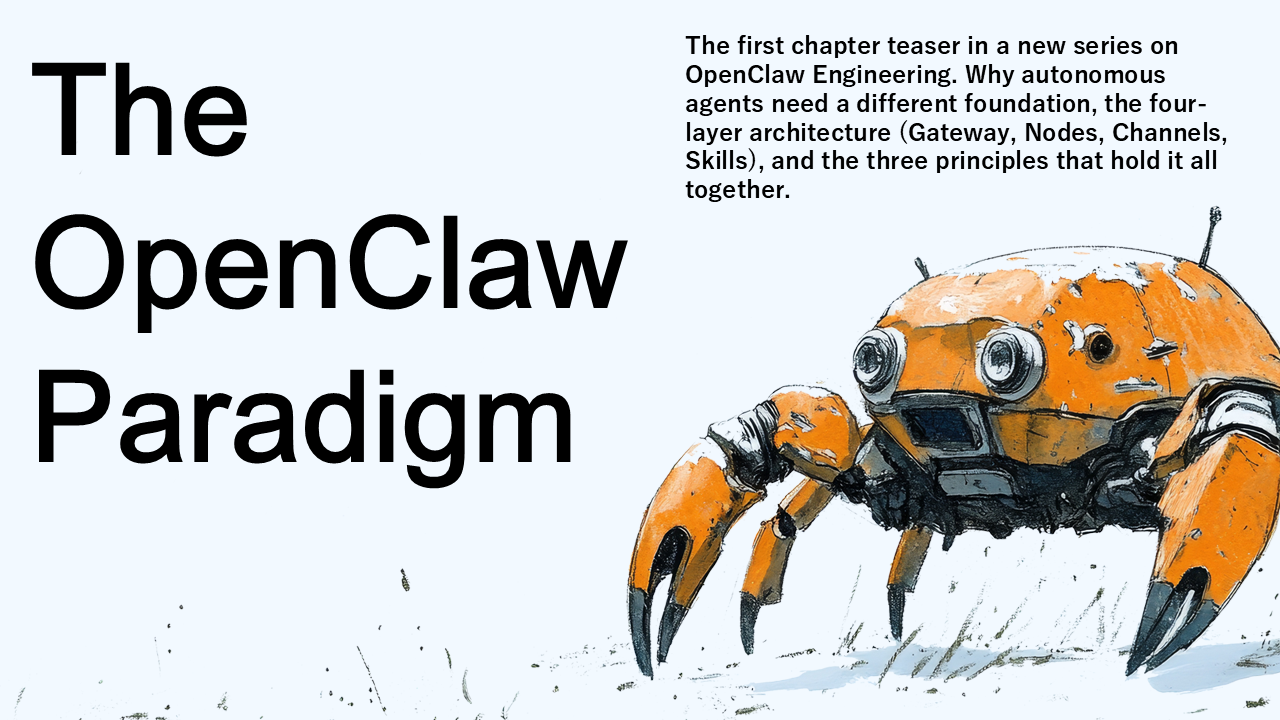
OpenClaw Engineering, Chapter 1: The OpenClaw Paradigm
The first chapter teaser in a new series on OpenClaw Engineering. Why autonomous agents need a different foundation, the four-layer architecture (Gateway, Nodes, Channels, Skills), and the three principles that hold it all together.
2026-03-16
Chapter 8: Securing Backend APIs — Bearer Tokens, Scopes, and Service-to-Service
Chapter 8 of the OpenID: Modern Identity series — securing backend APIs with bearer tokens, scope design for least privilege, token introspection versus local JWT validation, and the three mechanisms for service-to-service authentication.
2026-03-14
Chapter 12: CLAUDE.md — Designing Guardrails That Shape How Claude Thinks
Chapter 12 of Master Claude Chat, Cowork and Code explores CLAUDE.md as a living constitution for AI behavior — positive constraints over prohibitions, complete financial and startup examples, instruction decay, hierarchical files, and anti-patterns to avoid.
2026-03-13
Chapter 6: What Is Claude Cowork? — The Desktop Agent That Touches Your Files
Chapter 6 of Master Claude Chat, Cowork and Code introduces Claude Cowork — a sandboxed desktop agent that automates file management, data extraction, and cross-application workflows on your local machine.
2026-03-07
Chapter 1: Why Identity Is Hard — The Trust Problem Behind Every Login
Chapter 1 of the OpenID: Modern Identity book series — why identity is a trust problem first and a technology problem second, and why authentication and authorization must never be conflated.
2026-03-07
Master Claude, Chapter 4: Context Persistence with Claude Projects — Solving the AI Amnesia Problem
Chapter 4 of Master Claude Chat, Cowork and Code explains how Claude Projects solve the AI amnesia problem with persistent context — custom instructions, knowledge bases, and shared team workspaces that remember your architecture, conventions, and patterns across every conversation.
2026-03-05
Master Claude, Chapter 2: The Three Pillars of Claude — Chat, Cowork, and Code
Claude is not one product — it is three. Chat for reasoning, Cowork for desktop automation, Code for terminal-based development. Chapter 2 of Master Claude Chat, Cowork and Code explains the architecture of each and the decision framework for choosing the right one.
2026-03-03
Art of Coding, Chapter 19: Why I Still Code
The final chapter. A personal reflection on why the act of writing code remains meaningful—and why craftsmanship endures even as everything else changes.
2026-01-17
Art of Coding, Chapter 15: Code as a Team Sport
Code as a team sport: shared ownership, documentation as craft, and respecting the reader. The human practices that make software sustainable and teams thrive.
2026-01-12
Art of Coding, Chapter 11: Architectural Thinking
Architectural thinking is the discipline of designing systems that survive real-world growth. It means asking how your code will feel to live in years from now.
2026-01-06
Art of Coding, Chapter 3: Readability First
Readability first: how naming, structure, and visual rhythm make code habitable for teams and time.
2025-12-27
Art of Coding, Part II: Principles of Clarity
Part II introduces clarity as the compass of software: readability, maintainability, and the consistency that makes teams move faster.
2025-12-26
Art of Coding, Chapter 2: The Philosophy of Clean Code
Clean code is a philosophy, not a rulebook. Explore simplicity vs. cleverness, expressiveness as communication, and code as a form of writing.
2025-12-25
Categories
Tags
Search Logs
Hello World bot 1185
IT assistant bot 1140
Deploy Teams bot to Azure 1137
Microsoft Bot Framework 1052
Teams bot development 1025
Teams production bot 1004
bot for sprint updates 994
Microsoft Teams Task Modules 979
Zendesk Teams integration 979
Teams app zip 977
Bot Framework Adaptive Card 973
Bot Framework example 964
Task Modules 961
Teams chatbot 955
Azure CLI webapp deploy 952
C 952
Teams bot packaging 947
Teams bot tutorial 946
Bot Framework proactive messaging 941
Graph API token 937
Bot Framework CLI 932
Adaptive Card Action.Submit 930
Bot Framework prompts 913
Azure App Service bot 908
Microsoft Graph 907
Azure Bot Services 883
Adaptive Cards 881
Azure bot registration 880
ServiceNow bot 866
proactive messages 814
Development & Technical Consulting
Working on a new product or exploring a technical idea? We help teams with system design, architecture reviews, requirements definition, proof-of-concept development, and full implementation. Whether you need a quick technical assessment or end-to-end support, feel free to reach out.
Contact Us