
{R}R Dev Notes
Found total of 81 articles.
Loop Engineering, Chapter 4: From Laptop Loops to LLMOps
Chapter 4 of the Loop Engineering blog series. The laptop loop is a real achievement and a terrible production system. A teaser on its failure modes, why LLMOps is not MLOps, and the AI gateway that centralizes fallbacks, budgets, and observability.
2026-06-18
Loop Engineering, Chapter 3: Choosing the Right Orchestration Framework
Chapter 3 of the Loop Engineering blog series. LangGraph, AutoGen, or CrewAI? A teaser on matching the framework to the shape of your workflow with the Diagram Test, and the honest trade-offs between them.
2026-06-17
Loop Engineering, Chapter 2: The Six Primitives of Loop Engineering
Chapter 2 of the Loop Engineering blog series. If a loop is the engine, the six primitives are the parts. A teaser on automations, worktrees, skills, connectors (MCP), the maker/checker split, and external memory.
2026-06-16
The Forward Deployed Engineer, Chapter 19: The Future of Forward Deployment
Chapter 19 of The Forward Deployed Engineer blog series. The final chapter — the automation wave, what the AI FDE cannot do, the rise of FDE-as-a-Service, the talent market evolution, the customer wave, and the function's longer-term maturity. Plus a closing word, and the book.
2026-06-14
The Forward Deployed Engineer, Chapter 14: Where Does the FDE Function Belong?
Chapter 14 of The Forward Deployed Engineer blog series. The placement decision, revisited. A teaser on the five real placement options, the federated model, the five factors that drive the choice, and what to do when the placement turns out to be wrong.
2026-06-09
The Forward Deployed Engineer, Chapter 10: Governance, Risk, and Safe Deployment
Chapter 10 of The Forward Deployed Engineer blog series. In regulated industries, governance is not a tax — it's a feature. A teaser on the risk taxonomy, audit trails, human-in-the-loop checkpoints, the EU AI Act, sector compliance, and the governance dashboard.
2026-06-05
The Forward Deployed Engineer, Chapter 8: The Inner Loop — Prototype to Production
Chapter 8 of The Forward Deployed Engineer blog series. From the end of discovery to the first production milestone, the engagement runs on the inner loop. A teaser on the DARE framework, Minimum Viable Architectures, demo-driven development, the hardening phase, and when the customer wants to help.
2026-06-03
The Forward Deployed Engineer, Chapter 1: What Is a Forward Deployed Engineer?
Chapter 1 of The Forward Deployed Engineer blog series. The opening chapter of a new book — the operator's contradiction, the Palantir origin, the anatomy of the role, why the AI moment needs it now, and how the FDE differs from every sister role it gets confused with.
2026-05-27
The Engineering of Intent, Chapter 40: The De-Vibing Protocol — Stabilization Sprints for Production
Chapter 40 of The Engineering of Intent blog series. The final chapter and the remedy for the autocomplete trap — a two-week, agent-heavy stabilization sprint that moves a fast vibes-only build from 90/10 to 50/50 without halting feature development. A teaser on recognizing when you need it, the four tracks, and the three post-sprint disciplines.
2026-05-26

The Engineering of Intent, Chapter 34: Language-Specific Field Notes
Chapter 34 of The Engineering of Intent blog series. Every programming language produces its own Vibe Coding texture. A teaser with field notes on TypeScript, Python, Go, Rust, Java/Kotlin, Ruby, C#, and Shell — including the cross-language pattern that fixes agent default-to-stale-idiom in any language.
2026-05-20
Azure Front Door: a practical introduction
What Azure Front Door is, who it's for, what it costs, how it compares to Cloudflare and CloudFront, and a walkthrough of the settings that matter when putting it in front of an Azure App Service.
2026-05-11
The Engineering of Intent, Chapter 24: The Failure Mode Catalog
Chapter 24 of The Engineering of Intent blog series. Fifteen named failure modes I keep seeing in Vibe Coding practice, with remedies. A teaser on phantom confidence, silent scope creep, context amnesia, loop obsession, the yes-person agent, and the deprecation blind spot.
2026-05-10
The Engineering of Intent, Chapter 15: The Future of the Human Engineer
Chapter 15 of The Engineering of Intent blog series. Am I going to be replaced? The honest answer, after five years of watching the discipline evolve. A teaser on intent architecture, staying relevant, the economic reshaping of the senior-to-junior ratio, and craft in a craftless era.
2026-05-01
The Engineering of Intent, Chapter 14: The 30-Day Pilot Framework
Chapter 14 of The Engineering of Intent blog series. Every successful AI-native transformation starts as a thirty-day pilot on a single well-scoped project. A teaser on how to scope the first project, the week-by-week playbook, the five-question graduation rubric, and the three pilots that show what works and what doesn't.
2026-04-30
The Engineering of Intent, Chapter 13: VibeOps and CI/CD Evolution
Chapter 13 of The Engineering of Intent blog series. Static CI/CD was built for human-paced commits. AI-native velocity needs dynamic, context-aware, agent-literate pipelines. A teaser on VibeOps, context preservation across deployments, merge queues at velocity, and the ten-minute pipeline contract.
2026-04-29
The Engineering of Intent, Chapter 5: Agentic Editors and Flow States
Chapter 5 of The Engineering of Intent blog series. The editor is where the wiring meets your hands. A teaser on the three generations of editor, how semantic search amplifies your codebase's virtues and vices, the flow killers that destroy productivity, and the shortcut rebind that doubled a team lead's output.
2026-04-21
The Engineering of Intent, Chapter 4: The Model Context Protocol (MCP)
Chapter 4 of The Engineering of Intent blog series. MCP is to agents what HTTP was to the early Web — a common protocol that turns bespoke integrations into reusable infrastructure. A teaser on host/client/server roles, the anatomy of a good tool, the six anti-patterns, and the security pitfalls every team trips over.
2026-04-20
The Engineering of Intent, Chapter 3: Context Momentum and Path Dependence
Chapter 3 of The Engineering of Intent blog series. Agents amplify project momentum — good patterns propagate, bad ones propagate just as fast. A teaser on the First Prompt Trap, context rot, the physics of convention drift, and the ten-thousand-dollar rule for decision rigor.
2026-04-19
Frictionless SaaS, Chapter 24: Anti-Patterns and Failure Modes
The last chapter of Frictionless SaaS is about the mistakes teams keep making, even when they know better. A teaser covering the Anti-Pattern Registry, the Feature Trap, and the additional failure modes that quietly erode good products.
2026-04-14
Frictionless SaaS, Chapter 23: Pattern Libraries and Proven Approaches
Frameworks are nice. Patterns are what you actually ship. A teaser for Chapter 23 of Frictionless SaaS, introducing the Fast Activation Pattern Library, the Frictionless Onboarding Catalog, and a set of high-performing product patterns borrowed from the SaaS companies that get activation right.
2026-04-13
Frictionless SaaS, Chapter 22: AI, Automation, and the Future of Frictionless Design
In the AI era, features are commoditized overnight. So what actually becomes defensible? A teaser for Chapter 22 of Frictionless SaaS, covering the AI-Era SaaS Framework and the Experience Moat — the only lasting competitive advantage left.
2026-04-12
Frictionless SaaS, Chapter 21: Operations and Scalability Without Friction
Why growing SaaS companies hit a wall that is not a product problem or a sales problem — it is an operations problem. A teaser for Chapter 21 of Frictionless SaaS covering the Event-Driven Operations Architecture and the Scalability Without Headcount Principle.
2026-04-11
Frictionless SaaS, Chapter 19: Self-Serve Monetization and Growth
The Self-Serve Growth Engine, the Expansion Revenue Framework, and the Seamless Handoff Principle — how to turn upgrades into a natural moment instead of a sales call.
2026-04-09
Frictionless SaaS, Chapter 18: Building Knowledge Into Your Product
The Zero-Support Design Model, Contextual Help Architecture, and four AI Assistant Design Patterns that turn your product into its own best documentation.
2026-04-08
Frictionless SaaS, Chapter 17: Self-Serve Onboarding and Setup
Why self-serve setup converts 2-3x better than assisted onboarding, and the Progressive Setup Pattern and Smart Defaults Strategy that make complex products feel simple.
2026-04-07
Frictionless SaaS Chapter 16: The Power of Self-Service
Chapter 16 preview of Frictionless SaaS: the Self-Serve Maturity Model, the Independence Principle, and how self-serve billing and account management turn scalability into a competitive moat.
2026-04-06
Frictionless SaaS Chapter 15: Continuous Optimization and the Data-Intuition Balance
Chapter 15 preview of Frictionless SaaS: the Experiment-Learn-Ship cycle, the Data-Intuition Balance, staged rollouts, and the retention operating model that turns improvement into a flywheel.
2026-04-05
Frictionless SaaS Chapter 13: SaaS Metrics, Cohort Analysis, and the North Star
Chapter 13 preview of Frictionless SaaS: the SaaS Metrics Pyramid, Net Revenue Retention, cohort-based optimization, and how to choose a North Star that actually drives retention and revenue.
2026-04-03
Frictionless SaaS Chapter 12: Detecting Disengagement and Structured Win-Back
Chapter 12 preview of Frictionless SaaS: the Disengagement Detection System, the four-touch Win-Back Sequence, and why value rediscovery beats discount offers every time.
2026-04-02
Frictionless SaaS Chapter 11: Lifecycle Messaging and Engagement
Chapter 11 preview of Frictionless SaaS: the Lifecycle Messaging Architecture, the Message-Moment Fit Principle, and the Customer Feedback Loop Framework for turning communication into a retention engine.
2026-04-01
Frictionless SaaS Chapter 10: Data Lock-In and Network Lock-In
Chapter 10 preview of Frictionless SaaS: the Data Gravity Effect, the Network Lock-In Model, and how to build structural moats that make churn expensive without being manipulative.
2026-03-31

Frictionless SaaS, Chapter 8: Designing for Habit - Why Retention Is Your Real Growth Engine
Chapter 8 of the Frictionless SaaS blog series. Retention is the multiplier on every dollar of acquisition you'll ever spend. The Habit Loop Engine, the Return Reason Architecture, and the DAU/WAU signals that tell you whether you're building a habit or a one-night stand.
2026-03-29

Frictionless SaaS, Chapter 6: The Activation Event - The One Metric That Predicts Everything Else
Chapter 6 of the Frictionless SaaS blog series. Activation isn't a moment - it's a specific, measurable event. How to define it, why precision matters, and how the Micro-Success Ladder turns a single activation action into a path most users will actually walk.
2026-03-27
Frictionless SaaS, Chapter 5: Just-In-Time Learning - Teach Users at the Exact Moment They Need It
Chapter 5 of the Frictionless SaaS blog series. Users don't want to learn your product - they want to solve their problem. Just-In-Time Learning teaches at the moment of need, and the Skippable Onboarding Principle respects the users who already know what they're doing.
2026-03-26
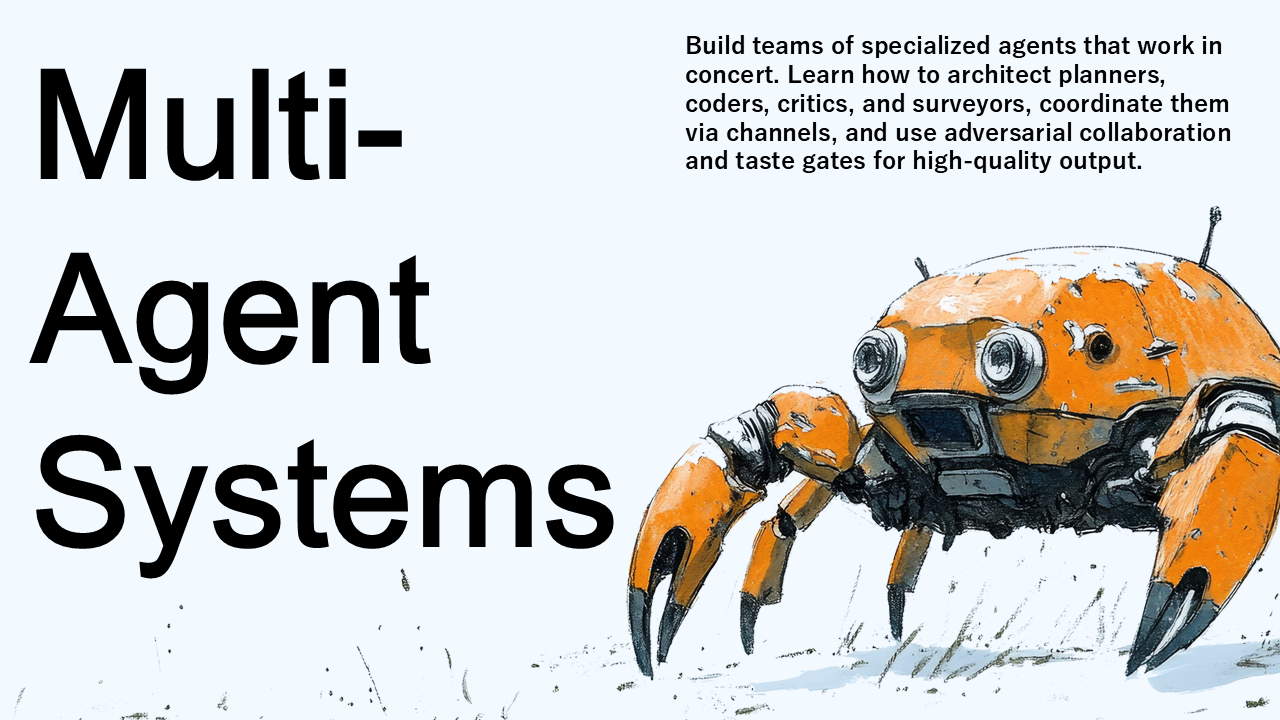
OpenClaw Engineering, Chapter 10: Multi-Agent Systems
Build teams of specialized agents that work in concert. Learn how to architect planners, coders, critics, and surveyors, coordinate them via channels, and use adversarial collaboration and taste gates for high-quality output.
2026-03-25
Frictionless SaaS, Chapter 3: Signup Design - Stop Interrogating People Before They Can Use Your Product
Chapter 3 of the Frictionless SaaS blog series. Why most SaaS signup forms are conversion killers, what the Minimum Viable Signup really looks like, and how the Progressive Commitment Model lets you collect every piece of information you want - without scaring users off at the door.
2026-03-24
Frictionless SaaS, Chapter 2: The SAFE Journey — A Map of Where Your Users Actually Quit
Chapter 2 of the Frictionless SaaS blog series. The SAFE Journey Framework breaks the user lifecycle into Signup, Activation, Frequency, and Expansion — each with different friction, different metrics, and different fixes. Plus: why Time to Value is the most important retention metric in early-stage SaaS.
2026-03-23
Frictionless SaaS, Chapter 1: Silent Churn — The Users Who Leave Without Complaining
Chapter 1 of the Frictionless SaaS blog series. Silent churn is the most dangerous kind of churn — users who sign up, disappear, and never tell you why. A look at the Silent Churn Pattern and the Activation Gap.
2026-03-22
Frictionless SaaS, Part 0: How Users Actually Find, Judge, and Try Your Product
Kicking off a blog series based on the book "Frictionless SaaS." This first post introduces Chapters 0.1 through 0.3 — Discovery, the Landing Page, and Freemium & Entry Points — the three friction points every user hits before they ever sign up.
2026-03-21
OpenClaw Engineering, Chapter 6: Extending Capabilities with SKILL.md
The anatomy of SKILL.md files in OpenClaw: how to author reusable, versioned instruction sets with YAML frontmatter, dependencies, and explicit procedural guidance for agents.
2026-03-21
Frictionless SaaS: The Complete Series Index — Your Guide to All 24 Chapters
The complete reader's guide to the Frictionless SaaS blog series. An introduction to the thesis — that in the AI era, features are commoditized and experience is the only lasting competitive advantage — plus direct links to all 25 posts across the 24 chapters of the book.
2026-03-20
OpenClaw Engineering, Chapter 5: Connecting Multiple Channels
How to connect your OpenClaw agent to multiple messaging platforms (Telegram, WhatsApp, Discord, Slack) and manage multi-channel routing. Setup, configuration quirks, and troubleshooting for each platform.
2026-03-20
Chapter 19 – Measuring AI Effectiveness
Chapter 19 of Master Claude Chat, Cowork and Code tackles the question every team eventually asks: is our AI actually working? Learn to build metrics frameworks, structured evaluations, and workflow acceleration measurements that prove (or disprove) AI's value.
2026-03-19
OpenClaw Engineering, Chapter 4: Managing the Gateway and Models
Configuring your running gateway with the onboard wizard, diagnostics, and openclaw.json. How to connect model providers, manage API keys securely, and route different queries to different models.
2026-03-19
Chapter 18 – Sub-Agents and Multi-Agent Collaboration
Chapter 18 of Master Claude Chat, Cowork and Code explores multi-agent architecture — how to decompose complex problems into specialized sub-agents, coordinate parallel execution, and synthesize results into coherent outputs.
2026-03-18
OpenClaw Engineering, Chapter 3: Deployment and Environment Setup
From local development to production: installing Node.js 22+, setting up Docker containers, and deploying OpenClaw to the cloud via AWS Lightsail or VPS providers.
2026-03-18
Chapter 11: MFA and Conditional Access — Dispersing Authentication Risk
Chapter 11 of the OpenID: Modern Identity series — MFA fundamentals across the three factor categories, risk-based adaptive authentication, and step-up authentication using the OIDC acr and amr claims to match assurance to operation sensitivity.
2026-03-17
OpenClaw Engineering, Chapter 2: Anatomy of the Agent Brain
How OpenClaw agents think through their identity files, two-layer memory system, and proactive task scheduling. A deep dive into SOUL.md, AGENTS.md, USER.md, MEMORY.md, HEARTBEAT.md, and semantic memory via Supermemory.
2026-03-17
OpenClaw Engineering, Chapter 1: The OpenClaw Paradigm
The first chapter teaser in a new series on OpenClaw Engineering. Why autonomous agents need a different foundation, the four-layer architecture (Gateway, Nodes, Channels, Skills), and the three principles that hold it all together.
2026-03-16
Chapter 12: CLAUDE.md — Designing Guardrails That Shape How Claude Thinks
Chapter 12 of Master Claude Chat, Cowork and Code explores CLAUDE.md as a living constitution for AI behavior — positive constraints over prohibitions, complete financial and startup examples, instruction decay, hierarchical files, and anti-patterns to avoid.
2026-03-13
Categories
Tags
Search Logs
Hello World bot 1251
IT assistant bot 1228
Deploy Teams bot to Azure 1225
Microsoft Bot Framework 1117
Teams bot development 1097
Teams production bot 1089
bot for sprint updates 1076
Zendesk Teams integration 1057
Teams app zip 1052
Bot Framework Adaptive Card 1038
Microsoft Teams Task Modules 1038
Teams chatbot 1033
Teams bot tutorial 1023
Teams bot packaging 1016
Bot Framework example 1015
Task Modules 1015
C 1003
Bot Framework proactive messaging 1002
Graph API token 995
Azure CLI webapp deploy 989
Bot Framework CLI 985
Bot Framework prompts 980
Adaptive Card Action.Submit 971
Azure App Service bot 961
Microsoft Graph 943
Azure Bot Services 939
Adaptive Cards 913
ServiceNow bot 913
Azure bot registration 909
sideload bot in Teams 885
Development & Technical Consulting
Working on a new product or exploring a technical idea? We help teams with system design, architecture reviews, requirements definition, proof-of-concept development, and full implementation. Whether you need a quick technical assessment or end-to-end support, feel free to reach out.
Contact Us