
{R}R Dev Notes
Found total of 58 articles.
Loop Engineering, Chapter 2: The Six Primitives of Loop Engineering
Chapter 2 of the Loop Engineering blog series. If a loop is the engine, the six primitives are the parts. A teaser on automations, worktrees, skills, connectors (MCP), the maker/checker split, and external memory.
2026-06-16
The Engineering of Intent, Chapter 39: Impressionistic Scanning — A Visual Heuristic Guide
Chapter 39 of The Engineering of Intent blog series. Shape matters before content — especially for AI-generated code, where the agent is often blind to global shape. A teaser cheat sheet of six visual code shapes (wide-flat, deep-nesting, high-import-churn, long-thin, jagged, suspicious-uniformity) and what each one means.
2026-05-25
The Engineering of Intent, Chapter 32: Vibe Coding in Platform and Infrastructure
Chapter 32 of The Engineering of Intent blog series. Platform work is slow-moving by nature, but every improvement compounds across the whole engineering org. A teaser on infrastructure-as-code, CI evolution, internal-tool velocity, and the deployment-tool rebuild that dropped deploys from 40 minutes to 12.
2026-05-18
The Engineering of Intent, Chapter 17: The Flow Loop
Chapter 17 of The Engineering of Intent blog series. Flow with an agent in the loop is different from classical flow, but just as performance-defining. A teaser on the two-minute rule, the three-strike rule, the flow killers, and the checkout refactor that shipped in one afternoon instead of two days.
2026-05-03
The Engineering of Intent, Chapter 6: Autonomous Orchestration Frameworks
Chapter 6 of The Engineering of Intent blog series. Editors run one agent at a time; orchestration runs many. A teaser on task-specific personalities, memory banks, when to orchestrate (and when not), the 14,000-test case study, and the economics of multi-agent pipelines.
2026-04-22
The Engineering of Intent, Chapter 5: Agentic Editors and Flow States
Chapter 5 of The Engineering of Intent blog series. The editor is where the wiring meets your hands. A teaser on the three generations of editor, how semantic search amplifies your codebase's virtues and vices, the flow killers that destroy productivity, and the shortcut rebind that doubled a team lead's output.
2026-04-21
The Engineering of Intent, Chapter 1: The Triadic Relationship Model
Chapter 1 of The Engineering of Intent blog series. Software used to be a dyad between engineer and machine. Now a third actor — the AI agent — has joined permanently. A teaser covering the Triadic Relationship Model, the CMDP view of software, and the six failure modes every AI-native team needs to name.
2026-04-17
Frictionless SaaS, Chapter 4: The First Ten Minutes - Designing the Session That Decides Everything
Chapter 4 of the Frictionless SaaS blog series. The first ten minutes of a user's first session decide whether they activate or silently churn. The First Session Blueprint and the Empty State Opportunity are the two design patterns that separate products users love from products users forget.
2026-03-25
OpenClaw Engineering, Chapter 9: Scheduling and Deterministic Orchestration
Time-based automation for agents: cron jobs for simple periodic tasks and the Lobster workflow engine for complex, deterministic, resumable multi-step pipelines with human approval gates.
2026-03-24
OpenClaw Engineering, Chapter 4: Managing the Gateway and Models
Configuring your running gateway with the onboard wizard, diagnostics, and openclaw.json. How to connect model providers, manage API keys securely, and route different queries to different models.
2026-03-19
OpenClaw Engineering, Chapter 3: Deployment and Environment Setup
From local development to production: installing Node.js 22+, setting up Docker containers, and deploying OpenClaw to the cloud via AWS Lightsail or VPS providers.
2026-03-18
Chapter 16 – Execution Risks and Isolation
Chapter 16 of Master Claude Chat, Cowork and Code confronts the real security risks of AI systems that execute commands and manipulate files — from command injection to data exposure — and explains the isolation models that keep things safe.
2026-03-17
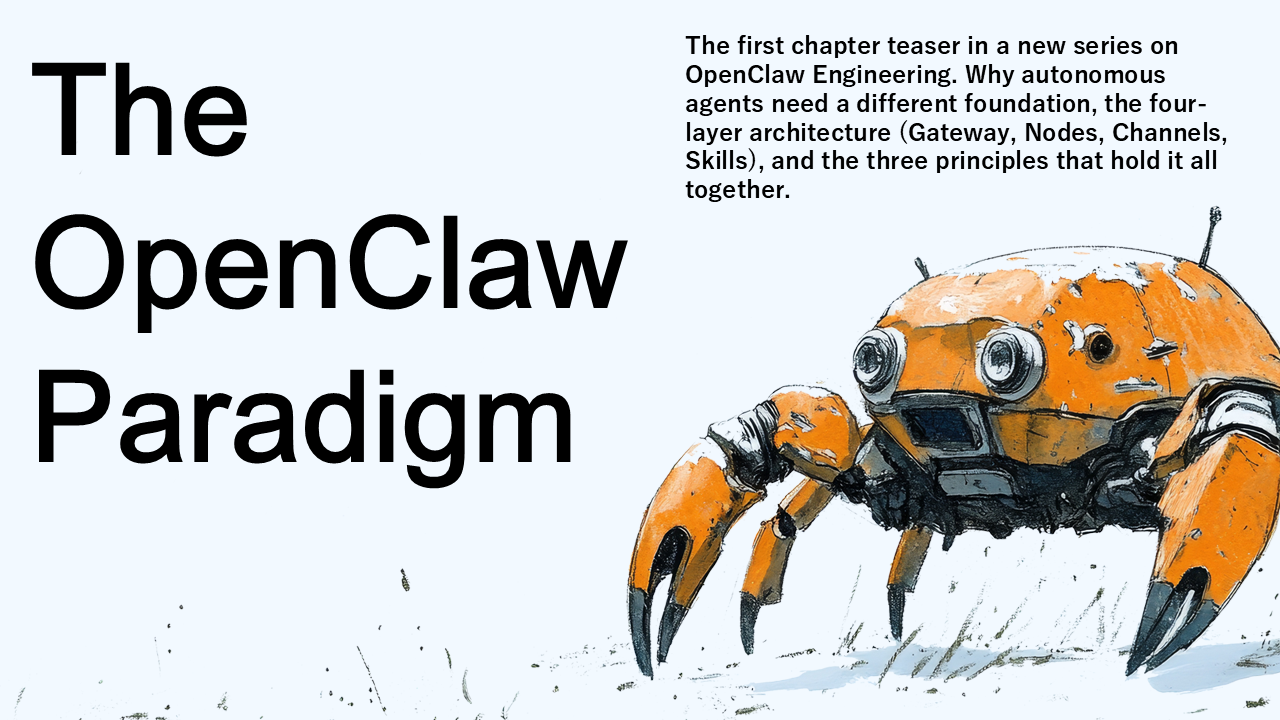
OpenClaw Engineering, Chapter 1: The OpenClaw Paradigm
The first chapter teaser in a new series on OpenClaw Engineering. Why autonomous agents need a different foundation, the four-layer architecture (Gateway, Nodes, Channels, Skills), and the three principles that hold it all together.
2026-03-16
Chapter 3: Core Concepts — The Vocabulary of OpenID Connect
Chapter 3 of the OpenID: Modern Identity series — the IdP/RP/user triangle, claims and JWTs, the three OIDC token types, consent and scopes, sessions vs tokens, and the boundary between authentication and authorization.
2026-03-09
Chapter 6: What Is Claude Cowork? — The Desktop Agent That Touches Your Files
Chapter 6 of Master Claude Chat, Cowork and Code introduces Claude Cowork — a sandboxed desktop agent that automates file management, data extraction, and cross-application workflows on your local machine.
2026-03-07
Master Claude, Chapter 2: The Three Pillars of Claude — Chat, Cowork, and Code
Claude is not one product — it is three. Chat for reasoning, Cowork for desktop automation, Code for terminal-based development. Chapter 2 of Master Claude Chat, Cowork and Code explains the architecture of each and the decision framework for choosing the right one.
2026-03-03
Art of Coding, Chapter 17: AI, Automation, and the Role of the Engineer
How AI changes engineering roles. Why automation removes drudgery but makes human judgment more valuable, and what "curation" means for the future programmer.
2026-01-15
Art of Coding, Chapter 16: Ethics and Longevity
How ethics and longevity intertwine in code. Why the systems you write today remain your responsibility for years, and how empathy shapes sustainable software.
2026-01-13
Art of Coding, Part VI: The Human Side of Code
The human side of code: collaboration, culture, and the practices that make software sustainable. How teams thrive when they value people as much as process.
2026-01-11
Art of Coding, Part V: Tools and the Ecosystem
Tools shape the culture of how teams code. The right ecosystem amplifies clarity and craftsmanship; the wrong one creates friction and distraction.
2026-01-07
Art of Coding, Chapter 11: Architectural Thinking
Architectural thinking is the discipline of designing systems that survive real-world growth. It means asking how your code will feel to live in years from now.
2026-01-06

Art of Coding, Chapter 6: Abstraction and Modularity
Drawing boundaries that make systems stronger. How to abstract without over-engineering, and design interfaces that last.
2025-12-31
Art of Coding, Chapter 5: Consistency and Style
Consistency is kindness. How coding standards, formatters, and idiomatic style shape code that teams can actually live with.
2025-12-29
Art of Coding, Chapter 2: The Philosophy of Clean Code
Clean code is a philosophy, not a rulebook. Explore simplicity vs. cleverness, expressiveness as communication, and code as a form of writing.
2025-12-25
Art of Coding, Part I: Why Code is an Art
Introducing the Art of Coding blog series: a 26-week exploration of what makes code beautiful, maintainable, and enduring in the age of AI.
2025-12-23
8.4 PCA and Spectral Methods
An intuitive, in-depth explanation of PCA, spectral clustering, and eigenvector-based data analysis. Covers covariance matrices, graph Laplacians, and why eigenvalues reveal hidden structure in data. Concludes Chapter 8 and leads naturally into SVD in Chapter 9.
2025-10-10
8.3 The QR Algorithm (High-Level Intuition)
A clear, intuitive, and comprehensive explanation of the QR algorithm—how repeated QR factorizations reveal eigenvalues, why orthogonal transformations provide stability, and how shifts and Hessenberg reductions make the method efficient. Ends with a smooth bridge to PCA and spectral methods.
2025-10-09
Chapter 8 — Eigenvalues and Eigenvectors
A deep, intuitive introduction to eigenvalues and eigenvectors for engineers and practitioners. Explains why spectral methods matter, where they appear in real systems, and how modern numerical algorithms compute eigenvalues efficiently. Leads naturally into the power method and inverse iteration.
2025-10-06
7.3 Least Squares Problems
A clear, intuitive, book-length explanation of least squares problems, including the geometry, normal equations, QR decomposition, and SVD. Learn why least-squares solutions are central to ML and data science, and why QR provides a stable foundation for practical algorithms.
2025-10-04
7.2 Householder Reflections
A clear, intuitive, book-length explanation of Householder reflections and why they form the foundation of modern QR decomposition. Learn how reflections overcome the numerical instability of Gram–Schmidt and enable stable least-squares solutions across ML, statistics, and scientific computing.
2025-10-03
7.1 Gram–Schmidt and Modified GS
A clear, practical, book-length explanation of Gram–Schmidt and Modified Gram–Schmidt, why classical GS fails in floating-point arithmetic, how MGS improves stability, and why real numerical systems eventually rely on Householder reflections. Ideal for ML engineers, data scientists, and numerical computing practitioners.
2025-10-02
Chapter 7 — QR Decomposition
A deep, intuitive introduction to QR decomposition, explaining why orthogonality and numerical stability make QR essential for least squares, regression, kernel methods, and large-scale computation. Covers Gram–Schmidt, Modified GS, Householder reflections, and why QR is often preferred over LU and normal equations.
2025-10-01
6.3 Applications in ML, Statistics, and Kernel Methods
A deep, intuitive explanation of how Cholesky decomposition powers real machine learning and statistical systems—from Gaussian processes and Bayesian inference to kernel methods, Kalman filters, covariance modeling, and quadratic optimization. Understand why Cholesky is essential for stability, speed, and large-scale computation.
2025-09-30
6.2 Memory Advantages
A detailed, intuitive explanation of why Cholesky decomposition uses half the memory of LU decomposition, how memory locality accelerates computation, and why this efficiency makes Cholesky essential for large-scale machine learning, kernel methods, and statistical modeling.
2025-09-29
6.1 SPD Matrices and Why They Matter
A deep, intuitive explanation of symmetric positive definite (SPD) matrices and why they are essential in machine learning, statistics, optimization, and numerical computation. Covers geometry, stability, covariance, kernels, Hessians, and how SPD structure enables efficient Cholesky decomposition.
2025-09-28
Chapter 6 — Cholesky Decomposition
A deep, narrative-driven introduction to Cholesky decomposition explaining why symmetric positive definite matrices dominate real computation. Covers structure, stability, performance, and the role of Cholesky in ML, statistics, and optimization.
2025-09-27
5.2 Numerical Pitfalls
A deep, accessible explanation of the numerical pitfalls in LU decomposition. Learn about growth factors, tiny pivots, rounding errors, catastrophic cancellation, ill-conditioning, and why LU may silently produce incorrect results without proper pivoting and numerical care.
2025-09-24
5.1 LU with and without Pivoting
A clear and practical explanation of LU decomposition with and without pivoting. Learn why pivoting is essential, how partial and complete pivoting work, where no-pivot LU fails, and why modern numerical libraries rely on pivoted LU for stability.
2025-09-23
Chapter 5 — LU Decomposition
An in-depth, accessible introduction to LU decomposition—why it matters, how it improves on Gaussian elimination, where pivoting fits in, and what modern numerical libraries like NumPy and LAPACK do under the hood. Includes a guide to stability, practical applications, and a smooth transition into LU with and without pivoting.
2025-09-22
4.4 When Elimination Fails
An in-depth, practical explanation of why Gaussian elimination fails in real numerical systems—covering zero pivots, instability, ill-conditioning, catastrophic cancellation, and singular matrices—and how these failures motivate the move to LU decomposition.
2025-09-21
4.1 Gaussian Elimination Revisited
A deep, intuitive exploration of Gaussian elimination as it actually behaves inside floating-point arithmetic. Learn why the textbook algorithm fails in practice, how instability emerges, why pivoting is essential, and how elimination becomes reliable through matrix transformations.
2025-09-18
4.0 Solving Ax = b
A deep, accessible introduction to solving linear systems in numerical computing. Learn why Ax = b sits at the center of AI, ML, optimization, and simulation, and explore Gaussian elimination, pivoting, row operations, and failure modes through intuitive explanations.
2025-09-17

3.4 Exact Algorithms vs Implemented Algorithms
Learn why textbook algorithms differ from the versions that actually run on computers. This chapter explains rounding, floating-point errors, instability, algorithmic reformulation, and why mathematically equivalent methods behave differently in AI, ML, and scientific computing.
2025-09-16
3.3 Conditioning of Problems vs Stability of Algorithms
Learn the critical difference between problem conditioning and algorithmic stability in numerical computing. Understand why some systems fail even with correct code, and how sensitivity, condition numbers, and numerical stability determine the reliability of AI, ML, and scientific algorithms.
2025-09-15
3.2 Measuring Errors
A clear and intuitive guide to absolute error, relative error, backward error, and how numerical errors propagate in real systems. Essential for understanding stability, trustworthiness, and reliability in scientific computing, AI, and machine learning.
2025-09-14

3.1 Norms and Why They Matter
A deep yet accessible exploration of vector and matrix norms, why they matter in numerical computation, and how they influence stability, conditioning, error growth, and algorithm design. Essential reading for AI, ML, and scientific computing engineers.
2025-09-13
Chapter 3 — Computation & Mathematical Systems
A clear, insightful introduction to numerical computation—covering norms, error measurement, conditioning vs stability, and the gap between mathematical algorithms and real implementations. Essential reading for anyone building AI, optimization, or scientific computing systems.
2025-09-12
2.4 Vector and Matrix Storage in Memory
A clear, practical guide to how vectors and matrices are stored in computer memory. Learn row-major vs column-major layout, strides, contiguity, tiling, cache behavior, and why memory layout affects both speed and numerical stability in real systems.
2025-09-11

2.3 Overflow, Underflow, Loss of Significance
A clear and practical guide to overflow, underflow, and loss of significance in floating-point arithmetic. Learn how numerical computations break, why these failures occur, and how they impact AI, optimization, and scientific computing.
2025-09-10

2.2 Machine Epsilon, Rounding, ULPs
A comprehensive, intuitive guide to machine epsilon, rounding behavior, and ULPs in floating-point arithmetic. Learn how precision limits shape numerical accuracy, how rounding errors arise, and why these concepts matter for AI, ML, and scientific computing.
2025-09-09
Categories
Tags
Search Logs
Hello World bot 1239
IT assistant bot 1210
Deploy Teams bot to Azure 1207
Microsoft Bot Framework 1105
Teams bot development 1085
Teams production bot 1075
bot for sprint updates 1061
Zendesk Teams integration 1048
Teams app zip 1044
Microsoft Teams Task Modules 1026
Teams chatbot 1024
Bot Framework Adaptive Card 1022
Teams bot tutorial 1013
Bot Framework example 1008
Task Modules 1007
Teams bot packaging 1005
Bot Framework proactive messaging 995
C 993
Graph API token 991
Bot Framework CLI 978
Azure CLI webapp deploy 976
Bot Framework prompts 971
Adaptive Card Action.Submit 965
Azure App Service bot 952
Microsoft Graph 935
Azure Bot Services 933
Adaptive Cards 906
ServiceNow bot 906
Azure bot registration 904
identity in Teams 875
Development & Technical Consulting
Working on a new product or exploring a technical idea? We help teams with system design, architecture reviews, requirements definition, proof-of-concept development, and full implementation. Whether you need a quick technical assessment or end-to-end support, feel free to reach out.
Contact Us