
{R}R Dev Notes
Found total of 43 articles.
The Forward Deployed Engineer, Chapter 7: Customer Discovery and the Messy Reality
Chapter 7 of The Forward Deployed Engineer blog series. The most important fourteen days of any engagement are the first fourteen. A teaser on the three outputs of discovery, the async interview, the Weird Tuesday problem, the workflow inventory, and the Eval-Customer Split.
2026-06-02
The Forward Deployed Engineer, Chapter 6: The Soft Stack — Diplomacy and Strategy
Chapter 6 of The Forward Deployed Engineer blog series. The "soft stack" is the part of the FDE skillset most often dismissed as soft. A teaser on MECE, the Pyramid Principle, stakeholder mapping, Managing the Skeptic, the Diplomatic Register, and stress inoculation.
2026-06-01
The Forward Deployed Engineer, Chapter 5: The AI and Agentic Frontier
Chapter 5 of The Forward Deployed Engineer blog series. The technical bar that the FDE shares with platform engineers — plus the AI-specific skills that separate the role in 2026. A teaser on agents beyond chatbots, RAG, multi-agent orchestration, evals as a discipline, and model-agnostic deployment.
2026-05-31
The Forward Deployed Engineer, Chapter 4: The Technical Bar
Chapter 4 of The Forward Deployed Engineer blog series. The FDE is, first and last, an engineer. A teaser on the four technical primitives, the non-obvious skills, what you don't need to be, and the four-round interview that actually tests for it.
2026-05-30
The Forward Deployed Engineer, Chapter 3: Where the FDE Sits in the Org
Chapter 3 of The Forward Deployed Engineer blog series. The first organizational decision is also the most consequential — and the most often wrong. A teaser on the classification mistake, the pod structure, the seniority distribution, and the career-path problem that quietly kills FDE functions.
2026-05-29
The Forward Deployed Engineer, Chapter 2: The Last-Mile Problem in Enterprise AI
Chapter 2 of The Forward Deployed Engineer blog series. Where SaaS stopped at the enterprise threshold, AI has to walk the last mile. A teaser on the four frictions at the last mile, the integration tax no demo shows, and why workflow redesign — not the model — is the product.
2026-05-28
The Forward Deployed Engineer, Chapter 1: What Is a Forward Deployed Engineer?
Chapter 1 of The Forward Deployed Engineer blog series. The opening chapter of a new book — the operator's contradiction, the Palantir origin, the anatomy of the role, why the AI moment needs it now, and how the FDE differs from every sister role it gets confused with.
2026-05-27
The Engineering of Intent, Chapter 32: Vibe Coding in Platform and Infrastructure
Chapter 32 of The Engineering of Intent blog series. Platform work is slow-moving by nature, but every improvement compounds across the whole engineering org. A teaser on infrastructure-as-code, CI evolution, internal-tool velocity, and the deployment-tool rebuild that dropped deploys from 40 minutes to 12.
2026-05-18
The Engineering of Intent, Chapter 31: Vibe Coding in Data and ML
Chapter 31 of The Engineering of Intent blog series. Data and ML work is where AI-native velocity meets statistical thinking and slow feedback loops. A teaser on ETL graduated rollout, feature-leakage guards, model evaluation boundaries, and the churn-pipeline case study that split build-time (8 days) from validation-time (weeks).
2026-05-17
Azure Front Door: a practical introduction
What Azure Front Door is, who it's for, what it costs, how it compares to Cloudflare and CloudFront, and a walkthrough of the settings that matter when putting it in front of an Azure App Service.
2026-05-11
The Engineering of Intent, Chapter 12: The GenDD Pod
Chapter 12 of The Engineering of Intent blog series. Three people, continuous flow, almost no ceremony — the team structure that actually ships AI-native work sustainably. A teaser on the Agentic Product Lead, Engineer, and QA roles, the transition from Agile, and the case study where a SaaS company went from 72 engineers to 24.
2026-04-28
The Engineering of Intent, Chapter 4: The Model Context Protocol (MCP)
Chapter 4 of The Engineering of Intent blog series. MCP is to agents what HTTP was to the early Web — a common protocol that turns bespoke integrations into reusable infrastructure. A teaser on host/client/server roles, the anatomy of a good tool, the six anti-patterns, and the security pitfalls every team trips over.
2026-04-20
The Engineering of Intent, Chapter 3: Context Momentum and Path Dependence
Chapter 3 of The Engineering of Intent blog series. Agents amplify project momentum — good patterns propagate, bad ones propagate just as fast. A teaser on the First Prompt Trap, context rot, the physics of convention drift, and the ten-thousand-dollar rule for decision rigor.
2026-04-19
OpenClaw Engineering, Chapter 13: Hardening the Ecosystem
The final chapter: ecosystem security, the ClawHavoc incident, defending against malware in dependencies, confirming high-risk operations, and building auditing and disaster recovery systems.
2026-03-28
OpenClaw Engineering, Chapter 11: Continuous Learning with OpenClaw-RL
How OpenClaw-RL extracts training signals from conversations and uses them to improve agent behavior continuously. From binary feedback to token-level distillation, agents learn from every interaction without retraining the base model.
2026-03-26
OpenClaw Engineering, Chapter 10: Multi-Agent Systems
Build teams of specialized agents that work in concert. Learn how to architect planners, coders, critics, and surveyors, coordinate them via channels, and use adversarial collaboration and taste gates for high-quality output.
2026-03-25
OpenClaw Engineering, Chapter 9: Scheduling and Deterministic Orchestration
Time-based automation for agents: cron jobs for simple periodic tasks and the Lobster workflow engine for complex, deterministic, resumable multi-step pipelines with human approval gates.
2026-03-24
OpenClaw Engineering, Chapter 8: Event-Driven Workflows
How OpenClaw agents spring into action automatically via hooks, webhooks, and TypeScript handlers—without waiting for human invocation. From internal events to CI/CD pipelines.
2026-03-23
OpenClaw Engineering, Chapter 7: The Skill Ecosystem
Bundled skills vs workspace skills, skill discovery and context, publishing to ClawHub, managing 13,000+ community skills without collision, semantic search, and the meta-skills that let agents improve themselves.
2026-03-22
Chapter 15: FAPI and High-Stakes Security — When the Defaults Aren't Enough
Chapter 15 of the OpenID: Modern Identity series — FAPI for high-stakes scenarios: what FAPI 1.0 Advanced and 2.0 require, Pushed Authorization Requests (PAR), JWT-Secured Authorization Requests (JAR), and migrating from FAPI 1.0 Advanced to FAPI 2.0.
2026-03-21
OpenClaw Engineering, Chapter 6: Extending Capabilities with SKILL.md
The anatomy of SKILL.md files in OpenClaw: how to author reusable, versioned instruction sets with YAML frontmatter, dependencies, and explicit procedural guidance for agents.
2026-03-21
Chapter 20 – The Next Decade of AI Coworkers
Chapter 20 of Master Claude Chat, Cowork and Code looks ahead — from conversational AI to embedded infrastructure, from chat interfaces to computer use, and the trust and responsibility questions that will define how AI reshapes work over the next decade.
2026-03-20
Chapter 14: Hardening Your Identity Stack — Setting the Defaults That Keep You Safe
Chapter 14 of the OpenID: Modern Identity series — hardening defaults that neutralize common attacks: strict redirect URI matching, audience validation to solve the confused deputy problem, token lifetime tuning, and refresh token binding, rotation, and revocation.
2026-03-20
OpenClaw Engineering, Chapter 5: Connecting Multiple Channels
How to connect your OpenClaw agent to multiple messaging platforms (Telegram, WhatsApp, Discord, Slack) and manage multi-channel routing. Setup, configuration quirks, and troubleshooting for each platform.
2026-03-20
Chapter 19 – Measuring AI Effectiveness
Chapter 19 of Master Claude Chat, Cowork and Code tackles the question every team eventually asks: is our AI actually working? Learn to build metrics frameworks, structured evaluations, and workflow acceleration measurements that prove (or disprove) AI's value.
2026-03-19
Chapter 13: Threat Modeling OpenID Systems — Thinking Like the Adversary
Chapter 13 of the OpenID: Modern Identity series — threat modeling for OIDC systems: token theft vectors and defenses, replay attacks and nonce validation, CSRF and state parameter mismanagement, redirect abuse and mix-up attacks.
2026-03-19
OpenClaw Engineering, Chapter 4: Managing the Gateway and Models
Configuring your running gateway with the onboard wizard, diagnostics, and openclaw.json. How to connect model providers, manage API keys securely, and route different queries to different models.
2026-03-19
Chapter 17 – Guardrails and Governance
Chapter 17 of Master Claude Chat, Cowork and Code moves from understanding risks to implementing controls — permission isolation, tool allow-lists, human-in-the-loop approval workflows, validation hooks, and enterprise-grade audit logging.
2026-03-18
OpenClaw Engineering, Chapter 3: Deployment and Environment Setup
From local development to production: installing Node.js 22+, setting up Docker containers, and deploying OpenClaw to the cloud via AWS Lightsail or VPS providers.
2026-03-18
Chapter 12: User Lifecycle Management — Provisioning, SCIM, and the De-Provisioning Problem
Chapter 12 of the OpenID: Modern Identity series — user lifecycle management: JIT and bulk provisioning, SCIM for cross-system sync, de-provisioning done right, role mapping from IdP claims, and identity architecture for multi-tenant SaaS.
2026-03-18
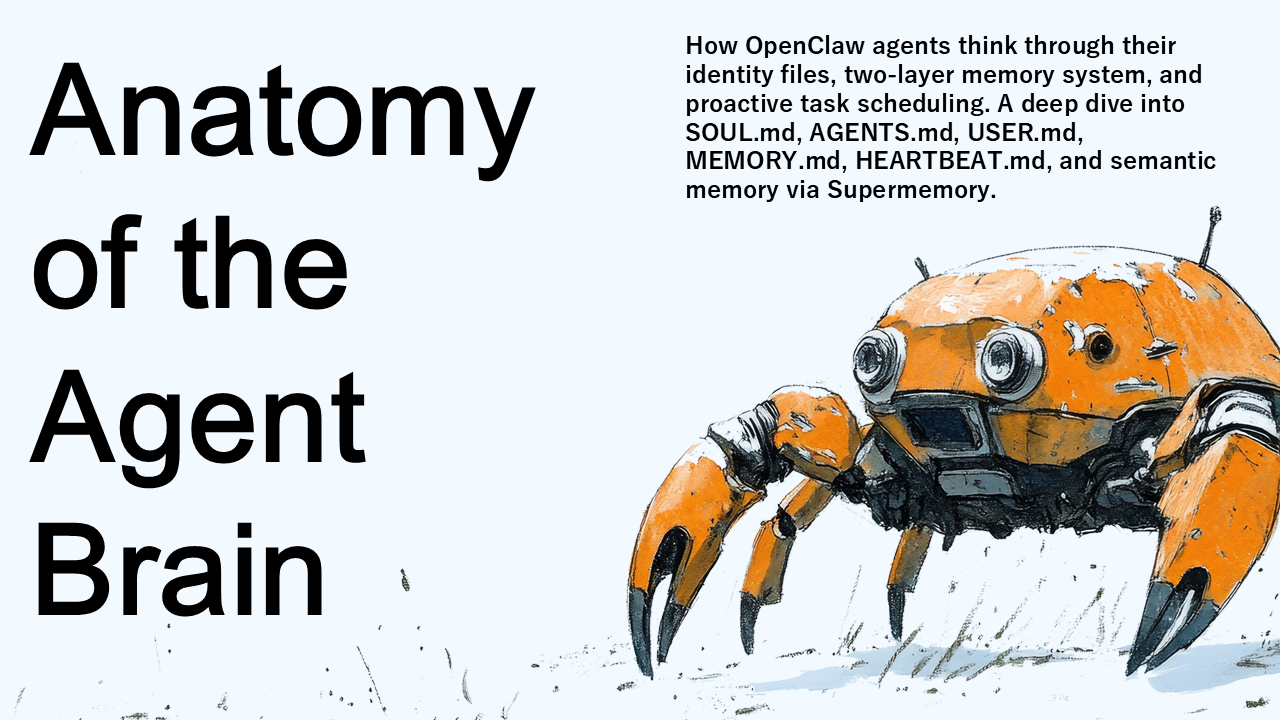
OpenClaw Engineering, Chapter 2: Anatomy of the Agent Brain
How OpenClaw agents think through their identity files, two-layer memory system, and proactive task scheduling. A deep dive into SOUL.md, AGENTS.md, USER.md, MEMORY.md, HEARTBEAT.md, and semantic memory via Supermemory.
2026-03-17
Chapter 13: Encapsulating Knowledge with Agent Skills — From Conversations to Autonomous Procedures
Chapter 13 of Master Claude Chat, Cowork and Code introduces Skills — reusable, encapsulated procedures that Claude executes autonomously. Covers SKILL.md structure, YAML frontmatter, trigger descriptions, and the Skills Library pattern for team distribution.
2026-03-14
Chapter 8: Scheduled Tasks and Autonomous Execution — Making Claude Work While You Sleep
Chapter 8 of Master Claude Chat, Cowork and Code covers scheduled automation with Claude Cowork — cron-based recurring workflows, sleep/connectivity handling, error strategies, and applying GTD principles to AI task automation.
2026-03-09
Master Claude, Chapter 4: Context Persistence with Claude Projects — Solving the AI Amnesia Problem
Chapter 4 of Master Claude Chat, Cowork and Code explains how Claude Projects solve the AI amnesia problem with persistent context — custom instructions, knowledge bases, and shared team workspaces that remember your architecture, conventions, and patterns across every conversation.
2026-03-05
Master Claude, Chapter 2: The Three Pillars of Claude — Chat, Cowork, and Code
Claude is not one product — it is three. Chat for reasoning, Cowork for desktop automation, Code for terminal-based development. Chapter 2 of Master Claude Chat, Cowork and Code explains the architecture of each and the decision framework for choosing the right one.
2026-03-03
Master Claude Chat, Cowork and Code – The Complete Blog Series
The complete index for the Master Claude Chat, Cowork and Code blog series — 20 chapter teasers covering everything from prompting fundamentals to multi-agent architectures, security governance, and the future of AI-powered work.
2026-03-01
Art of Coding, Chapter 15: Code as a Team Sport
Code as a team sport: shared ownership, documentation as craft, and respecting the reader. The human practices that make software sustainable and teams thrive.
2026-01-12
Art of Coding, Chapter 12: Version Control as a Storytelling Tool
Git is not just a backup system—it's a narrative tool. How clean commits and thoughtful branching strategies turn version control into a form of storytelling.
2026-01-08
Art of Coding, Part V: Tools and the Ecosystem
Tools shape the culture of how teams code. The right ecosystem amplifies clarity and craftsmanship; the wrong one creates friction and distraction.
2026-01-07

Teams App Manifest and Packaging|Mastering Microsoft Teams Bots 5.2
Transform your bot into a full Teams app. This section walks through how to create a Teams app manifest, add branding, define scopes, and package your bot into a distributable .zip file for sideloading, internal use, or submission to the Microsoft App Store.
2025-04-16
Deploying to Azure|Mastering Microsoft Teams Bots 5.1
Learn how to deploy your Microsoft Teams bot to Azure for production use. This section walks through setting up an Azure App Service, configuring environment variables, connecting to Bot Channels Registration, and testing your bot in the cloud.
2025-04-15

Localization and Multi-Tenant Support|Mastering Microsoft Teams Bots 4.4
Prepare your Microsoft Teams bot for real-world deployment. This section covers how to support multiple languages using localization, and how to safely handle multiple organizations with multi-tenant support — including tenant isolation, data security, and consent flows.
2025-04-14
Mastering Microsoft Teams Bots: A Complete Developer’s Guide
The definitive guide to building bots for Microsoft Teams—from fundamentals to deployment. Learn how to build intelligent and interactive bots using the Microsoft Bot Framework, integrate Adaptive Cards and Task Modules, send proactive messages, authenticate users with Teams SSO, and deploy securely on Azure. Packed with practical examples and real-world use cases, this book will help you automate workflows, enhance collaboration, and deliver smart experiences inside Teams.
2025-04-01
Categories
Tags
Search Logs
Hello World bot 1179
IT assistant bot 1131
Deploy Teams bot to Azure 1129
Microsoft Bot Framework 1047
Teams bot development 1014
Teams production bot 998
bot for sprint updates 982
Teams app zip 973
Zendesk Teams integration 971
Microsoft Teams Task Modules 968
Bot Framework Adaptive Card 963
Bot Framework example 956
Teams chatbot 950
Azure CLI webapp deploy 948
Task Modules 947
Teams bot tutorial 944
C 943
Teams bot packaging 938
Bot Framework proactive messaging 934
Graph API token 931
Bot Framework CLI 929
Adaptive Card Action.Submit 924
Bot Framework prompts 907
Azure App Service bot 903
Microsoft Graph 903
Azure Bot Services 878
Adaptive Cards 877
Azure bot registration 871
ServiceNow bot 861
proactive messages 813
Development & Technical Consulting
Working on a new product or exploring a technical idea? We help teams with system design, architecture reviews, requirements definition, proof-of-concept development, and full implementation. Whether you need a quick technical assessment or end-to-end support, feel free to reach out.
Contact Us