
{R}R Dev Notes
Found total of 66 articles.
Loop Engineering, Chapter 2: The Six Primitives of Loop Engineering
Chapter 2 of the Loop Engineering blog series. If a loop is the engine, the six primitives are the parts. A teaser on automations, worktrees, skills, connectors (MCP), the maker/checker split, and external memory.
2026-06-16
The Forward Deployed Engineer, Chapter 17: Measuring Success with Outcome-Level Agreements
Chapter 17 of The Forward Deployed Engineer blog series. Standard SaaS metrics fail for the FDE function. A teaser on Outcome-Level Agreements (OLAs), the engagement dashboard, function-level metrics, building the dashboard, and the OLA as a strategic tool with customers.
2026-06-12
The Forward Deployed Engineer, Chapter 6: The Soft Stack — Diplomacy and Strategy
Chapter 6 of The Forward Deployed Engineer blog series. The "soft stack" is the part of the FDE skillset most often dismissed as soft. A teaser on MECE, the Pyramid Principle, stakeholder mapping, Managing the Skeptic, the Diplomatic Register, and stress inoculation.
2026-06-01
The Engineering of Intent, Chapter 39: Impressionistic Scanning — A Visual Heuristic Guide
Chapter 39 of The Engineering of Intent blog series. Shape matters before content — especially for AI-generated code, where the agent is often blind to global shape. A teaser cheat sheet of six visual code shapes (wide-flat, deep-nesting, high-import-churn, long-thin, jagged, suspicious-uniformity) and what each one means.
2026-05-25
The Engineering of Intent, Chapter 37: Context Scaling — Just-In-Time Retrieval for Million-Line Codebases
Chapter 37 of The Engineering of Intent blog series. Hand-authored Context Packs don't scale past a million lines. A teaser on Just-In-Time Context, retrieval via MCP, the three governors that prevent runaway retrieval, and a concrete pipeline from a 3.8M-line codebase.
2026-05-23
The Engineering of Intent, Chapter 33: Building Your Personal Vibe Coding Operating System
Chapter 33 of The Engineering of Intent blog series. Every sustainable Vibe Coder has a personal operating system — tools, files, conventions, and habits that turn the practices in this book into your own durable system. A teaser on the five files, the three models, the two editors, the one discipline, and the wonder to keep.
2026-05-19
The Engineering of Intent, Chapter 29: Vibe Coding in the Backend
Chapter 29 of The Engineering of Intent blog series. Backends are unusually well suited to agentic development — but each subdomain has characteristic failure modes. A teaser on API design, migrations, job idempotency, caching, auth, and the billing-service rewrite that shipped in four months via extraction rather than vibes.
2026-05-15
Azure Front Door: a practical introduction
What Azure Front Door is, who it's for, what it costs, how it compares to Cloudflare and CloudFront, and a walkthrough of the settings that matter when putting it in front of an Azure App Service.
2026-05-11
The Engineering of Intent, Chapter 24: The Failure Mode Catalog
Chapter 24 of The Engineering of Intent blog series. Fifteen named failure modes I keep seeing in Vibe Coding practice, with remedies. A teaser on phantom confidence, silent scope creep, context amnesia, loop obsession, the yes-person agent, and the deprecation blind spot.
2026-05-10
The Engineering of Intent, Chapter 23: Context Pack Recipes
Chapter 23 of The Engineering of Intent blog series. Twelve Context Pack recipes for the situations you actually build packs for — greenfield, legacy monolith, migration, microservices, security, debugging, refactor, and more. A teaser on size budgets, disciplined exclusions, and the kitchen-sink reflex that drowns agents.
2026-05-09
The Engineering of Intent, Chapter 20: The Weekly Cadence
Chapter 20 of The Engineering of Intent blog series. Daily habits compound; weekly rituals keep the compounding honest. A teaser on the four weekly practices — the Friday Review, the Context Pack Audit, the Skill Refresh, and the Reading Hour — that separate sharp Vibe Coders from those who drift.
2026-05-06
The Engineering of Intent, Chapter 18: The Prompt Patterns Catalog
Chapter 18 of The Engineering of Intent blog series. Ten prompt patterns I use every day, with the design moves behind them. A teaser on Planning, Targeted Diff, Adversarial Review, Bug-Hypothesis, Scoping-Down, Consistency-Check, Teach-Back, Written-Down-Rule, Test-First, and One-Page-Design prompts.
2026-05-04
The Engineering of Intent, Chapter 11: The Art of Agentic Debugging
Chapter 11 of The Engineering of Intent blog series. Debugging in the AI-native regime is archaeology — the code may have been written by an agent you supervised loosely. A teaser on the self-correction loop, control-flow visualization, bisection under velocity, and the caching heisenbug that took hours manually but fifteen minutes with the agent.
2026-04-27
The Engineering of Intent, Chapter 9: Advanced Context Engineering
Chapter 9 of The Engineering of Intent blog series. Context engineering is the highest-leverage activity in AI-native development. A teaser on the Context Pack, the Layered Prompt, the A/B test that proved more context isn't better context, and the three anti-patterns that quietly kill agent quality.
2026-04-25
The Engineering of Intent, Chapter 7: The GenDD Execution Loop
Chapter 7 of The Engineering of Intent blog series. Generative-Driven Development replaces your ceremony set with a fractal five-step loop: Context, Plan, Confirm, Execute, Validate. A teaser on each step, what goes wrong when it's skipped, and the payments team that cut one-hour cycles down to ten minutes.
2026-04-23
The Engineering of Intent, Chapter 6: Autonomous Orchestration Frameworks
Chapter 6 of The Engineering of Intent blog series. Editors run one agent at a time; orchestration runs many. A teaser on task-specific personalities, memory banks, when to orchestrate (and when not), the 14,000-test case study, and the economics of multi-agent pipelines.
2026-04-22
The Engineering of Intent, Chapter 5: Agentic Editors and Flow States
Chapter 5 of The Engineering of Intent blog series. The editor is where the wiring meets your hands. A teaser on the three generations of editor, how semantic search amplifies your codebase's virtues and vices, the flow killers that destroy productivity, and the shortcut rebind that doubled a team lead's output.
2026-04-21
The Engineering of Intent, Chapter 3: Context Momentum and Path Dependence
Chapter 3 of The Engineering of Intent blog series. Agents amplify project momentum — good patterns propagate, bad ones propagate just as fast. A teaser on the First Prompt Trap, context rot, the physics of convention drift, and the ten-thousand-dollar rule for decision rigor.
2026-04-19
The Engineering of Intent, Chapter 2: Cognitive Load and Material Disengagement
Chapter 2 of The Engineering of Intent blog series. When the agent does most of the typing, the real failure mode is the engineer who has stopped engaging. A teaser on material disengagement, impressionistic scanning, the autocomplete trap, decision fatigue, and the seven habits of engaged engineers.
2026-04-18
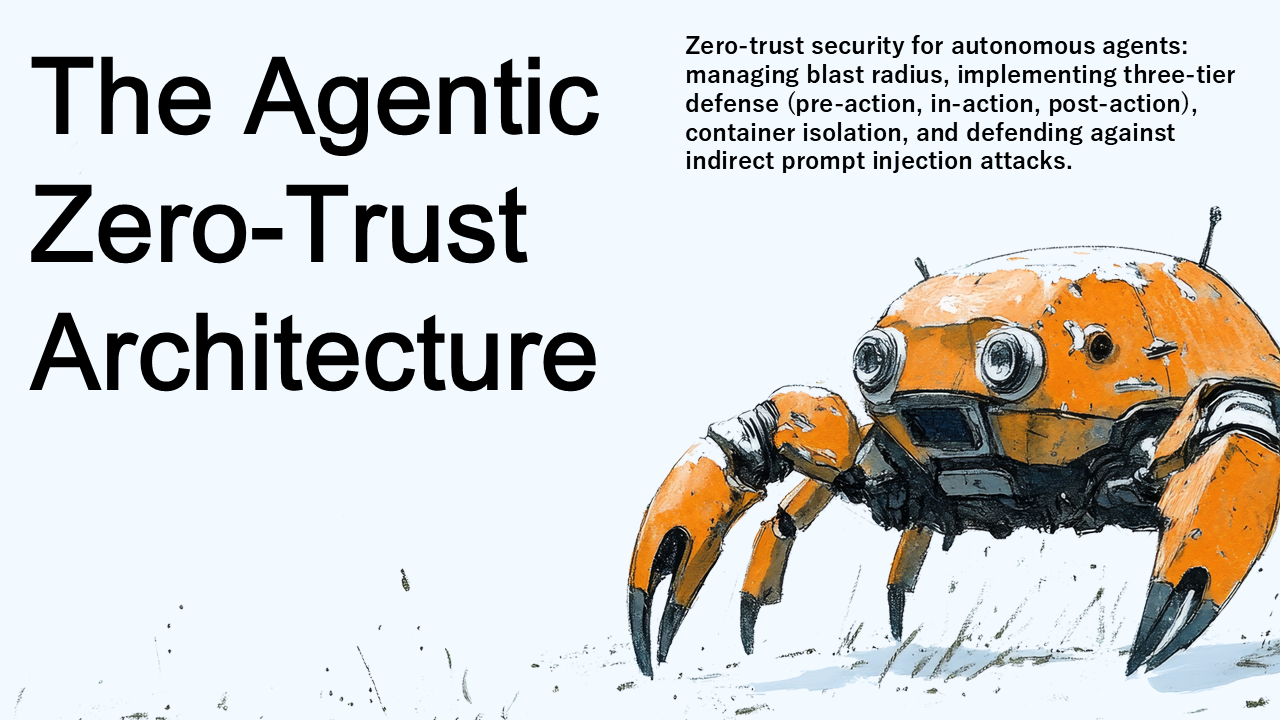
OpenClaw Engineering, Chapter 12: The Agentic Zero-Trust Architecture
Zero-trust security for autonomous agents: managing blast radius, implementing three-tier defense (pre-action, in-action, post-action), container isolation, and defending against indirect prompt injection attacks.
2026-03-27
OpenClaw Engineering, Chapter 7: The Skill Ecosystem
Bundled skills vs workspace skills, skill discovery and context, publishing to ClawHub, managing 13,000+ community skills without collision, semantic search, and the meta-skills that let agents improve themselves.
2026-03-22
OpenClaw Engineering, Chapter 6: Extending Capabilities with SKILL.md
The anatomy of SKILL.md files in OpenClaw: how to author reusable, versioned instruction sets with YAML frontmatter, dependencies, and explicit procedural guidance for agents.
2026-03-21
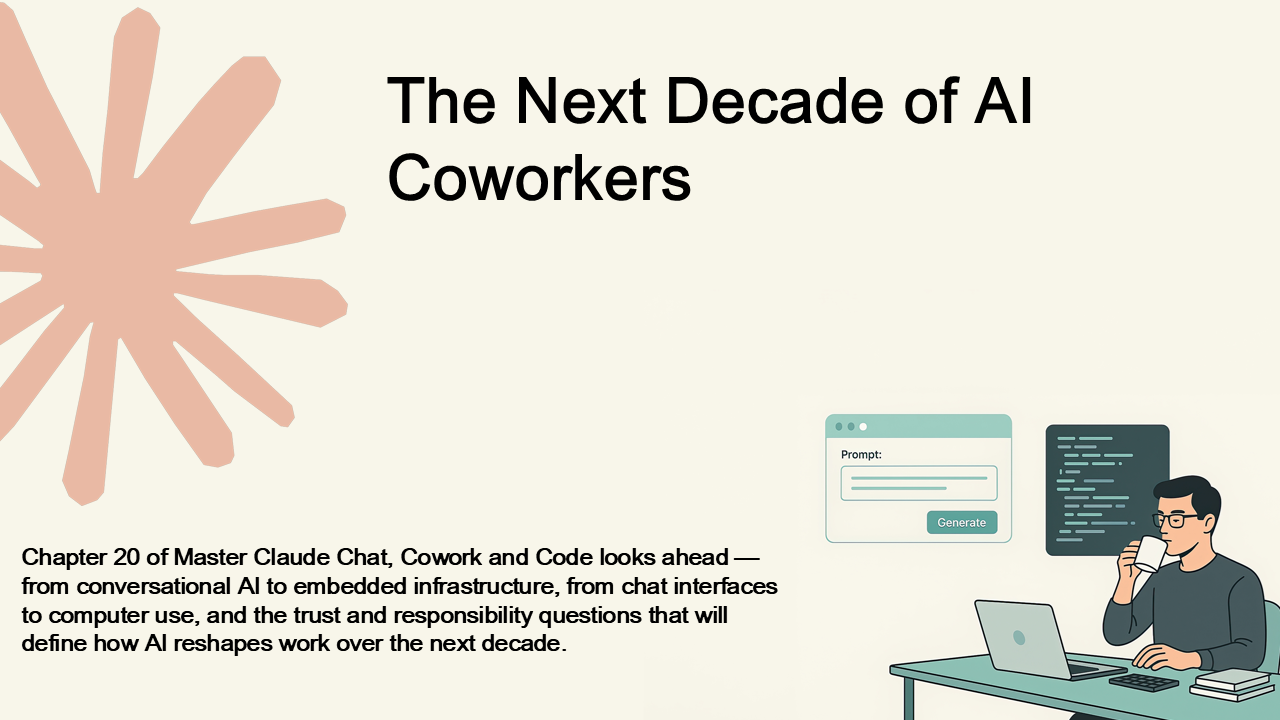
Chapter 20 – The Next Decade of AI Coworkers
Chapter 20 of Master Claude Chat, Cowork and Code looks ahead — from conversational AI to embedded infrastructure, from chat interfaces to computer use, and the trust and responsibility questions that will define how AI reshapes work over the next decade.
2026-03-20
OpenClaw Engineering, Chapter 5: Connecting Multiple Channels
How to connect your OpenClaw agent to multiple messaging platforms (Telegram, WhatsApp, Discord, Slack) and manage multi-channel routing. Setup, configuration quirks, and troubleshooting for each platform.
2026-03-20
OpenClaw Engineering, Chapter 4: Managing the Gateway and Models
Configuring your running gateway with the onboard wizard, diagnostics, and openclaw.json. How to connect model providers, manage API keys securely, and route different queries to different models.
2026-03-19
Chapter 17 – Guardrails and Governance
Chapter 17 of Master Claude Chat, Cowork and Code moves from understanding risks to implementing controls — permission isolation, tool allow-lists, human-in-the-loop approval workflows, validation hooks, and enterprise-grade audit logging.
2026-03-18
OpenClaw Engineering, Chapter 3: Deployment and Environment Setup
From local development to production: installing Node.js 22+, setting up Docker containers, and deploying OpenClaw to the cloud via AWS Lightsail or VPS providers.
2026-03-18
Chapter 16 – Execution Risks and Isolation
Chapter 16 of Master Claude Chat, Cowork and Code confronts the real security risks of AI systems that execute commands and manipulate files — from command injection to data exposure — and explains the isolation models that keep things safe.
2026-03-17
OpenClaw Engineering, Chapter 2: Anatomy of the Agent Brain
How OpenClaw agents think through their identity files, two-layer memory system, and proactive task scheduling. A deep dive into SOUL.md, AGENTS.md, USER.md, MEMORY.md, HEARTBEAT.md, and semantic memory via Supermemory.
2026-03-17
Chapter 15 – Managing Context Rot and Entropy
Chapter 15 of Master Claude Chat, Cowork and Code tackles the silent failure mode of long-running AI sessions — context rot. Learn strategies for context compression, structured state management, and thinking like an operations team to keep Claude sharp over time.
2026-03-16
OpenClaw Engineering, Chapter 1: The OpenClaw Paradigm
The first chapter teaser in a new series on OpenClaw Engineering. Why autonomous agents need a different foundation, the four-layer architecture (Gateway, Nodes, Channels, Skills), and the three principles that hold it all together.
2026-03-16
Chapter 14 – Connecting Systems with the Model Context Protocol (MCP)
Chapter 14 of Master Claude Chat, Cowork and Code explores the Model Context Protocol — the universal bridge that lets Claude connect to Slack, GitHub, Jira, Google Drive, and more, turning isolated AI into a deeply integrated workflow partner.
2026-03-15
Chapter 13: Encapsulating Knowledge with Agent Skills — From Conversations to Autonomous Procedures
Chapter 13 of Master Claude Chat, Cowork and Code introduces Skills — reusable, encapsulated procedures that Claude executes autonomously. Covers SKILL.md structure, YAML frontmatter, trigger descriptions, and the Skills Library pattern for team distribution.
2026-03-14
Chapter 12: CLAUDE.md — Designing Guardrails That Shape How Claude Thinks
Chapter 12 of Master Claude Chat, Cowork and Code explores CLAUDE.md as a living constitution for AI behavior — positive constraints over prohibitions, complete financial and startup examples, instruction decay, hierarchical files, and anti-patterns to avoid.
2026-03-13
Chapter 6: Discovery and Metadata — How Clients and Providers Find Each Other
Chapter 6 of the OpenID: Modern Identity series — how OIDC discovery, .well-known/openid-configuration, JWKS, and Dynamic Client Registration allow clients and providers to find each other without hand-crafted configuration.
2026-03-12
Chapter 11: CI/CD Integration and Automation — Claude Code in Your Pipeline
Chapter 11 of Master Claude Chat, Cowork and Code shows how to deploy Claude Code into CI/CD pipelines — GitHub Actions, GitLab CI, automated PR reviews, security audits, documentation sync, cost management, and production safety patterns.
2026-03-12
Chapter 9: Claude Code Fundamentals — The CLI Agent That Rewrites Your Codebase
Chapter 9 of Master Claude Chat, Cowork and Code introduces Claude Code — a CLI agent that reads, analyzes, and modifies codebases directly from the terminal. Covers architecture, multi-file refactoring, Git worktrees, and permission management.
2026-03-10
Chapter 7: Plugins and Domain Specialization — Turning Claude Into Your Organization's Expert
Chapter 7 of Master Claude Chat, Cowork and Code explores how plugins transform Claude from a generalist into a domain expert — with pre-built plugins for Sales, Finance, Marketing, and Legal, slash commands, and organization-managed customization.
2026-03-08
Chapter 6: What Is Claude Cowork? — The Desktop Agent That Touches Your Files
Chapter 6 of Master Claude Chat, Cowork and Code introduces Claude Cowork — a sandboxed desktop agent that automates file management, data extraction, and cross-application workflows on your local machine.
2026-03-07
Chapter 5: Rapid Prototyping with Artifacts — From Conversation to Live Application
Chapter 5 of Master Claude Chat, Cowork and Code explores how Claude Artifacts collapse the feedback loop between idea and execution — turning conversations into live, interactive applications in seconds.
2026-03-06
Master Claude, Chapter 4: Context Persistence with Claude Projects — Solving the AI Amnesia Problem
Chapter 4 of Master Claude Chat, Cowork and Code explains how Claude Projects solve the AI amnesia problem with persistent context — custom instructions, knowledge bases, and shared team workspaces that remember your architecture, conventions, and patterns across every conversation.
2026-03-05
Master Claude, Chapter 2: The Three Pillars of Claude — Chat, Cowork, and Code
Claude is not one product — it is three. Chat for reasoning, Cowork for desktop automation, Code for terminal-based development. Chapter 2 of Master Claude Chat, Cowork and Code explains the architecture of each and the decision framework for choosing the right one.
2026-03-03
Master Claude Chat, Cowork and Code – The Complete Blog Series
The complete index for the Master Claude Chat, Cowork and Code blog series — 20 chapter teasers covering everything from prompting fundamentals to multi-agent architectures, security governance, and the future of AI-powered work.
2026-03-01
Art of Coding, Chapter 13: Testing as a Design Discipline
Testing is a design discipline. How well-written tests reveal awkward APIs, improve code clarity, and become the most reliable documentation of system behavior.
2026-01-09
Art of Coding, Part V: Tools and the Ecosystem
Tools shape the culture of how teams code. The right ecosystem amplifies clarity and craftsmanship; the wrong one creates friction and distraction.
2026-01-07
Art of Coding, Chapter 6: Abstraction and Modularity
Drawing boundaries that make systems stronger. How to abstract without over-engineering, and design interfaces that last.
2025-12-31

Use Case: Sales Assistant Bot|Mastering Microsoft Teams Bots 6.3
Learn how to build a Sales Assistant Bot for Microsoft Teams. From surfacing leads to logging calls and syncing with CRMs, this section shows how bots can empower sales teams to move faster, close deals, and automate follow-ups — all within Teams.
2025-04-20
Use Case: Project Management Assistant Bot|Mastering Microsoft Teams Bots 6.2
Explore how to build a Project Management Assistant Bot for Microsoft Teams that delivers task summaries, reminders, and updates directly in the chat. Learn how this bot improves team productivity by integrating with tools like Jira or Trello and surfacing key information within the Teams workflow.
2025-04-19
Use Case: Helpdesk Assistant Bot|Mastering Microsoft Teams Bots 6.1
Explore how to build a Helpdesk Assistant Bot in Microsoft Teams. Learn how bots can reduce IT load by handling FAQs, logging support tickets, and notifying users — all within Teams. This section explains features, user experience, and implementation strategies.
2025-04-18
Monitoring, Logging, and Telemetry|Mastering Microsoft Teams Bots 5.3
Learn how to monitor and support your Microsoft Teams bot in production using logging, Azure Application Insights, and alerts. This section shows how to track user events, diagnose failures, and create telemetry that makes your bot reliable and supportable.
2025-04-17
Categories
Tags
Search Logs
Hello World bot 1256
IT assistant bot 1231
Deploy Teams bot to Azure 1227
Microsoft Bot Framework 1122
Teams bot development 1104
Teams production bot 1096
bot for sprint updates 1081
Zendesk Teams integration 1062
Teams app zip 1058
Microsoft Teams Task Modules 1042
Bot Framework Adaptive Card 1041
Teams chatbot 1037
Teams bot tutorial 1029
Bot Framework example 1020
Teams bot packaging 1020
Task Modules 1016
Bot Framework proactive messaging 1005
C 1005
Graph API token 997
Azure CLI webapp deploy 990
Bot Framework CLI 988
Bot Framework prompts 983
Adaptive Card Action.Submit 973
Azure App Service bot 963
Microsoft Graph 945
Azure Bot Services 941
Adaptive Cards 915
ServiceNow bot 915
Azure bot registration 910
sideload bot in Teams 886
Development & Technical Consulting
Working on a new product or exploring a technical idea? We help teams with system design, architecture reviews, requirements definition, proof-of-concept development, and full implementation. Whether you need a quick technical assessment or end-to-end support, feel free to reach out.
Contact Us